 格物
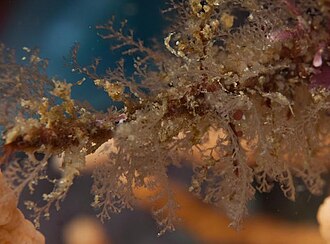
图:Seascapeza · CC BY-SA 3.0 · Wikimedia Commons
- 学名
- Hydrozoa
- 分类等级
- 纲
- 上级类群
- 水母亚门
- 大类
- 其他动物
- 命名
- 理查德·欧文,1843 年
- 数据库
- NCBI 分类 · GBIF
下级类群(2)
百科正文
分类
- 水螅纲动物的分类如下:
- 水螅纲 Hydrozoa
- 软水母亚纲 Hydroidolina
- 花水母目 Anthoathecata
- 亚目 Aplanulata
- 头螅水母亚目 Capitata
- 丝螅水母亚目 Filifera
- 软水母目 Leptothecata
- 管水母目 Siphonophorae
- 钟泳亚目 Calycophorae
- 胞泳亚目 Physonectae
- 囊泳亚目 Cystonectae
- 硬水母亚纲 Trachylinae
- 辐射水母目 Actinulida
- 淡水水母目 Limnomedusae
- 刚水母目 Narcomedusae
- 硬水母目 Trachymedusae
以上内容摘自维基百科「水螅纲」,按 CC BY-SA 4.0 使用,去掉了参考文献、外部链接等尾部小节,公式改写成了纯文本。全文、配图和出处见原文。
英文维基百科补充中文条目比较短,下面是英文条目「Hydrozoa」的原文
Hydrozoa (hydrozoans; from Ancient Greek ὕδωρ (húdōr) 'water' and ζώα (zóa) 'animals'), also called hydroids, are a taxonomic class of individually very small, predatory cnidarian animals, some solitary and some colonial, most of which inhabit saline water. The colonies of the colonial species can be large, and in some cases the specialized individual animals cannot survive outside the colony. A few genera within this class live in freshwater habitats. Hydrozoans, together with the true jellyfish, or scyphozoans, are members of the cnidarian subphylum Medusozoa.
Some examples of hydrozoans are the freshwater jelly (Craspedacusta sowerbii), freshwater polyps (Hydra), Obelia, Portuguese man o' war (Physalia physalis), chondrophores (Porpitidae), and pink-hearted hydroids (Tubularia).
Anatomy
Most hydrozoan species include both a polypoid and a medusoid stage in their life cycles, although a number of them have only one or the other. For example, Hydra has no medusoid stage, while Liriope lacks the polypoid stage.
Polyps
The hydroid form is usually colonial, with multiple polyps connected by tubelike hydrocauli. The hollow cavity in the middle of the polyp extends into the associated hydrocaulus, so that all the individuals of the colony are intimately connected. Where the hydrocaulus runs along the substrate, it forms a horizontal root-like stolon that anchors the colony to the bottom.
The colonies are generally small, no more than a few centimeters across, but some in Siphonophorae can reach sizes of several meters. They may have a tree-like or fan-like appearance, depending on species. The polyps themselves are usually tiny, although some noncolonial species are much larger, reaching 6 to 9 cm (2.4 to 3.5 in), or, in the case of the deep-sea Branchiocerianthus, a remarkable 2 m (6.6 ft).
The hydrocaulus is usually surrounded by a sheath of chitin and proteins called the perisarc.
Life cycle
Hydroid colonies are usually dioecious, with the polyps in each colony being either all male or all female. In some species, the reproductive polyps, known as gonozooids (or "gonotheca" in thecate hydrozoans) bud off asexually produced medusae. These tiny, new medusae (which are either male or female) mature and spawn, releasing gametes freely into the sea in most cases. Zygotes become free-swimming planula larvae or actinula larvae that either settle on a suitable substrate (in the case of planulae), or swim and develop into another medusa or polyp directly (actinulae). Colonial hydrozoans include siphonophore colonies, Hydractinia, Obelia, and many others.
In hydrozoan species with both polyp and medusa generations, the medusa stage is the sexually reproductive phase. Medusae of these species of Hydrozoa are known as "hydromedusae". Most hydromedusae have shorter lifespans than the larger scyphozoan jellyfish.
Systematics and evolution
The earliest hydrozoans may be from the Vendian (late Precambrian), more than 540 million years ago.
Hydrozoan systematics are highly complex. Several approaches for expressing their interrelationships were proposed and heavily contested since the late 19th century, but in more recent times a consensus seems to be emerging.
Historically, the hydrozoans were divided into a number of orders, according to their mode of growth and reproduction. Most famous among these was probably the assemblage called "Hydroida", but this group is apparently paraphyletic, united by plesiomorphic (ancestral) traits. Other such orders were the Anthoathecatae, Actinulidae, Laingiomedusae, Polypodiozoa, Siphonophorae and Trachylina.
As far as can be told from the molecular and morphological data at hand, the Siphonophora for example were just highly specialized "hydroids", whereas the Limnomedusae—presumed to be a "hydroid" suborder—were simply very primitive hydrozoans and not closely related to the other "hydroids".
以上节选摘自英文维基百科「Hydrozoa」,按 CC BY-SA 4.0 使用,去掉了参考文献、外部链接等尾部小节,公式改写成了纯文本。篇幅所限,较长的小节只摘了开头一部分,有的小节没有收;全文、配图和出处见原文。