 格物
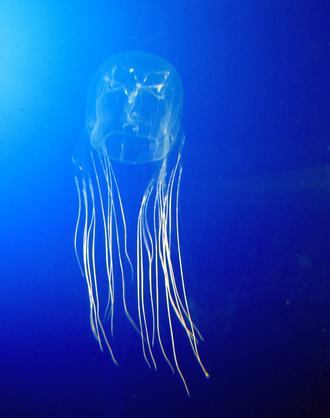
图:Avispa marina.jpg: Guido Gautsch, Toyota, Japan derivative w… · CC BY-SA 2.0 · Wikimedia Commons
- 学名
- Cubozoa
- 分类等级
- 纲
- 英文名
- box jellyfish
- 上级类群
- 水母亚门
- 大类
- 其他动物
- 命名
- Roger-Guy Werner,1973 年
- 数据库
- NCBI 分类 · GBIF
下级类群(2)
百科正文
生活史
从大型水母体发展出浮浪幼体,后来经水螅体渐渐发育,通过直接转变成为水母体,中间不经过节片生殖(横裂Strobilation)和蝶状幼体(Ephyra)阶段。
品种
澳洲箱形水母
澳洲箱形水母(学名:Chironex fleckeri),俗称“海黄蜂”,是世界最毒的动物之一以及世界最毒的海洋动物之一,其重要特征是伞体呈立体箱形状以及有四条较粗壮的触手,它的刺细胞所释出的毒性比眼镜蛇还要毒,可以让人在几分钟内死亡。
波布水母
波布水母(学名:Chironex yamaguchii),属于剧毒性的动物。被螫伤的话会产生巨大的痛苦,在日本水域造成很多人的死亡。产生的症状有心脏停止、急性肺水肿、引起呼吸衰竭。
伊鲁康吉水母
伊鲁康吉水母(英语:Irukandji jellyfish)是数种具有致命毒性的小型立方水母之通称。它们是世界上体型最小,毒性最强的水母之一,体型约只有1 cm3。主要栖息在澳洲周遭的海域。它们能够用刺丝胞把毒液注入受害者体内,并引发特定的症状,统称为“伊鲁康吉症候群”。目前伊鲁康吉水母共有16个已知的物种,其中Carukia barnesi、Malo kingi、 Malo maximus、Malo filipina 以及 Malo bella都是为人所熟知的种类。
以上内容摘自维基百科「立方水母纲」,按 CC BY-SA 4.0 使用,去掉了参考文献、外部链接等尾部小节,公式改写成了纯文本。全文、配图和出处见原文。
英文维基百科补充中文条目比较短,下面是英文条目「Box jellyfish」的原文
Box jellyfish (class Cubozoa) are cnidarian animals distinguished by their box-like (i.e., cube-shaped) body. Some species of box jellyfish produce potent venom delivered by contact with their tentacles. Stings from some species, including Chironex fleckeri, Carukia barnesi, Malo kingi, and a few others, are extremely painful and often fatal to humans. Some species like the Carybdea murrayana produce a painful sting but are not fatal to humans.
Taxonomy and systematics
Historically, cubozoans were classified as an order of Scyphozoa until 1973, when they were put in their own class due to their unique biological cycle (lack of strobilation) and morphology.
At least 51 species of box jellyfish were known as of 2018. These are grouped into two orders and eight families. A few new species have since been described, and it is likely that additional undescribed species remain.
- Class Cubozoa
- Order Carybdeida
- Family Alatinidae
- Family Carukiidae
- Family Carybdeidae
- Family Tamoyidae
Description
The medusa form of a box jellyfish has a squarish, box-like bell, from which its name is derived. From each of the four lower corners of this hangs a short pedalium or stalk which bears one or more long, slender, hollow tentacles. The rim of the bell is folded inwards to form a shelf known as a velarium which restricts the bell's aperture and creates a powerful jet when the bell pulsates.
Detection
Cubozoans are widely distributed throughout tropical and subtropical regions, yet the detection of these organisms can be quite difficult and costly due to a high amount of variation in their occurrence and abundance, their translucent body, two different life stages (medusa and polyp), and vast amounts of size variability within the different species in the class Cubozoa.
Ecology
Age and growth
It has been found that the statoliths, which are composed of calcium sulfate hemihydrate, exhibit clear sequential incremental layers, thought to be laid down on a daily basis. This has enabled researchers to estimate growth rates, ages, and age to maturity. Chironex fleckeri, for example, increases its inter-pedalia distance (IPD) by 3 mm (1⁄8 in) per day, reaching an IPD of 50 mm (2 in) when 45 to 50 days old.
Genetics
Box jellyfish have a mitochondrial genome that is arranged into eight linear chromosomes. As of 2022, only two Cubozoan species were fully sequenced, Alatina alata and Morbakka virulenta. A. alata has 66,156 genes, the largest gene count for any medusozoan. The mitochondrial genome of box jellyfish is uniquely structured into multiple linear fragments. Each one of the eight linear chromosomes have between one and four genes including two extra genes.
Danger to humans
Box jellyfish have been long known for their powerful sting. The lethality of the Cubozoan venom to humans is the primary reason for its research. Although unspecified species of box jellyfish have been called in newspapers "the world's most venomous creature" and the deadliest creature in the sea, only a few species in the class have been confirmed to be involved in human deaths; some species are not deadly to humans, possibly delivering a sting that is no more than painful.
Protection and treatment
Protective clothing
Wearing pantyhose, full body lycra suits, dive skins, or wetsuits is an effective protection against box jellyfish stings. The pantyhose were formerly thought to work because of the length of the box jellyfish's stingers (nematocysts), but it is now known to be related to the way the stinger cells work.
以上节选摘自英文维基百科「Box jellyfish」,按 CC BY-SA 4.0 使用,去掉了参考文献、外部链接等尾部小节,公式改写成了纯文本。篇幅所限,较长的小节只摘了开头一部分,有的小节没有收;全文、配图和出处见原文。