格物
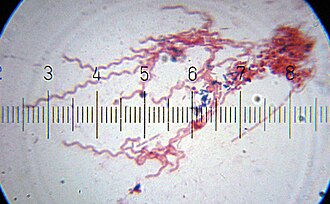
图:Bob Blaylock · CC BY-SA 3.0 · Wikimedia Commons
- 学名
- Spirochaetota
- 分类等级
- 门
- 上级类群
- 假单胞菌界
- 大类
- 细菌
- 命名
- 2021 年
- 异名
- 螺旋体
- 数据库
- NCBI 分类 · GBIF
下级类群(1)
- 螺旋体纲 Spirochaetia 纲
百科正文
琳·马古利斯曾经认为真核细胞的鞭毛来自共生的螺旋体,但同意这一观点的生物学家不多,因为二者结构上没有太多相似之处。
- 螺旋体门目前被分为三科,重要成员包括:
- 钩端螺旋体属(Leptospira),可引起钩端螺旋体病
- 疏螺旋体属(Borrelia)
- 伯氏疏螺旋体(Borrelia burgdorferi),可引起莱姆病
- 回归热疏螺旋体(Borrelia recurrentis),可引起回归热
- 密螺旋体属(Treponema)
- 斑点病密螺旋体(Treponema carateum),可引起品他病
- 苍白密螺旋体(Treponema pallidum)
- 梅毒螺旋体(T. p. pallidum),可引起梅毒
- 地方性螺旋体(T. p. endemicum),可引起贝杰病
- 细弱密螺旋体(T. p. pertenue),可引起雅司病、苺肿
以上内容摘自维基百科「螺旋體門」,按 CC BY-SA 4.0 使用,去掉了参考文献、外部链接等尾部小节,公式改写成了纯文本。全文、配图和出处见原文。
英文维基百科补充中文条目比较短,下面是英文条目「Spirochaete」的原文
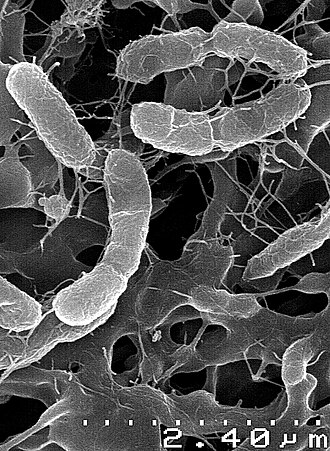
A spirochaete or spirochete is a member of the phylum Spirochaetota (also called Spirochaetes), which contains distinctive diderm (double-membrane) Gram-negative bacteria, most of which have long, helically coiled (corkscrew-shaped or spiraled, hence the name) cells. Spirochaetes are chemoheterotrophic in nature, with lengths between 3 and 500 μm and diameters around 0.09 to at least 3 μm.
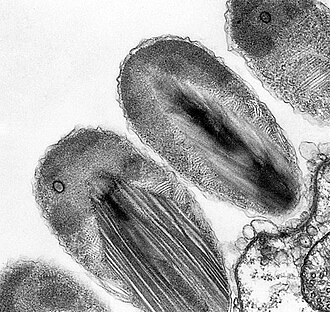
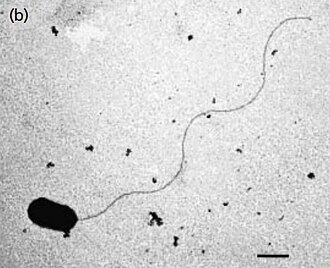
Spirochaetes are distinguished from other bacterial phyla by the location of their flagella, called endoflagella, or periplasmic flagella, which are sometimes called axial filaments. Endoflagella are anchored at each end (pole) of the bacterium within the periplasmic space (between the inner and outer membranes) where they project backwards to extend the length of the cell. These cause a twisting motion which allows the spirochaete to move. When reproducing, a spirochaete will undergo asexual transverse binary fission. Most spirochaetes are free-living and anaerobic, but there are numerous exceptions. Spirochaete bacteria are diverse in their pathogenic capacity and the ecological niches that they inhabit, as well as molecular characteristics including guanine-cytosine content and genome size.
Pathogenicity
Many organisms within the Spirochaetota phylum cause prevalent diseases. Pathogenic members of this phylum include the following:
Leptospira species, which causes leptospirosis
Borrelia burgdorferi, B. mayonii, B. bissettiae, B. garinii, B. afzelii, B. spielmanii, B. lusitaniae, which cause Lyme disease.
Borrelia recurrentis, which causes relapsing fever
Treponema pallidum subspecies which cause treponematoses such as syphilis and yaws.
Brachyspira pilosicoli and Brachyspira aalborgi, which cause intestinal spirochaetosis
Salvarsan, the first partially organic synthetic antimicrobial drug in medical history, was effective against spirochaetes and primarily used to cure syphilis. Additionally, oral spirochaetes are known to play a significant role in the pathogenesis of human periodontal disease.
Taxonomy and molecular signatures
The class currently consists of 14 validly named genera across four orders and five families. The orders Brachyspirales, Brevinematales and Leptospirales each contain a single family, Brachyspiraceae, Brevinemataceae and Leptospiraceae, respectively. The Spirochaetales order harbours two families, Spirochaetaceae and Borreliaceae. Molecular markers in the form of conserved signature indels (CSIs) and CSPs have been found specific for each of the orders, with the exception of Brevinimetales, that provide a reliable means to demarcate these clades from one another within the diverse phylum. Additional CSIs have been found exclusively shared by each family within the Spirochaetales. These molecular markers are in agreement with the observed phylogenetic tree branching of two monophyletic clades within the Spirochaetales order. CSIs have also been found that further differentiate taxonomic groups within the Borreliaceae family that further delineate evolutionary relationships that are in accordance with physical characteristics such as pathogenicity (viz. Borrelia emend. Borreliella gen. nov.). However, this study has been criticized, and other studies using different approaches do not support the proposed split.
Taxonomy
The currently accepted taxonomy is based on the List of Prokaryotic names with Standing in Nomenclature (LPSN) and National Center for Biotechnology Information (NCBI).
- Phylum Spirochaetota Garrity and Holt 2021
- Genus ?"Spirosymplokos" Guerrero et al. 1993
- Class Leptospiria Chuvochina et al. 2024
- Order Turneriellales Chuvochina et al. 2024
- Family Turneriellaceae Chuvochina et al. 2024
- Genus Turneriella Levett et al. 2005
- Order Leptospirales Gupta et al. 2014
- Family Leptonemataceae Chuvochina et al. 2024
- Genus Leptonema Hovind-Hougen 1983
- Family Leptospiraceae Hovind-Hougen 1979
- Genus Leptospira Noguchi 1917
- Class Brevinematia Chuvochina et al. 2024
- Order Brevinematales Gupta et al. 2014
- Family "Longinemataceae" Karnachuk et al. 2021
- Genus ?"Longinema" corrig. Karnachuk et al. 2021
- Family Brevinemataceae Paster 2012
- Genus Brevinema Defosse et al. 1995
- Family Thermospiraceae Ben Ali Gam et al. 2023
- Genus Thermospira Ben Ali Gam et al. 2023
- Class Brachyspiria Chuvochina et al. 2024
- Order Brachyspirales corrig. Gupta et al. 2014
- Family Brachyspiraceae Paster 2012
- Genus ?"Ca. Maribrachyspira" Matsuyama et al. 2017
- Genus Brachyspira Hovind-Hougen et al. 1982 non Foliella non Pfeiffer 1855
- Class Spirochaetia Paster 2020
- Order Spirochaetales Buchanan 1917
以上节选摘自英文维基百科「Spirochaete」,按 CC BY-SA 4.0 使用,去掉了参考文献、外部链接等尾部小节,公式改写成了纯文本。篇幅所限,较长的小节只摘了开头一部分,有的小节没有收;全文、配图和出处见原文。