 格物
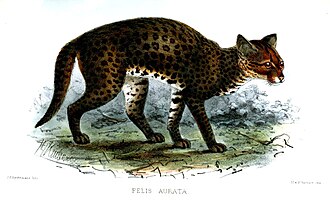
图:John Gerrard Keulemans · Public domain · Wikimedia Commons
- 学名
- Profelis aurata
- 分类等级
- 种
- 上级类群
- 狞猫属
- 大类
- 哺乳动物
- 命名
- 昆拉德·雅各布·特明克,1827 年
- 数据库
- NCBI 分类 · GBIF · IUCN 红色名录
百科正文
身体特征
非洲金猫为中等体型的野生猫科动物,分布在西非和中非的热带雨林地区。体长61-100厘米,尾长16-46厘米,肩高大约为39-55厘米。雄性非洲金猫的体重在11-14公斤之间,雌性较轻,一般在6公斤左右。
非洲金猫的毛皮颜色比较多样,一般为浅褐色或者红褐色,但也有黑色或灰色的变种。西非亚种带有斑点,中非亚种则除了腹部和腿部外,基本不带斑点。非洲金猫与亚洲金猫有许多相似之处,但研究表明,这些是趋同进化的结果。
非洲金猫的寿命约为15年。
习性
非洲金猫会爬树,但它们主要在地面上猎食。猎物包括啮齿类、鸟类以及小型猴类。它们栖息地通常比较隐蔽,因此人们对他们知之甚少。
亚种
中非亚种(Caracal aurata aurata)
西非亚种(Caracal aurata celidogaster)
以上内容摘自维基百科「非洲金貓」,按 CC BY-SA 4.0 使用,去掉了参考文献、外部链接等尾部小节,公式改写成了纯文本。全文、配图和出处见原文。
英文维基百科补充中文条目比较短,下面是英文条目「African golden cat」的原文
The African golden cat (Caracal aurata) is a wild cat endemic to the rainforests of West and Central Africa. It is threatened due to deforestation and bushmeat hunting and listed as Vulnerable on the IUCN Red List. It is a close relative of both the caracal and the serval. Previously, it was placed in the genus Profelis. Its body size ranges from 61 to 101 cm (24 to 40 in) with a 16 to 46 cm (6.3 to 18.1 in) long tail.
Characteristics
The African golden cat has a fur colour ranging from chestnut or reddish-brown, greyish brown to dark slate. Some are spotted, with the spots ranging from faded tan to black in colour. In others the spotting pattern is limited to the belly and inner legs. Its undersides and areas around the eyes, cheeks, chin, and throat are lighter in colour to almost white. Its tail is darker on the top and either heavily banded, lightly banded or plain, ending in a black tip. Cats in the western parts of its range tend to have heavier spotting than those in the eastern region. Two color morphs, a red and a grey phase, were once thought to indicate separate species, rather than colour variations of the same species. Grey skins have hairs that are not pigmented in their middle zones, whereas hair of red skins is pigmented intensively red.
Taxonomy
Felis aurata was the scientific name used by Coenraad Jacob Temminck who described a reddish-brown coloured cat skin in 1827 that he had bought from a merchant in London. Temminck also described a grey coloured skin of a cat with chocolate brown spots that had lived in the menagerie in London. He named it Felis celidogaster. Felis neglecta proposed by John Edward Gray in 1838 was a brownish grey cat skin from Sierra Leone. Felis rutilus proposed by George Robert Waterhouse in 1842 was a reddish cat skin from Sierra Leone. Felis chrysothrix cottoni proposed by Richard Lydekker in 1906 was a dark grey cat skin from the Ituri Rainforest. A black cat skin from eastern Congo was proposed as Felis maka in 1942.
In 1858, Nikolai Severtzov proposed the generic names Profelis with F. celidogaster as type species, and Chrysailurus with F. neglecta as type species.
Distribution and habitat
The African golden cat is distributed from Senegal to the Central African Republic, Kenya and as far south as northern Angola. It inhabits tropical forests from sea level to an elevation of 3,000 m (9,800 ft). It prefers dense, moist forest with heavy undergrowth close to rivers but lives also in cloud forest, bamboo forests, and high moorland habitats.
In Guinea's National Park of Upper Niger, it was recorded during surveys conducted from 1996 to 1997.
In Uganda's Kibale National Park, an African golden cat was recorded in an Uvariopsis forest patch in 2008. In Gabon's Moukalaba-Doudou National Park, it was recorded in forested areas during surveys in 2012. African Golden cats were recorded in Tanzania's Minziro Forest Reserve in 2018 for the first time.
Ecology and behaviour
Due to its extremely reclusive habits, little is known about the behaviour of African golden cats. They are solitary animals, and are normally crepuscular or nocturnal, although they have also been observed hunting during the day, depending on the availability of local prey.
African golden cats are able to climb, but hunt primarily on the ground. They mainly feed on tree hyrax, rodents, but also hunt birds, small monkeys, duikers, young of giant forest hog, and small antelope. They have also been known to take domestic poultry and livestock.
Reproduction
Knowledge of the African golden cat's reproductive habits is based on captive individuals. The female gives birth to one or two kittens after a gestation period of around 75 days. The kittens weigh 180 to 235 g (6.3 to 8.3 oz). Their eyes open within a week of birth, and they are weaned at 6–8 weeks.
Threats
The African golden cat is threatened by extensive deforestation of tropical rainforests, their conversion to oil palm plantations coupled with mining activities and road building, thus destroying its essential habitat. It is also threatened by bushmeat hunting, particularly in the Congo Basin. A dead African golden cat was offered as bushmeat in Angola's Uíge Province in May 2018.
Conservation
The African golden cat is listed in CITES Appendix II. Hunting African golden cats is prohibited in Angola, Benin, Burkina Faso, Congo, Côte d'Ivoire, Democratic Republic of Congo, Ghana, Kenya, Liberia, Nigeria, Rwanda, and Sierra Leone. In Gabon, Liberia and Togo, hunting regulations are in place.
以上节选摘自英文维基百科「African golden cat」,按 CC BY-SA 4.0 使用,去掉了参考文献、外部链接等尾部小节,公式改写成了纯文本。篇幅所限,较长的小节只摘了开头一部分,有的小节没有收;全文、配图和出处见原文。