 格物
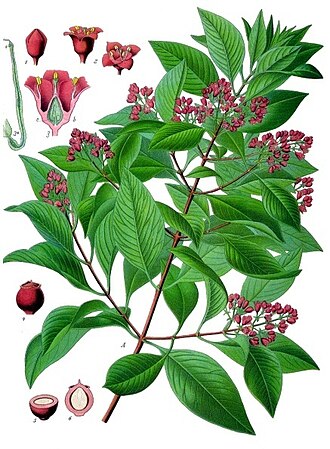
图:Franz Eugen Köhler, Köhler's Medizinal-Pflanzen · Public domain · Wikimedia Commons
- 学名
- Santalum album
- 分类等级
- 种
- 上级类群
- 檀香属
- 大类
- 被子植物
- 命名
- 卡尔·林奈,1753 年
- 中文别名
- 真檀、白旃檀、白檀、檀香油、檀香泥
- 用途
- 药用植物
- 数据库
- NCBI 分类 · GBIF · IUCN 红色名录
百科正文
常绿小乔木,高度达8至15米;长卵形叶子对生;花初为黄色,后变为血红色。
用途
其木有香味,能抚慰并释放受到压抑的心情,镇静内心的挫折感。可制家具及工艺品。亦可用于提炼香精及制作中药。檀木气味浓烈而且有刺激性,于是制香业者常常会陈放多年除去野气,再制粉取用,叫做“老山”粉,而新伐檀木所制者,叫做“新山”粉。另一种说法是,产于马来西亚半岛及老产区印度等野生檀香为老山檀,产于澳洲、东加等地的种植檀香为新山檀。很多店家只是在普通木粉中加一些檀香粉就号称是“檀香”,其实只是表示它有檀香的气味。
而檀香用于精油中是一种杀菌剂、再生剂。镇定及恢复稳定情绪。对焦虑、细胞再生、忧郁、头痛、恶心、经前症候群、紧张有帮助。可用于按摩油中或脸部护理油中。传统道教焚香以太真天香、沈香、降真为主,檀香为佛教所用。檀香同时也是制作香水常用的素材。
相关
香
甲醛
以上内容摘自维基百科「檀香」,按 CC BY-SA 4.0 使用,去掉了参考文献、外部链接等尾部小节,公式改写成了纯文本。全文、配图和出处见原文。
英文维基百科补充中文条目比较短,下面是英文条目「Santalum album」的原文
Santalum album is a small tropical tree, and the traditional source of sandalwood oil. It is native to Indonesia (Java and the Lesser Sunda Islands), the Philippines, and Western Australia. It is commonly known as the white sandalwood or Indian sandalwood. It was one of the plants exploited by Austronesian arboriculture and it was introduced by Austronesian sailors to Mainland Southeast Asia, South Asia and East Asia, during the ancient spice trade, becoming naturalized in South India by at least 1300 BCE. It was greatly valued for its fragrance, and is considered sacred in some religions like Hinduism. The high value of the species has caused over-exploitation, to the point where the wild population is vulnerable to extinction. Indian sandalwood still commands high prices for its essential oil owing to its high alpha-santalol content, but the lack of sizable trees has essentially eliminated its former use for fine woodworking. The plant is long-lived, but harvest is only viable after many years.
Description
Santalum album is an evergreen tree that grows between 4–9 metres (13–30 feet). The tree is variable in habit, usually upright to sprawling, and may intertwine with other species. The plant parasitises the roots of other tree species, with a haustorium adaptation on its own roots, but without major detriment to its hosts. An individual will form a non-obligate relationship with a number of other plants.
Taxonomy
Nomenclature
The nomenclature for other "sandalwoods" and the taxonomy of the genus are derived from this species' historical and widespread use. Etymologically it is derived from Sanskrit chandanam, meaning "wood for burning incense", and related to candrah, meaning "shining, glowing".
Santalum album is included in the family Santalaceae, and is commonly known as white or East Indian sandalwood. The name, Santalum ovatum, used by Robert Brown in Prodromus Florae Novae Hollandiae (1810) was described as a synonym of this species by Alex George in 1984.
Distribution and history
Sandalwood is originally native to dry areas in India, Indonesia (Java and the Lesser Sunda Islands), the Philippines, and Western Australia, where it is found with close congeners. It was introduced very early (c. 1500 BCE) into Dravidian regions of South Asia via the Austronesian maritime spice trade, along with other Austronesian domesticates like areca nut and coconuts. It first appears in archaeological records in South Asia in the southern Deccan by 1300 BCE. It became naturalized in these regions where dry sandy soils are common.
Habitat and growth
S. album occurs from coastal dry forests up to 700 metres (2,300 ft) elevation. It normally grows in sandy or well drained stony red soils, but a wide range of soil types are inhabited. This habitat has a temperature range from 0 to 38 °C (32 to 100 °F) and annual rainfall between 500 millimetres (20 in) and 3,000 millimetres (120 in). S. album can grow up to 9.1 metres (30 ft) vertically. It should be planted in good sunlight and does not require a lot of water. The tree starts to flower after seven years.
Conservation
S. album is recognized as a "vulnerable" species by the International Union for the Conservation of Nature (IUCN). It is threatened by over-exploitation and degradation to habitat through altered land use, fire (to which this species is extremely sensitive), Spike disease, agriculture, and land-clearing are the factors of most concern. To preserve this vulnerable resource from over-exploitation, legislation protects the species, and cultivation is researched and developed.
Uses and production
S. album has been the primary source of sandalwood and the derived oil. These often hold an important place in the societies of their naturalised distribution range. The central part of the tree, the heartwood, is the only part of the tree that is used for its fragrance. It is yellow-brown in colour, hard with an oily texture and due to its durability, is a preferred material for carving. The outer part of the tree, the sapwood, is unscented. The sapwood is white or yellow in colour and is used to make turnery items.
以上节选摘自英文维基百科「Santalum album」,按 CC BY-SA 4.0 使用,去掉了参考文献、外部链接等尾部小节,公式改写成了纯文本。篇幅所限,较长的小节只摘了开头一部分,有的小节没有收;全文、配图和出处见原文。