 格物
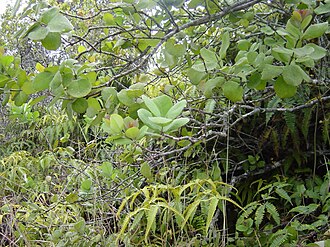
图:Kowloonese · CC BY-SA 3.0 · Wikimedia Commons
- 学名
- Santalum
- 分类等级
- 属
- 上级类群
- 檀香科
- 大类
- 被子植物
- 命名
- 卡尔·林奈,1753 年
- 数据库
- NCBI 分类 · GBIF
下级类群(2)
百科正文
种
密花澳洲檀香(Santalum acuminatum) A.DC. — 澳大利亚
白檀香(Santalum album) L. — 印度、印尼、澳大利亚北部
新克里多尼亚檀香(Santalum austrocaledonicum) Vieill. - 新卡里多尼亚、瓦努阿图
小笠原檀香(Santalum boninense) (Nakai) Tuyama - 波音群岛、日本
夏威夷椭圆叶檀香(Santalum ellipticum) Gaudich. — 夏威夷
(已灭绝)智利檀香(Santalum fernandezianum) Phil. - 胡安·费尔南德斯群岛
夏威夷弗氏檀香(Santalum freycinetianum) Gaudich. — 夏威夷
榄绿夏威夷檀香(Santalum haleakalae) Hillebr. — 夏威夷
大花澳洲檀香(Santalum lanceolatum) R.Br. — 澳大利亚
巴布亚檀香(Santalum macgregorii) F.Muell - 巴布亚新几内亚、印尼
钩叶澳洲檀香(Santalum murrayanum) C.A.Gardner — 澳大利亚
伞花澳洲檀香(Santalum obtusifolium) - 澳大利亚
亮叶夏威夷檀香(Santalum paniculatum) Hook. & Arn. — 夏威夷
- Santalum salicifolium—夏威夷
- Santalum spicatum(R.Br.) A.DC. — 澳大利亚
- 斐济檀香(Santalum yasi) Seem. - 斐济、纽埃、汤加
以上内容摘自维基百科「檀香属」,按 CC BY-SA 4.0 使用,去掉了参考文献、外部链接等尾部小节,公式改写成了纯文本。全文、配图和出处见原文。
英文维基百科补充中文条目比较短,下面是英文条目「Santalum」的原文
Santalum is a genus of woody flowering plants in the Santalaceae family, the best known and most commercially valuable of which is the Indian sandalwood tree, S. album. Members of the genus are trees or shrubs. Most are root parasites which photosynthesize their own food, but tap the roots of other species for water and inorganic nutrients. Several species, most notably S. album, produce highly aromatic wood, used for scents and perfumes and for herbal medicine. It has about 25 known species which are native to Island Southeast Asia (Indonesia, Timor-Leste, and the Philippines), Melanesia (Papua New Guinea, Vanuatu, Fiji, and New Caledonia), Australia, Polynesia, the Bonin Islands of Japan, and the Juan Fernández Islands of Chile.
Indian sandalwood (S. album) is native to the tropical dry deciduous forests the Lesser Sunda Islands of Indonesia, the Philippines, and Arnhem Land of northern Australia. It is the only species of the genus found on the Asian mainland, having been introduced to India from the Lesser Sundas centuries ago. Indian sandalwood has been stripped from most of India's forests, and is now rare in the wild. Five species, including S. album, are native to Australia. S. acuminatum, known as the sweet quandong or native peach, produces a shiny bright red fruit used increasingly in Australia for jams, jellies, chutneys, and pies. Four species, (including Santalum paniculatum, commonly called ʻiliahi), are endemic to Hawaiʻi. S. fernandezianum, endemic to the Juan Fernández Islands off the coast of Chile, was also overexploited for its aromatic wood, and may now be extinct.
Santalum species are used as food plants by the larvae of some Lepidoptera species, including Endoclita malabaricus.
Cultivation
The initial challenges to cultivating Santalum are numerous, not only due to its germination and growth needs, but also the amount of growing time required for the tree to properly mature. Germination of Santalum seeds is not completely understood. Seeds cannot be effectively stored, and must be planted upon harvesting them from a fruiting tree. Even in doing this, the seeds may not germinate. As such, growing saplings can be quite labour-intensive.
Furthermore, although Santalum trees photosynthesize on their own, the trees are hemiparasitic, with roots that seek out and tap the root systems of surrounding trees for water and nutrients. As such, each sapling is usually grown next to four or five host trees. Pruning of host trees is also needed at times, since Santalum trees require much sunlight for growth. Santalum plantations are also vulnerable to illegal harvesting and smuggling because the fragrant heartwood retains high market value even from relatively young trees.
To produce commercially valuable sandalwood with high levels of fragrance oils, the trees have to be at least 40 years of age, but 80 or above is preferred. As such, those who begin cultivation of Santalum likely will not live to reap the rewards of their work. However, inferior sandalwood that has been cut or toppled at 30 years old can still fetch a decent price due to the demand for real sandalwood.
Species
19 species are currently accepted:
S. acuminatum A.DC. – desert quandong, sweet quandong, native peach (Australia)
S. album L. – white sandalwood, Indian sandalwood (Indonesia, Philippines northern Australia)
- S. austrocaledonicum Vieill. (New Caledonia, Vanuatu)
- S. boninense (Nakai) Tuyama (Bonin Islands, Japan)
- S. ellipticum Gaudich. – ʻiliahialoʻe, coast sandalwood (Hawaiʻi)
- S. fernandezianum Phil. (Juan Fernández Islands)
- S. freycinetianum Gaudich. – ʻiliahi (Hawaiʻi)
- S. haleakalae Hillebr. – ʻiliahi (Hawaiʻi)
- S. insulare Bertero ex A.DC. (south-central Pacific)
- S. involutum H.St.John (Hawaiian Islands (Kauai))
- S. lanceolatum R.Br. – northern sandalwood (Australia)
- S. macgregorii F.Muell (Papua New Guinea, Indonesia)
- S. murrayanum (T.L.Mitch.) C.A.Gardner – bitter quandong (Australia)
- S. obtusifolium R.Br. (Australia)
- S. paniculatum Hook. & Arn. – ʻiliahi (Hawaiʻi)
- S. papuanum Summerh. (New Guinea)
- S. pyrularium A.Gray (Hawaiian Islands (Kauai))
- S. spicatum (R.Br.) A.DC. – Australian sandalwood (Australia)
- S. yasi Seem. - yasi (Fiji, Niue) Tonga- Ahi
Formerly placed here
Mida salicifolia A.Cunn. – willowleaf sandalwood (as S. salicifolium (A.Cunn.) Meurisse)
Etymology
Santalum derives its name from the Greek santalon, in turn from the Arabic sandal, in turn from Sanskrit chandana (Indian sandalwood).
以上节选摘自英文维基百科「Santalum」,按 CC BY-SA 4.0 使用,去掉了参考文献、外部链接等尾部小节,公式改写成了纯文本。篇幅所限,较长的小节只摘了开头一部分,有的小节没有收;全文、配图和出处见原文。