格物
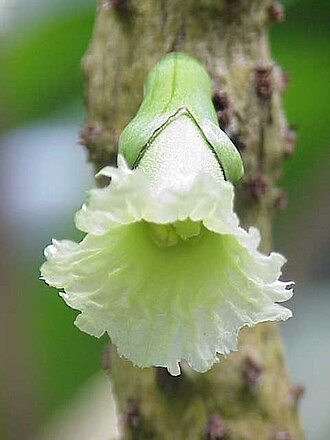
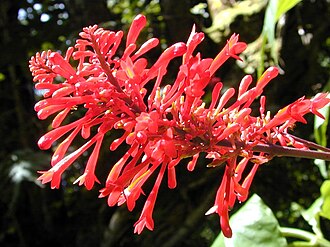
图:Kurt Stüber 1 · CC BY-SA 3.0 · Wikimedia Commons
- 学名
- Bignoniaceae
- 分类等级
- 科
- 上级类群
- 唇形目
- 大类
- 被子植物
- 命名
- 安托万·洛朗·德朱西厄,1789 年
- 数据库
- NCBI 分类 · GBIF
下级类群(13)
百科正文
分类
克朗奎斯特分类法将紫葳科分入玄参目,2003年的APG II 分类法将玄参目和唇形目合并。
用途
大部分为栽培观赏植物,也有部分木材用树的种类。
以上内容摘自维基百科「紫葳科」,按 CC BY-SA 4.0 使用,去掉了参考文献、外部链接等尾部小节,公式改写成了纯文本。全文、配图和出处见原文。
英文维基百科补充中文条目比较短,下面是英文条目「Bignoniaceae」的原文
Bignoniaceae is a family of flowering plants in the order Lamiales commonly known as the bignonias or trumpet vines. It is not known to which of the other families in the order it is most closely related.
Nearly all of the Bignoniaceae are woody plants, but a few are subwoody, either as vines or subshrubs. A few more are herbaceous plants of high-elevation montane habitats, in three exclusively herbaceous genera: Tourrettia, Argylia, and Incarvillea. The family includes many lianas, climbing by tendrils, by twining, or rarely, by aerial roots. The largest tribe in the family, called Bignonieae, consists mostly of lianas and is noted for its unique wood anatomy.
The family has a nearly cosmopolitan distribution, but is mostly tropical, with a few species native to the temperate zones. Its greatest diversity is in northern South America. The family has been covered in some major floristic projects, such as Flora of China, Flora Malesiana, and Flora Neotropica. It has not yet been covered in some others, such as Flora of Australia, and Flora of North America.
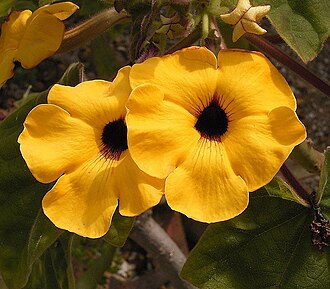
Bignoniaceae are most noted for ornamentals, such as Jacaranda, Tabebuia and Spathodea, grown for their conspicuous, tubular flowers. A great many species are known in cultivation. Various other uses have been made of members of this family. Several species were of great importance to the indigenous peoples of the American tropics. Fridericia elegans, Tanaecium bilabiata, and Tanaecium excitosum are poisonous to livestock and have caused severe losses.
According to different accounts, the number of species in the family is about 810 or about 860. The last monograph of the entire family was published in 2004. In that work, 104 genera were recognized. Since that time, molecular phylogenetic studies have greatly clarified relationships within the family, and the number of accepted genera is now between 80 and 85.
Description
Members of this family are mostly trees or lianas, sometimes shrubs, and rarely subshrubs or herbs.
Lianas of the tribe Bignonieae have a unique vascular structure, in which phloem arms extend downward into the xylem because certain segments of the cambium cease the production of xylem at an early stage of development. The number of these arms is four or a multiple thereof, up to 32. When four, the phloem arms appear as a cross, hence, the common name "cross vine". The phloem in the arms has wider sieve tubes and less parenchyma than the ordinary phloem.
The leaves are petiolate. Leaf arrangement usually is opposite, or rarely alternate or verticillate (in whorls). Leaves are usually compound, bifoliate, trifoliate, pinnate, or palmate, or rarely simple. Stipules are absent, but persistent; enlarged axillary bud scales (pseudostipules) are often present.
Taxonomy
The family Bignoniaceae was first validly published in the botanical literature (as Bignonieae) by Antoine Laurent de Jussieu in 1789 in his classic work, Genera Plantarum. The type genus for this family is Bignonia, which was validated by Linnaeus in Species Plantarum in 1753. The name originated with Joseph Pitton de Tournefort, who named it for his benefactor, Jean-Paul Bignon, in 1694, in his influential Eléments de botanique ou méthode pour connaître les plantes.
Important groundwork for future study of the family was laid down from 1789 to 1837, mostly by Jussieu, Kunth, Bojer and G.Don (George Don (1798–1856) not George Don the elder (1764–1814). Bentham and Hooker surveyed the family in their Genera Plantarum in 1876. Karl Moritz Schumann wrote a monograph on Bignoniaceae in 1894 for Engler and Prantl's Die Natürlichen Pflanzenfamilien.
Uses
Many species of Bignoniaceae have some use, either commercially or ethnobotanically, but the most important, by far, are those planted as ornamentals, especially the flowering trees. Jacaranda, Campsis, Pyrostegia, Tabebuia, Catalpa, Roseodendron, Handroanthus and Crescentia all have species of horticultural significance, at least in warm climates. Several others, including Tecoma, Podranea, Pandorea, Bignonia and Mansoa are frequently grown as ornamentals, at least in certain areas of the tropics. A great many species are known in cultivation, if only rarely.
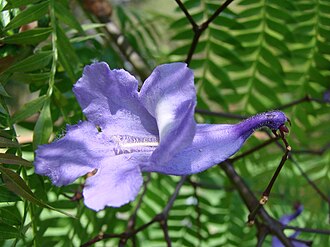
Jacaranda mimosifolia is common as an avenue tree. The winged petiole and trifoliate leaf of Crescentia alata resembles a crucifixion cross, so is sometimes planted in the Philippines as a religious symbol.
以上节选摘自英文维基百科「Bignoniaceae」,按 CC BY-SA 4.0 使用,去掉了参考文献、外部链接等尾部小节,公式改写成了纯文本。篇幅所限,较长的小节只摘了开头一部分,有的小节没有收;全文、配图和出处见原文。