 格物
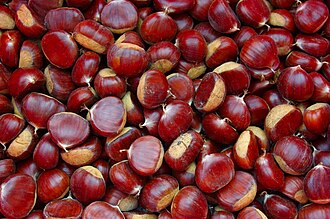
图:JLPC · CC BY-SA 3.0 · Wikimedia Commons
- 学名
- Castanea sativa
- 分类等级
- 种
- 上级类群
- 板栗属
- 大类
- 被子植物
- 命名
- 菲利普·米勒,1768 年
- 中文别名
- 东欧栗、欧洲板栗
- 保护状况(IUCN)
- 无危物种
- 异名
- Castanea vesca Gaertn. (1788)、Fagus castanea、Castanea vulgaris
- 用途
- 食用坚果
- 数据库
- NCBI 分类 · GBIF · IUCN 红色名录
百科正文
英文维基百科补充中文条目比较短,下面是英文条目「Sweet chestnut」的原文
The sweet chestnut (Castanea sativa), also known as the Spanish chestnut or European chestnut, is a species of tree in the flowering plant family Fagaceae.
Growing up to 35 m (115 ft) tall and with trunks over 4 m (13 ft) wide, the tree has long toothed leaves. Its long catkins contain both male and female flowers, the latter producing brownish nuts with spiky sheaths in the fall. The tree can live for hundreds of years.
The species is native to Southern Europe and Anatolia, and widely cultivated in Western and Central Europe. It provides food for animals but is affected by fungal pathogens. The starch-containing seed, the chestnut, is edible to humans and has been used in cooking since ancient times.
Description
Castanea sativa is a deciduous tree attaining a height of 20–35 metres (66–115 feet) with a trunk often 2 m (7 ft) in diameter. Around 20 trees are recorded with diameters over 4 m (13 ft) including one 7.5 m (25 ft) in diameter at breast height. A famous ancient tree known as the Hundred Horse Chestnut in Sicily was historically recorded at 18 m (59 ft) in diameter (although it has split into multiple trunks above ground). The bark often has a net-shaped (retiform) pattern with deep furrows or fissures running spirally in both directions up the trunk. The trunk is mostly straight with branching starting at low heights.
Taxonomy
The tree is only distantly related to the horse chestnut Aesculus hippocastanum, which bears superficially similar but inedible seeds (conkers) in a dehiscent seed case (ie. it splits open). Other common names include "Spanish chestnut" or "marron" (French for "chestnut"). The generic name Castanea is the old Latin name for the plant species, while the specific epithet sativa means "cultivated by humans". Some selected varieties are smaller and more compact in growth yielding earlier in life with different ripening time: the Marigoule, the Marisol and the Maraval.
Distribution and habitat
The species is native to Southern Europe and Anatolia. It is found across the Mediterranean region, from the Caspian Sea to the Atlantic Ocean. It is thought to have survived the last ice age in several refuges in Southern Europe, on the southern coast of the Black Sea with a main centre on the southern slope of the Caucasus and in the region of north-western Syria, possibly extending into Lebanon.
Ecology
The leaves provide food for animals including Lepidoptera such as the case-bearer moth Coleophora anatipennella and the North American rose chafer Macrodactylus subspinosus.
The two major fungal pathogens of the sweet chestnut are the chestnut blight (Cryphonectria parasitica) and the ink disease caused by Phytophthora cambivora and P. cinnamomi. In North America as well as in Southern Europe Cryphonectria parasitica destroyed most of the chestnut population in the 20th century. With biological control, the population of the sweet chestnut is not threatened anymore by the chestnut blight and is regenerating.
Cultivation
History
Pollen data indicates that the first spreading of Castanea sativa due to human activity started around 2100–2050 B.C. in Anatolia, northeastern Greece and southeastern Bulgaria. Compared to other crops, the sweet chestnut was probably of relatively minor importance and distributed very heterogeneously throughout these regions. The first charcoal remains of sweet chestnut only date from around 850–950 B.C., making it very difficult to infer a precise origin history. A newer but more reliable source are the literary works of Ancient Greece, with the richest being Theophrastus's Historia plantarum, written in the third century B.C.
Uses
Food
Nutrition
The edible seeds (also called chestnuts) have a low fat content, dominated by unsaturated fatty acids. Sweet chestnut is a good source of starch. The energy value per 100 g (3.5 oz) of C. sativa amounts to 891 kJ (213 kcal) (table). C. sativa nuts are characterised by high moisture content, which ranges from 41% to 59%. The chestnut provides a good source of copper, phosphorus, manganese and potassium (table). Its sugar content ranges from 14% to 20% dry weight, depending on the cultivar. Fructose is mostly responsible for the sweet taste.
以上节选摘自英文维基百科「Sweet chestnut」,按 CC BY-SA 4.0 使用,去掉了参考文献、外部链接等尾部小节,公式改写成了纯文本。篇幅所限,较长的小节只摘了开头一部分,有的小节没有收;全文、配图和出处见原文。