 格物
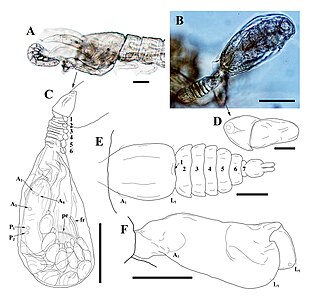
图:Boyko Christopher B., Williams Jason D., Rhodes Adelaide. Fi… · CC BY 4.0 · Wikimedia Commons
生命之树 › 真核生物 › 动物界 › 真后生动物亚界 › 两侧对称动物 › 原口动物 › 蜕皮动物总门 › 节肢动物门 › 甲壳亚门 › 多甲总纲
微虾亚纲纲
Tantulocarida
Tantulocarida is a highly specialised group of parasitic crustaceans that consists of about 33 species, treated as a class in superclass Multicrustacea. They are typically ectoparasites that infest copepods, isopods, tanaids, amphipods and ostracods.
摘自英文维基百科「Tantulocarida」(英文维基百科,暂无中文条目),CC BY-SA 4.0
- 学名
- Tantulocarida
- 分类等级
- 纲
- 上级类群
- 多甲总纲
- 大类
- 其他动物
- 数据库
- NCBI 分类 · GBIF
百科正文
本条目暂无中文维基百科条目,下面是英文维基百科原文。
Description
In the Tantulocarida, animals do not ever present eyes.
The tantulus larvae has a head with a ventral oral disc but no appendages, a six-segmented thorax with six pairs of legs, and a limbless abdomen consisting of one to six segments in addition to a telson. The larvae also possesses a cuticular stylet on the cephalon through which they can push a rootlet system for extraction of nutrients from a host. The rootlet system itself is a direct extension of the gut.
Body length
Members of this subclass are minute – less than 0.3 millimetres (0.012 in) in length and have a dramatic reduction in body form compared to other crustaceans, with an unsegmented, sac-like thorax and a much reduced abdomen. One tantulocarid species, Tantulacus dieteri, is the world's smallest crustacean, with a total body length of only 85 micrometres (0.0033 in).
Life cycle
The tantulocarid life cycle is unique among crustaceans. The tantulus larva transforms directly from a non-feeding (lecithotrophic) and free-swimming organism into a parasite without any instars. When entering the parasitic stage much of the body, such as the muscles, degenerates, even if the body itself becomes bigger. As a parasite it is permanently attached to its host, and after piercing its host's cuticle with an unpaired stylet, a rootlet system used to absorb nutrients enters through the hole and grow into the host's tissue. The adult form develops inside the larva, and can become either a sac-like parthenogenetic female, or a fully developed free-living, non-feeding and sexually-reproducing male or female. The eggs inside the parthenogenetic female are eventually released as fully developed tantulus larvae. The finding of what appears to be a benthic non-feeding nauplius larva suggests that eggs produced by sexual females hatch as nauplii instead of tantulus larvae. Both the parthenogenetic and sexual females are semelparous.
以上内容摘自英文维基百科「Tantulocarida」,按 CC BY-SA 4.0 使用,去掉了参考文献、外部链接等尾部小节,公式改写成了纯文本。全文、配图和出处见原文。