 格物
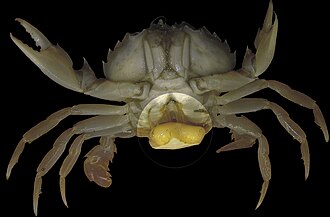
图:Hans Hillewaert · CC BY-SA 4.0 · Wikimedia Commons
- 学名
- Rhizocephala
- 分类等级
- 总纲
- 上级类群
- 蔓足亚纲
- 大类
- 其他动物
- 数据库
- NCBI 分类
下级类群(1)
- 蟹奴科 Sacculinidae 科
百科正文
下级分类
- 本下纲包括以下科:
- Chthamalophilidae Bocquet-Védrine, 1961
- Clistosaccidae Boschma, 1928
- Clistosaccus Lilljeborg, 1861
- Sylon M.Sars, 1870
- Sylon hippolytes M.Sars, 1870
- Duplorbidae Høeg & Rybakov, 1992
- Mycetomorphidae Høeg & Rybakov, 1992
- Parthenopeidae Rybakov & Høeg, 2013
- Peltogasterellidae Høeg & Glenner, 2019
- Peltogastridae Lilljeborg, 1861
- Pirusaccidae Høeg & Glenner, 2019
- Polyascidae Høeg & Glenner, 2019
- Polysaccidae Lützen & Takahashi, 1996
- 蟹奴科 Sacculinidae Lilljeborg, 1861
- Thompsoniidae Høeg & Rybakov, 1992
- Triangulidae Høeg & Glenner, 2019
以上内容摘自维基百科「根頭下綱」,按 CC BY-SA 4.0 使用,去掉了参考文献、外部链接等尾部小节,公式改写成了纯文本。全文、配图和出处见原文。
英文维基百科补充中文条目比较短,下面是英文条目「Rhizocephala」的原文
Rhizocephala are derived barnacles that are parasitic castrators. Their hosts are mostly decapod crustaceans, but include Peracarida, mantis shrimps and thoracican barnacles. Their habitats range from the deep ocean to freshwater. Together with their sister groups Thoracica and Acrothoracica, they make up the subclass Cirripedia. Their body plan is uniquely reduced in an extreme adaptation to their parasitic lifestyle, and makes their relationship to other barnacles unrecognisable in the adult form. They also exhibit the most extreme sexual dimorphism of all known animals. The females are parasites who inject themselves into a host and take over their bodies through a network of filaments, while the males are hyperparasites who inject themselves into a settled female and cease to exist as independent organisms through the degeneration of all tissues except the ones responsible for spermatogenesis. The name Rhizocephala derives from the Ancient Greek roots ῥίζα (rhiza, "root") and κεφαλή (kephalē, "head"), describing the adult female, which mostly consists of a network of thread-like extensions penetrating the body of the host.
Description
Adults
Adult rhizocephalans lack appendages, segmentation, and all internal organs except gonads, a few muscles, and the remains of the nervous system. Females have a cuticle, which is never shed. Other than the larval stages, there is nothing identifying them as crustaceans or arthropods in general. The only distinguishable portion of an adult rhizocephalan body is the externa: the reproductive portion of adult females.
Nauplius and cypris larvae
Nauplii released from adult females swim in water for several days without taking food (the larva has no mouth and no intestine) and transform into cypris larvae (cyprids) after several moults. Like the nauplii, the cyprids are lecithotrophic (non-feeding).
Parasitism
Rhizocephalan crustaceans were traditionally divided into Kentrogonida, with a kentrogon stage, and Akentrogonida, which lack it. However, molecular data show these groups are paraphyletic, so they can only be considered developmental types rather than formal orders.
The female cypris larva in Kentrogonida settles on a host and metamorphoses into a specialized juvenile form, a kentrogon. This has no visible segmentation and no appendages except the antennules. These are used to attach the larva to the host; their only purpose is to inject a cell mass, the vermigon, into the host's hemolymph through a retractive hollow stylet on the larva's head. The kentrogon stage seems to have been secondarily lost in all of the Akentrogonida, where the cypris injects the vermigon through one of its antennules. The vermigon grows into a network of root-like threads through the host's tissue, centering on the digestive system and especially the hepatopancreas, and absorb nutrients from the hemolymph. The network of threads is called the interna. The female then grows a sac-like externa, which consists of a mantle, a mantle cavity, an ovary and a pair of passageways known as cell receptacles, extruding from the abdomen of the host.
In the order Kentrogonida, the virgin externa contains no openings at first. But it soon molts to a second stage that contains an orifice known as the mantle departure, and which leads into the two receptacle passageways — once assumed to be the testes in hermaphroditic parasites before the realization that they were actually two separate sexes — and starts releasing pheromones to attract male cyprids. From inside the body of the male cypris that succeeds in entering the departure, a unique and very short lived male stage called the trichogen emerges through the antennule opening. It is the homologue of the female kentrogon, but is reduced to an amoeboid unsegmented cuticle-covered mass of cells consisting of three to four cell-types: the dorsolateral, the ventral epidermis, the inclusion cells, and the postganglion.
Classification
Following an updated classification of barnacles by Chan et al. (2021), the subgroups Akentrogonida and Kentrogonida were dropped, leaving 13 families as children of the infraclass Rhizocephala.
Phylogeny
The Rhizocephala have not so far been found as fossils.
External
The following cladogram shows the phylogenetic relationships of the Cirripedia within Thecostraca as of 2021.
Internal
The following cladogram summarizes the internal relationships of Rhizocephala as of 2020, as well as the number of species in each family. The tree is not fully resolved.
以上节选摘自英文维基百科「Rhizocephala」,按 CC BY-SA 4.0 使用,去掉了参考文献、外部链接等尾部小节,公式改写成了纯文本。篇幅所限,较长的小节只摘了开头一部分,有的小节没有收;全文、配图和出处见原文。