格物
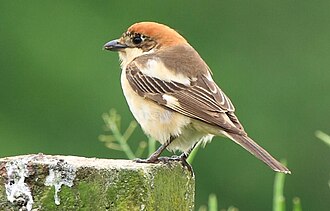
图:Lanius_senator01.jpg: chausinho derivative work: Bogbumper (… · CC BY-SA 2.0 · Wikimedia Commons
- 学名
- Lanius senator
- 分类等级
- 种
- 英文名
- Woodchat Shrike
- 上级类群
- 伯劳属
- 大类
- 鸟类
- 命名
- 卡尔·林奈,1758 年
- 保护状况(IUCN)
- 近危物种
- 体重
- 3.4 克(出生体重)
- 数据库
- NCBI 分类 · GBIF · IUCN 红色名录
百科正文
林䳭伯劳是一种候鸟,中等体型,以大型昆虫、小鸟和青蛙为食。和其他伯劳一样,林䳭伯劳会从突出的高处向猎物发起突袭,并用荆棘或带刺的铁丝刺穿其猎物。
以上内容摘自维基百科「林䳭伯劳」,按 CC BY-SA 4.0 使用,去掉了参考文献、外部链接等尾部小节,公式改写成了纯文本。全文、配图和出处见原文。
英文维基百科补充中文条目比较短,下面是英文条目「Woodchat shrike」的原文
The woodchat shrike (Lanius senator) is a member of the shrike family Laniidae. It can be identified by its red-brown crown and nape. It is mainly insectivorous and favours open wooded areas with scattered trees such as orchards, particularly when there is bare or sandy ground. The woodchat shrike breeds in southern Europe, the Middle East and northwest Africa, and winters in tropical Africa.
Taxonomy
The woodchat shrike was formally described by the Swedish naturalist Carl Linnaeus in 1758 in the tenth edition of his Systema Naturae under the binomial name Lanius senator. Linnaeus based his description on the "red headed butcher-bird" that had been described and illustrated in 1734 by the English naturalist Eleazar Albin in the second volume of his A Natural History of Birds. Linnaeus mistakenly specified the type locality as "Indiis". This was corrected to the River Rhine in Germany by Ernst Hartert in 1907. The genus name, Lanius, is derived from the Latin word for "butcher", and some shrikes are also known as "butcher birds" because of their feeding habits. The specific senator is Latin for "senator", so-named because its chestnut cap recalled the colour of the stripe on the toga of a Roman senator. The common name "woodchat" is an Anglicisation of German waldkatze, literally "woodcat", and "shrike" is from Old English scríc, "shriek", referring to the shrill call.
Description
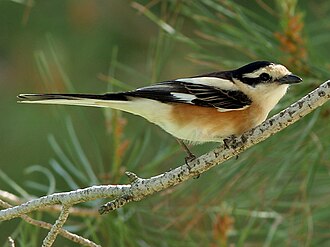
The woodchat shrike is 17–19 cm (6.7–7.5 in) in overall length which is slightly larger than a red-backed shrike. The male is a striking bird with black and white upper parts, a chestnut crown and pure white underparts. The race L. s. badius of the western Mediterranean lacks the large white wing patches. In the female and young birds, the upperparts are brown and white and vermiculated. Underparts are buff and also vermiculated.
Distribution and habitat
The breeding range of the woodchat shrike is in southern Europe, northern Africa and the Middle East. The range extends from Portugal to Greece, Turkey, Iraq and Iran, and in the Arabian Peninsula including Bahrain and Kuwait, and from Mauritania and Western Sahara in northern Africa to Libya. This bird overwinters in tropical central Africa, its winter range extending from Senegal to Sudan and Ethiopia in the east and southwards to Gabon. This species often overshoots its breeding range on spring migration, and is a rare, but annual, visitor to Great Britain. The Balearic race badius has occurred in Britain around four times as a vagrant, and has also been recorded once in Ireland.
Behaviour and ecology
Breeding
Eggs are laid from early May to mid-July. The nest is built by both sexes and is placed in a tree, usually a fruit or olive tree. The nest is a strong cup of plant material which is lined with wool, hair, fine roots, cobwebs and lichen. The nest sometimes includes green plant material. The clutch is usually 5–6 eggs which are laid daily. The eggs are glossy and vary in colour: they can be pale olive-green, sandy, greyish-yellow or brown. They have brown to pale olive speckles concentrated at the broader end. For the nominate subspecies the average size is 23 mm × 17 mm (0.91 in × 0.67 in) with a calculated weight of 3.4 g (0.12 oz). After the last egg is laid they are incubated by the female; only very rarely does the male participate. The eggs hatch after 14–15 days. The young are cared for by both parents and fledge after 15–20 days. The parents continue to feed the fledgelings up to 3 to 4 weeks of age.
The longest lived woodchat shrike recorded by ring-recovery data is 5 years and eight months for a bird found dead in Germany.
Population
Though it remains common, the woodchat shrike has been declining for a long period. In its European range, it is listed as a threatened species in many countries, such as France, Poland, and Switzerland. Due to its large population, estimated to be 5.9-10 million individuals, it was listed as a least concern species by the IUCN since 1988. The species for a long time had battled several devastating threats, including loss of habitat due to agriculture, afforestation, excessive use of pesticides, climate change shrinking the species' range, trans-migratory hunting, declines of insect prey and droughts.
以上节选摘自英文维基百科「Woodchat shrike」,按 CC BY-SA 4.0 使用,去掉了参考文献、外部链接等尾部小节,公式改写成了纯文本。篇幅所限,较长的小节只摘了开头一部分,有的小节没有收;全文、配图和出处见原文。