 格物
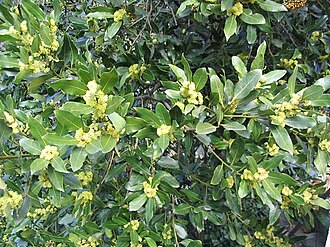
- 学名
- Laurus nobilis
- 分类等级
- 种
- 上级类群
- 月桂属
- 大类
- 被子植物
- 命名
- 卡尔·林奈,1753 年
- 中文别名
- 月桂子、月桂叶、月桂樱子
- 保护状况(IUCN)
- 无危物种
- 用途
- 植树造林、药用植物、食物、香辛料
- 数据库
- NCBI 分类 · GBIF · IUCN 红色名录
百科正文
叶片深绿色,椭圆形,革质,味苦,清香。干燥后,苦味减少,香气增强,可以用作调料,即“香叶”。
古代希腊人用月桂的小枝条编织成桂冠,授予皮提亚运动会的胜利者,象征荣耀与胜利。
特征
月桂树高50~60英尺,树皮光滑呈橄榄绿或略带红棕色。叶片很厚,叶面光滑呈深绿色,叶底呈浅绿色,呈椭圆形,干燥后很硬,易碎裂,但有韧性,边缘具腊质。月桂树是多性植物,一株树上有雄花及雌花,也有雌雄同体的花,花小色黄或浅绿,果实像葡萄呈深紫色。
用途
希腊神话中,月桂代表着“阿波罗的荣耀”。在罗马时期,人们就使用月桂编织的花环戴在胜利者的头上,所以常听到“诗人的桂冠”,就是指着胜利加冠。月桂据说又有驱魔避邪的传说,所以在圣诞节,它就常被用来装饰。在意大利,毕业生要戴月桂枝条编成的桂冠庆祝毕业。
月桂叶常被使用在意大利、土耳其、印度、中国北方和泰式餐饮中,不管是炖煮、汤品、泡菜、入茶,都倍具独特迷人的香气,也具有防腐、助消化的效果;叶片可置于衣柜或米桶中以防虫。药效上,月桂叶可以减轻扭伤、瘀青和风湿所引起的疼痛。
传说
吴刚伐桂
吴刚伐桂最早可以追溯到唐朝,唐朝人段成式所作《酉阳杂俎·天咫》中有:“旧言月中有桂,有蟾蜍,故异书言月桂高五百丈,下有一人常斫之,树创随合。人姓吴名刚,西河人,学仙有过,谪令伐树。”这里的“月桂”指的是月中的桂,实际是肉桂,而并非是本文中的月桂。
以上内容摘自维基百科「月桂」,按 CC BY-SA 4.0 使用,去掉了参考文献、外部链接等尾部小节,公式改写成了纯文本。全文、配图和出处见原文。
英文维基百科补充中文条目比较短,下面是英文条目「Laurus nobilis」的原文
Laurus nobilis is an aromatic evergreen tree or large shrub with green, glabrous (smooth) leaves. Common names include bay tree (especially in the United Kingdom), bay laurel, sweet bay, true laurel, Grecian laurel, or simply laurel.
It is in the flowering plant family Lauraceae. The stem can be 1 metre in diameter and the tree can be as high as 20 metres. Native to the Mediterranean region, Laurus nobilis figures prominently in classical Greco-Roman culture and served various medicinal, religious, and symbolic purposes. Bay leaves are widely used as seasoning in cooking.
Worldwide, many other kinds of plants in diverse families are also called "bay" or "laurel", generally due to similarity of foliage or aroma to Laurus nobilis.
Description
The laurel is an evergreen shrub or small tree, variable in size and sometimes reaching 7–18 m (23–59 ft) tall. The genus Laurus includes three accepted species, whose diagnostic key characters often overlap.
The bay laurel is dioecious (unisexual), with male and female flowers on separate plants. Each flower is pale yellow-green, about 1 cm (3⁄8 in) diameter, and they are borne in pairs beside a leaf. The leaves are glabrous, 6–12 cm (2–5 in) long and 2–4 cm (3⁄4–1+5⁄8 in) broad, with an entire (untoothed) margin. On some leaves the margin undulates. The fruit is a small, shiny black drupe-like berry about 1 cm (3⁄8 in) long that contains one seed.
Ecology
Laurus nobilis is a widespread relict of the laurel forests that originally covered much of the Mediterranean Basin when the climate of the region was more humid. With the drying of the Mediterranean during the Pliocene era, the laurel forests gradually retreated, and were replaced by the more drought-tolerant sclerophyll plant communities familiar today. Most of the last remaining laurel forests around the Mediterranean are believed to have disappeared approximately ten thousand years ago, although some remnants still persist in the mountains of southern Turkey, northern Syria, southern Spain, north-central Portugal, northern Morocco, the Canary Islands and in Madeira.
Human uses
History
Early evidence of the use of the plant has been found at Ashkelon in modern Israel, dating to 7th century BC Judea/Assyria.
Food
The plant is the source of several popular herbs and one spice used in a wide variety of recipes, particularly among Mediterranean cuisines. They are typically removed from dishes before serving, although they may also be used as a simple garnish. Whole bay leaves have a long shelf life of about one year, under normal temperature and humidity. Whole bay leaves are used almost exclusively as flavor agents during the food preparation stage. Ground bay leaves, however, can be ingested safely and are often used in soups and stocks, as well as being a common addition to a Bloody Mary.
Symbolism
Greece
In Greek, the plant is called δάφνη dáphnē, after the mythic mountain nymph of the same name. In the myth of Apollo and Daphne, the god Apollo fell in love with Daphne, a priestess of Gaia (Mother Earth), and when he tried to seduce her she pleaded for help to Gaia, who transported her to Crete. In Daphne's place Gaia left a laurel tree, from which Apollo fashioned wreaths to console himself.
Other versions of the myth, including that of the Roman poet Ovid, state that Daphne was transformed directly into a laurel tree.
Bay laurel was used to fashion the laurel wreath of ancient Greece, a symbol of highest status. A wreath of bay laurels was given as the prize at the Pythian Games because the games were in honor of Apollo, and the laurel was one of his symbols.
Chemical constituents
The most abundant component found in laurel essential oil is 1,8-cineole, also called eucalyptol. The leaves contain about 1.3% essential oils (ol. lauri folii), consisting of 45% eucalyptol, 12% other terpenes, 8–12% terpinyl acetate, 3–4% sesquiterpenes, 3% methyleugenol, and other α- and β-pinenes, phellandrene, linalool, geraniol, and terpineol. It contains lauric acid also.
Both essential and fatty oils are present in the fruit. The fruit is pressed and water-extracted to obtain these products. The fruit contains up to 30% fatty oils and about 1% essential oils (terpenes, sesquiterpenes, alcohols, and ketones). This laurel oil is the characteristic ingredient of Aleppo soap. The chemical compound lauroside B has been isolated from Laurus nobilis.
以上节选摘自英文维基百科「Laurus nobilis」,按 CC BY-SA 4.0 使用,去掉了参考文献、外部链接等尾部小节,公式改写成了纯文本。篇幅所限,较长的小节只摘了开头一部分,有的小节没有收;全文、配图和出处见原文。