 格物
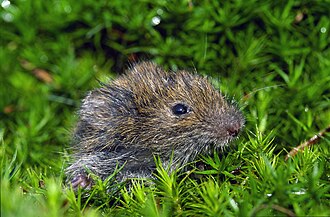
图:Fer boei at Dutch Wikipedia · CC BY-SA 3.0 · Wikimedia Commons
生命之树 › 真核生物 › 动物界 › 真后生动物亚界 › 两侧对称动物 › 后口动物总门 › 脊索动物门 › 脊椎动物亚门 › 有颌下门 › 肉鳍鱼总纲 › 四足形类 › 希望螈目 › 四足总纲 › 哺乳动物 › 兽型类 › 全兽类 › 兽亚纲 › 有胎盘类 › 北方真兽高目 › 灵长总目 › 啮齿目 › 鼠形亚目 › 鼠总科 › 仓鼠科 › 田鼠亚科 › 田鼠属
黑田鼠种
Microtus agrestis
黑田鼠 为仓鼠科田鼠属的动物。在中国大陆,分布于新疆(阿尔泰山、巴尔鲁克山)等地,多见于森林和森林草原的潮湿地区。该物种的模式产地在瑞典。
摘自维基百科「黑田鼠」,CC BY-SA 4.0
- 学名
- Microtus agrestis
- 分类等级
- 种
- 英文名
- field vole
- 上级类群
- 田鼠属
- 大类
- 哺乳动物
- 命名
- 卡尔·林奈,1761 年
- 保护状况(IUCN)
- 无危物种
- 异名
- Mus gregarius
- 栖息地
- 森林、灌丛
- 体重
- 2 克(出生体重)
- 数据库
- NCBI 分类 · GBIF · IUCN 红色名录
百科正文
英文维基百科补充中文条目比较短,下面是英文条目「Short-tailed field vole」的原文
The short-tailed field vole, short-tailed vole, or simply field vole (Microtus agrestis), is a grey-brown vole, around 10 cm in length, with a short tail. It is one of the most common mammals in Europe, with a range extending from the Atlantic coast to Lake Baikal. These voles are found in moist grassy habitats, such as woodland, marsh or on river banks. Although they make shallow burrows, they usually build nests above ground. They are an important food source for owls and some other predators and their population size tends to peak and trough cyclically. Field voles breed prolifically, mainly in summer, but often all year round, even under snow. Females produce up to seven litters a year, each averaging from four to six young which are weaned after about fourteen days. The short-tailed field vole is both widespread and common and is listed as being of "Least Concern" by the IUCN.
Description
The short-tailed field vole is a small, dark brown rodent with a short tail, distinguishable from the closely related common vole (Microtus arvalis) by its darker, longer and shaggier hair and by its more densely haired ears. The head and body length varies between 8 and 13 centimetres (3.1 and 5.1 in) and the tail between 3 and 4 centimetres (1.2 and 1.6 in). The weight is 20 to 50 grams (0.71 to 1.76 oz). The voice is a faint, low squeak and it also emits a range of chattering sounds.
Distribution and habitat
The short-tailed field vole has a palearctic distribution. Its range extends throughout Western Europe and eastwards to Lake Baikal in Siberia and north west China and northward to Norway, Sweden and Finland. It is absent from Iceland and thins out southwards towards the Mediterranean Sea. Previously absent, it was detected in Ireland in 2022. It is found in a range of habitats including meadows, field borders, plantations, woodland verges, clearings, upland heaths, dunes, marshes, bogs and river banks and tends to prefer wet areas. It is found at altitudes of up to about 1,700 metres (5,600 ft).
Behaviour
The short-tailed field vole is more active by day than the common vole. It excavates shallow burrows close to the surface of the ground, under leaf litter and under snow in winter. It also makes surface runs through tall vegetation, routes along which it can scurry back to safety if danger threatens. Off these are dedicated defecation sites and it often leaves little piles of chopped up grass stalks nearby.
The short-tailed field vole is a herbivore and feeds on grasses, herbs, root tubers, moss and other vegetation and gnaws bark during the winter (it does not hibernate). It occasionally eats invertebrates such as insect larvae. Among the plants it favours are the grasses Agrostis spp. and Festuca rubra, the yarrow (Achillea millefolium), clover (Trifolium spp.), dandelion (Taraxacum officinale) and buttercups (Ranunculus spp.). The voles choose species with high digestibility where possible and avoid some common plants amongst which they live such as the tufted hairgrass (Deschampsia cespitosa) and rosebay willowherb (Chamerion angustifolium).
Breeding
Field voles are induced ovulators. The short-tailed field vole breeds throughout the year but the breeding season peaks in spring and summer. The nest is made on or just under the surface of the ground, often in a clump of grass or sedge. The gestation period is about three weeks and up to a dozen young are borne. These grow rapidly, suckle for twelve days and leave the nest at twenty one days, reaching sexual maturity soon afterwards. Like the common vole, the short-tailed field vole is subject to population explosions when conditions are right. Females become pregnant again soon after parturition. The pregnancy rate is nearly 100% in late spring but falls during midsummer only to rise again later. Mortality in the nest is about 20% but may rise to 50% in the middle of summer when the digestibility of the food supplies fall. Life expectancy is about two years but is lower for spring-born individuals than for ones born later in the year.
Conservation status
The short-tailed field vole is common over most of its very wide range, although thinning out towards the peripheries and may be locally scarce where conditions are less suitable. The population seems stable over the long term though there are marked fluctuations from year to year. The IUCN in its Red List of Threatened Species has therefore listed it as being of "Least Concern".
以上节选摘自英文维基百科「Short-tailed field vole」,按 CC BY-SA 4.0 使用,去掉了参考文献、外部链接等尾部小节,公式改写成了纯文本。篇幅所限,较长的小节只摘了开头一部分,有的小节没有收;全文、配图和出处见原文。