 格物
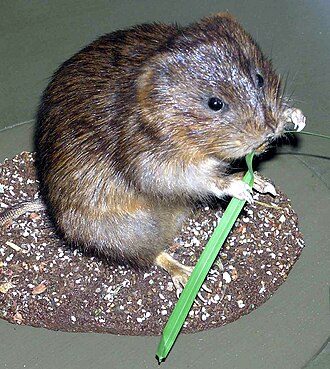
图:Adrian Pingstone · Public domain · Wikimedia Commons
- 学名
- Arvicola amphibius
- 分类等级
- 种
- 上级类群
- 水䶄属
- 大类
- 哺乳动物
- 命名
- 卡尔·林奈,1758 年
- 中文别名
- 水
- 保护状况(IUCN)
- 无危物种
- 异名
- Mus terrestris、Mus paludosus、Arvicola terrestris amphibius
- 数据库
- NCBI 分类 · GBIF · IUCN 红色名录
百科正文
特征
体长14—22厘米(5.5—8.7英寸),尾巴长度是身体的一半。成年个体体重225—386 g(7.9—13.6 oz),但这是其体重每年达到峰值时的数据,成功过冬的雌性体重最低为112 g(4.0 oz),雄性为115 g(4.1 oz)。
它们和家鼠一样皮毛呈黑褐色,但不同之处在于水䶄的尾巴上也有毛发覆盖。
亚种
水䶄塔尔巴哈台亚种(学名:Arvicola terrestris kuznetzovi),Ognev于1933年命名。在中国大陆,分布于新疆(塔尔巴哈台山)等地。该物种的模式产地在哈萨克斯坦赛米巴拉金斯克地区。
水䶄哈萨克亚种(学名:Arvicola terrestris scythicus),Thomas于1914年命名。在中国大陆,分布于新疆(天山、加依尔山)等地。该物种的模式产地在哈萨克斯坦塞米列奇地区。
以上内容摘自维基百科「水䶄」,按 CC BY-SA 4.0 使用,去掉了参考文献、外部链接等尾部小节,公式改写成了纯文本。全文、配图和出处见原文。
英文维基百科补充中文条目比较短,下面是英文条目「European water vole」的原文
The European water vole (Arvicola amphibius) or northern water vole is a semi-aquatic rodent. It is often informally called the water rat, though it only superficially resembles a true rat. Water voles have rounder noses than rats, deep brown fur, chubby faces, and short fuzzy ears; unlike rats, their tails, paws, and ears are covered with hair.
In the wild, on average, water voles only live about five months. Maximum longevity in captivity is two and a half years.
Appearance
Water voles reach 14–22 centimetres (5.5–8.7 in) in length, plus a tail which is about half the length of the body. Weights reported for adults are variable. It is possible for large, optimal adults to weigh as much as 225 to 386 g (7.9 to 13.6 oz). However, these are peak weights. Elsewhere, the mean body mass has been reported as 60 to 140 g (2.1 to 4.9 oz), although this figure includes immature water voles.
Taxonomy
The binomial applied to the European water vole is Arvicola amphibius; it was formerly known by the junior synonym A. terrestris. The confusion stems from the fact that Linnaeus described two species of water vole on the same page of the same work. Those two forms are now universally considered the same species. It has been recognized as A.
Range
The European water vole is found in most of Europe, Russia, West Asia and Kazakhstan.
Habitat
In Britain, water voles live in burrows excavated within the banks of rivers, ditches, ponds, and streams. Burrows are normally located adjacent to slow-moving, calm water, which they seem to prefer. They also live in reed beds, where they will weave ball-shaped nests above ground if no suitable banks exist in which to burrow.
Diet
Water voles mainly eat grass, sedges, rushes, herbs, and other vegetation near the water, but will also consume fruits, seeds, bulbs, twigs, buds, and roots when given the opportunity. In Europe, rich harvest periods can cause water vole "plagues" to take place, during which the voles eat ravenously, destroying entire fields of grass and leaving the fields full of burrows.
Breeding
The mating period lasts from March into late autumn. The female vole's pregnancy lasts for approximately 21 days. Up to 8 baby voles can be born, each weighing around 10 grams (0.4 oz). The young voles open their eyes three days after their birth. They are half the size of a full-grown water vole by the time they are weaned.
Behaviour
Water voles are expert swimmers and divers. They do not usually live in large groups. Adult water voles each have their own territory, which they mark with fecal latrines located either near the nest or burrow, or at favoured water's edge platforms where voles leave or enter the water. Latrines are a good survey indicator of this species and can be used to gauge the abundance of animals.
Predation
As a large and common microtine rodent, the range of predators faced by the European water vole is extensive. However, many species of predator prefer other rodents, such as Microtus voles and wood mice, due to their greater abundance.
Conservation
United Kingdom
In 2006, water voles had returned to Lindow Common nature reserve in Cheshire, after many years of absence.
On 26 February 2008, the U.K. Government announced full legal protection for water voles would be introduced from 6 April 2008.
In 2015, People's Trust for Endangered Species launched a new project to try to coordinate conservation efforts for the water-vole in the U.K.
Literary appearances
A water vole named "Ratty" is a leading character in the 1908 children's book The Wind in the Willows by Kenneth Grahame: the locality used in the book is believed to be Moor Copse in Berkshire, England, and the character's name "Ratty" has become widely associated with the species and their riverbank habitat, as well as the misconception that they are a species of rat. There are also watervoles in the works of Redwall by Brian Jacques.
以上节选摘自英文维基百科「European water vole」,按 CC BY-SA 4.0 使用,去掉了参考文献、外部链接等尾部小节,公式改写成了纯文本。篇幅所限,较长的小节只摘了开头一部分,有的小节没有收;全文、配图和出处见原文。