 格物
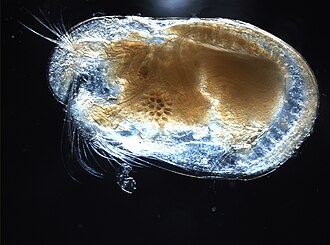
图:Anna33 at English Wikipedia · CC BY 2.5 · Wikimedia Commons
- 学名
- Ostracoda
- 分类等级
- 纲
- 上级类群
- 寡甲总纲
- 大类
- 其他动物
- 命名
- 皮埃尔·安德烈·拉特雷耶,1802 年
- 数据库
- NCBI 分类 · GBIF
下级类群(2)
百科正文
现今介形纲生物分布广泛,大部分为淡水与海水中的水生动物,也有部分品种为潮湿地带的陆生动物。
在奥陶纪的沉积层中,就已经发现携带卵堆的雌性介形类化石。它们也是地球上已知最早有保护幼体的行为的动物。
特征
介形纲生物均为细小甲壳亚门生物,一般约1毫米(0.04英寸)大,但其大小的差异可以由0.2毫米(0.008英寸)到30毫米(1.2英寸)不等,当中以巨海萤的体型最大。
介形纲的整个身体被包裹在两片介壳当中。这两片介壳是特化的头胸甲,在背脊上具有特殊的铰合结构,并且由专门的肌肉控制,可以自由开闭。
身体分节不明显,头部的两对触角是甲壳亚门的基本特征。根据生活方式的不同,可能有一对触角特别强大,用来划水游泳。附肢的数量较少,并且有明显的分化,可以在海底爬行,或者抓握食物和异性,帮助进食和交配。
以上内容摘自维基百科「介形綱」,按 CC BY-SA 4.0 使用,去掉了参考文献、外部链接等尾部小节,公式改写成了纯文本。全文、配图和出处见原文。
英文维基百科补充中文条目比较短,下面是英文条目「Ostracod」的原文
Ostracods, or ostracodes, are a class of the Crustacea (class Ostracoda), sometimes known as seed shrimp. Some 33,000 species (only 13,000 of which are extant) have been identified, grouped into 7 valid orders. They are small crustaceans, typically around 1 mm (0.04 in) in size, but varying from 0.2 to 32 mm (0.0079 to 1.3 in), the latter in the case of the marine Gigantocypris. The largest known freshwater species is Megalocypris princeps, which reach 8 mm in length. In most cases, their bodies are flattened from side to side and protected by a bivalve-like valve or "shell" made of chitin, and often calcium carbonate. The family Entocytheridae and many planktonic forms do not have calcium carbonate. The hinge of the two valves is in the upper (dorsal) region of the body. Ostracods are grouped together based on shell and soft part morphology, and molecular studies have not unequivocally supported the group's monophyly. They have a wide range of diets, and the class includes carnivores, herbivores, scavengers and filter feeders, but most ostracods are deposit feeders.
Etymology
Ostracod comes from the Greek óstrakon meaning shell or tile.
Fossils
Ostracods are "by far the most common arthropods in the fossil record" with fossils being found from the early Ordovician to the present. An outline microfaunal zonal scheme based on both Foraminifera and Ostracoda was compiled by M. B. Hart. Freshwater ostracods have even been found in Baltic amber of Eocene age, having presumably been washed onto trees during floods.
Description
The body of an ostracod is encased by a carapace originating from the head region, and consists of two valves superficially resembling the shell of a clam. A distinction is made between the valve (hard parts) and the body with its appendages (soft parts). Studies of the embryonic development in Myodocopida show that the bivalved carapace develops from two independent buds of the carapace valves. As the two halves grow, they meet in the middle. In Manawa, an ostracod in the order Palaeocopida, the carapace originates as a single element and during growth folds at the midline.
Palaeoclimatic reconstruction
A new method is in development called mutual ostracod temperature range (MOTR), similar to the mutual climatic range (MCR) used for beetles, which can be used to infer palaeotemperatures. The ratio of oxygen-18 to oxygen-16 (δ18O) and the ratio of magnesium to calcium (Mg/Ca) in the calcite of ostracod valves can be used to infer information about past hydrological regimes, global ice volume and water temperatures.
Distribution
Ecologically, marine ostracods can be part of the zooplankton or (most commonly) are part of the benthos, living on or inside the upper layer of the sea floor. Ostracods has been found as deep as 9,307 m (genus Krithe in family Krithidae). Subclass Myodocopa and the two podocop orders Palaeocopida and Platycopida are restricted to marine environments (except for Platycopida which have a few brackish species), but we find non-marine forms in the four superfamilies Terrestricytheroidea, Cypridoidea, Darwinuloidea, and Cytheroidea in the order Podocopida.
Ecology
Lifecycle
Male ostracods have two penises, corresponding to two genital openings (gonopores) on the female. The individual sperm are often large, and are coiled up within the testis prior to mating; in some cases, the uncoiled sperm can be up to six times the length of the male ostracod itself. Mating typically occurs during swarming, with large numbers of females swimming to join the males. Some species are partially or wholly parthenogenetic.
Classification
Early work indicated that Ostracoda may not be monophyletic, and early molecular phylogeny was ambiguous on this front. Recent combined analyses of molecular and morphological data suggested monophyly in analyses with broadest taxon sampling, but with no or very little support. The molecular analysis of Bernot et al. found Ostracoda to be nonmonophyletic, with Podocopa being Mystacocarida's sister group while Myodocopa is more closely related to Branchiura.
- Class Ostracoda is divided into following living clades:
- Subclass Myodocopa
- Order Myodocopida
- Suborder Myodocopina
以上节选摘自英文维基百科「Ostracod」,按 CC BY-SA 4.0 使用,去掉了参考文献、外部链接等尾部小节,公式改写成了纯文本。篇幅所限,较长的小节只摘了开头一部分,有的小节没有收;全文、配图和出处见原文。