 格物
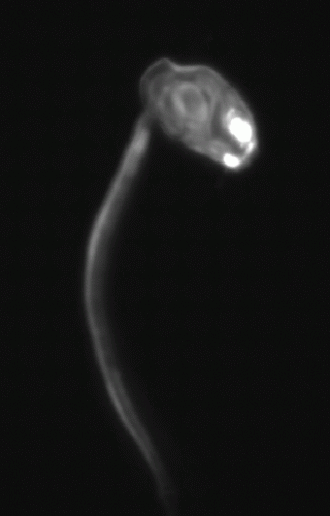
图:Dr. Thomas Clarke RedEnsign at English Wikipedia · CC BY 2.5 · Wikimedia Commons
- 学名
- Appendicularia
- 分类等级
- 纲
- 上级类群
- 尾索动物亚门
- 大类
- 其他动物
- 数据库
- NCBI 分类 · GBIF
百科正文
科
- 本纲包括以下科:
- 住筒虫科 Fritillariidae
- 科氏虫科 Kowalevskiidae
- 住囊虫科 Oikopleuridae
以上内容摘自维基百科「尾海鞘纲」,按 CC BY-SA 4.0 使用,去掉了参考文献、外部链接等尾部小节,公式改写成了纯文本。全文、配图和出处见原文。
英文维基百科补充中文条目比较短,下面是英文条目「Larvacean」的原文
Larvaceans, copelates or appendicularians, class Appendicularia, are solitary, free-swimming tunicates found throughout the world's oceans. While larvaceans are filter feeders like most other tunicates, they keep their tadpole-like shape as adults, with the notochord running through the tail. They can be found in the pelagic zone, specifically in the photic zone, or sometimes deeper. They are transparent planktonic animals, usually ranging from 2 mm (0.079 in) to 8 mm (0.31 in) in body length including the tail, although giant larvaceans can reach up to 10 cm (3.9 in) in length.
Larvaceans are known for the large houses they build around their bodies to assist in filter-feeding. Secreted from mucus and cellulose, these structures often comprise several layers of filters and can reach up to ten times their body length. In some genera like Oikopleura, houses are built and discarded every few hours, with sinking houses playing a key role in the oceanic carbon cycle.
History
The study of larvaceans began with the description of Appendicularia flagellum by Chamisso and Eysenhardt in 1821. More species were quickly discovered, with Oikopleura in 1830 providing the first evidence of the larvacean house, although its role in feeding wouldn't be understood until Eisen's discoveries in 1874.
Larvaceans as tunicates
Huxley was the first to suggest the identity of larvaceans as tunicates in 1851. Their relationship with other tunicates remained unclear, with larvaceans being argued to be ascidian larvae or a free-swimming generation of ascidians.
An attempt at establishing the internal phylogeny of the class was realized by Fol following the discovery of the aberrant Kowalevskia.
Anatomy
The adult larvaceans resemble the tadpole-like larvae of most tunicates. Like a common tunicate larva, the adult Appendicularia have a discrete trunk and tail. It was originally believed that larvaceans were neotenic tunicates, giving them their common name. Recent studies hint at an earlier divergence, with ascidians having developed their sessile adult form later on.
As the larvae of ascidian tunicates don't feed at all, the larvae of doliolids goes through their metamorphosis while still inside the egg, and salps and pyrosomes have both lost the larval stage, it makes the larvaceans the only tunicates that feed and have fully functional internal organs during their tailed "tadpole stage", which in Appendicularia is permanent.
Ecology
Habitat
Larvaceans are widespread, motile planktonic creatures, living through the water column. As their habitats are mostly defined by ocean currents, many species have a cosmopolitan distribution, with some like Oikopleura dioica being found in all of the world's oceans. Larvaceans have been reported as far as the Southern Ocean, where they are estimated to comprise 10.5 million tonnes of wet biomass.
Taxonomy
Appendicularia is most often recovered as the sister group of the other tunicate groups (Ascidiacea and Thaliacea). Already in the late 19th to early 20th century, it was hypothesized by Seeliger and later by Lohmann that Appendicularia diverged first from a free-swimming ancestral tunicate, with sessile forms evolving later in the sister lineage (often termed Acopa).
The following cladogram is based on the 2018 phylogenomic study of Delsuc and colleagues.
Fossil record
Being delicate and soft-bodied, Appendicularia has no definitive fossil record, although the Cambrian form Oesia disjuncta has historically been suggested to belong to the class.
Use as a model species
The dioecious Oikopleura dioica is the only larvacean species that has successfully been cultured in laboratory. The ease of cultivation, combined with extremely small genome size and recent development of techniques for expressing foreign genes in O. dioica, has led to the advancement of this species as a model organism for the study of gene regulation, chordate evolution, developmental biology, and ecology.
以上节选摘自英文维基百科「Larvacean」,按 CC BY-SA 4.0 使用,去掉了参考文献、外部链接等尾部小节,公式改写成了纯文本。篇幅所限,较长的小节只摘了开头一部分,有的小节没有收;全文、配图和出处见原文。