格物
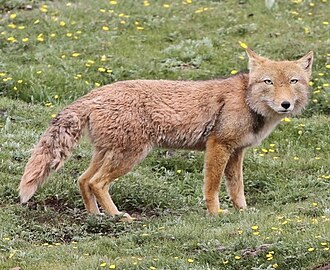
图:James Eaton · CC0 · Wikimedia Commons
- 学名
- Vulpes ferrilata
- 分类等级
- 种
- 英文名
- Tibetan fox
- 上级类群
- 狐属
- 大类
- 哺乳动物
- 命名
- 布赖恩·霍顿·霍奇森,1842 年
- 保护状况(IUCN)
- 无危物种
- 栖息地
- 灌丛、草原
- 数据库
- NCBI 分类 · GBIF · IUCN 红色名录
百科正文
特征
中型狐类,成年个体体长60至70厘米(24至28英寸),体重4至5.5千克(8.8至12.1磅),尾长29至40厘米(11至16英寸)。背部为棕黄色,两侧及尾巴为银灰或灰蓝色。尾部末端为白色,耳朵外侧为灰色,内部为白色
与其他狐属生物相比,它们的颅基长度更长,下颌齿、犬齿和臼齿也更长,因此更加适宜捕猎。
生境与习性
栖息于高原地带,喜独居。通常在旱獭的洞穴居住。主要捕食高原鼠兔,其次以野鼠、土拨鼠、高原兔、兔子、鸟类和蜥蜴为食。
以上内容摘自维基百科「藏狐」,按 CC BY-SA 4.0 使用,去掉了参考文献、外部链接等尾部小节,公式改写成了纯文本。全文、配图和出处见原文。
英文维基百科补充中文条目比较短,下面是英文条目「Tibetan fox」的原文
The Tibetan fox (Vulpes ferrilata), also known as the Tibetan sand fox, is a species of true fox endemic to the high Tibetan Plateau and Bhutan, China, India and Nepal up to elevations of about 5,300 m (17,400 ft). It is listed as Least Concern in the IUCN Red List, on account of its widespread range in the Tibetan Plateau's steppes and semi-deserts.
Characteristics
The Tibetan fox has a soft and dense rufous coloured coat from the crown, neck, back to the lower legs. Its muzzle is narrow, its cheeks, flanks, upper legs and rumps are grey, and its bushy tail has white tips. The short ears are tan to greyish tan on the back, while the insides and undersides are white. Adult Tibetan foxes are 60 to 70 cm (24 to 28 in), not including tail, and have tail lengths of 29 to 40 cm (11 to 16 in). Weights of adults are usually 4 to 5.5 kg (8.8 to 12.1 lb).
Among the true foxes, its skull is the most specialised in the direction of carnivory; it is longer in the condylobasal length, and in mandible and cheek tooth length, than those of hill foxes. Its cranial region is shorter than that of hill foxes, and the zygomatic arches narrower. Its jaws are also much narrower, and the forehead concave. Its canine teeth are also much longer than those of hill foxes.
Taxonomy
Tibetan fox is one of 12 extant Vulpes species and a member of the family Canidae. The cladogram below is based on the phylogeny of Lindblad-Toh (2005) modified to incorporate recent findings on Vulpes.
Distribution and habitat
The Tibetan fox is restricted to the Tibetan Plateau in western China and the Ladakh plateau and Sikkim in India. It occurs north of the Himalayas in the northernmost border regions of Nepal and India, across Tibet, and in parts of the Chinese provinces of Qinghai, Gansu, Xinjiang, Yunnan and Sichuan. It primarily inhabits semi-arid to arid grasslands, well away from humans or from heavy vegetation cover. It lives in upland plains and hills from 3,500 to 5,200 m (11,500 to 17,100 ft) elevation, and has occasionally been sighted at elevations of around 2,500 m (8,200 ft).
Due to the generalized nature of the Tibetan fox, its distribution has been greatly affected by climate change. Due to the rising temperatures of the Tibetan Plateau, its suitable habitat has shifted towards higher elevations on the plateau. This has caused its range to further overlap with the red fox (Vulpes vulpes) and increased the competition between the two species.
Behaviour and ecology
The Tibetan fox primarily preys on plateau pikas, followed by rodents, marmots, woolly hares, rabbits, small ground birds and lizards. It also scavenges on the carcasses of Tibetan antelopes, musk deer, blue sheep and livestock. Tibetan foxes are mostly solitary, daytime hunters as their main prey, pikas, are diurnal. Tibetan foxes may form commensal relationships with brown bears during hunts for pikas. The bears dig out the pikas, and the foxes grab them when they escape the bears.
Mated pairs remain together and may also hunt together. After a gestation period of about 50 to 60 days, two to four young are born in a den, and stay with the parents until they are eight to ten months old. Their burrows are made at the base of boulders, at old beach lines and low slopes. Dens may have four entrances, with entrances being 25–35 cm (9.8–13.8 in) in diameter.
Diseases and parasites
Tibetan foxes in the Sêrxü County of China's Sichuan province are heavily infected with Echinococcus, while foxes in western Sichuan are definitive hosts of alveolar hydatid disease.
以上内容摘自英文维基百科「Tibetan fox」,按 CC BY-SA 4.0 使用,去掉了参考文献、外部链接等尾部小节,公式改写成了纯文本。全文、配图和出处见原文。