 格物
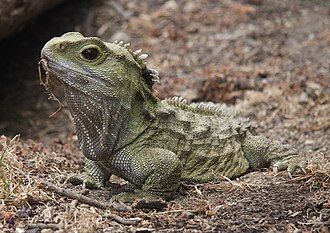
图:No machine-readable author provided. Knutschie assumed (base… · Public domain · Wikimedia Commons
- 学名
- Sauropsida
- 上级类群
- 羊膜动物
- 大类
- 爬行动物
- 命名
- 托马斯·亨利·赫胥黎,1864 年
- 数据库
- NCBI 分类
下级类群(3)
百科正文
相比之下,爬行纲(Reptilia)的旧定义未包含鸟类,但却包括了合弓纲的兽孔目,即所谓的“似哺乳爬行动物”,包括了哺乳动物的直系祖先和远亲,这种定义下的“爬行纲”其实是个多系群。有些分类学者会因此用蜥形纲来替代爬行纲,使其定义属于并系群;但也有学者重新定义爬行纲,使之成为与蜥形纲同义的单系群,于是蜥形纲在这情况下会成为爬行纲的次异名。
以上内容摘自维基百科「蜥形纲」,按 CC BY-SA 4.0 使用,去掉了参考文献、外部链接等尾部小节,公式改写成了纯文本。全文、配图和出处见原文。
英文维基百科补充中文条目比较短,下面是英文条目「Sauropsida」的原文
Sauropsida (Greek for "lizard faces") is a clade of amniotes, broadly equivalent to the class Reptilia, though typically used in a broader sense to also include extinct stem-group relatives of modern non-avian reptiles and birds (which, as theropod dinosaurs, are nested within reptiles as more closely related to crocodilians than to lizards or turtles). The most popular definition states that Sauropsida is the sibling taxon to Synapsida, the other clade of amniotes which includes mammals as its only modern representatives. Although early synapsids have historically been referred to as "mammal-like reptiles", all synapsids are more closely related to mammals than to any modern reptile. Sauropsids, on the other hand, include all amniotes more closely related to modern reptiles than to mammals. This includes Aves (birds), which are a group of theropod dinosaurs despite originally being named as a separate class in Linnaean taxonomy.
The base of Sauropsida is traditionally divided into main groups of "reptiles": Eureptilia ("true reptiles") and Parareptilia ("next to reptiles"). Eureptilia encompasses all living reptiles (including birds), as well as various extinct groups. Parareptilia is typically considered to be an entirely extinct group, though a few hypotheses for the origin of turtles have suggested that they belong to the parareptiles. The clades Recumbirostra and Varanopidae, traditionally thought to be lepospondyls and synapsids respectively, may also be basal sauropsids. The term "Sauropsida" originated in 1864 with Thomas Henry Huxley, who grouped birds with reptiles based on fossil evidence. The divisions of "Eureptilia" and "Parareptilia" have been challenged in a number of recent studies, who find that they do not represent monophyletic groups.
During the Permian, sauropsids were predominately small, although some pareiasaurian parareptiles weighed over 1,000 kg (2,200 lb), approaching the size of the largest dinocephalians. Following the Permian-Triassic extinction event, sauropsids would come to replace synapsids as the dominant group of tetrapods. During the Mesozoic, they diversified in marine, aerial, and terrestrial ecosystems. Sauropsids suffered a decline in diversity following the Cretaceous-Paleogene extinction event, which saw the extinction of all non-avian dinosaurs, pterosaurs, and marine reptiles such as mosasaurs and plesiosaurs.
Following the K-Pg extinction, mammals, the only living group of synapsids diversified and filled the niches left vacant following the extinction of the dinosaurs. Despite this, the remaining sauropsids also diversified, with sauropsids making up roughly 20,000 species, over twice the number of mammals, which have roughly 6,800 species.
以上节选摘自英文维基百科「Sauropsida」,按 CC BY-SA 4.0 使用,去掉了参考文献、外部链接等尾部小节,公式改写成了纯文本。篇幅所限,较长的小节只摘了开头一部分,有的小节没有收;全文、配图和出处见原文。