 格物
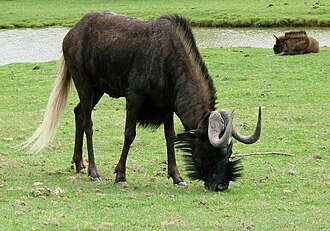
图:Vassil · Public domain · Wikimedia Commons
- 学名
- Connochaetes gnou
- 分类等级
- 种
- 英文名
- Black wildebeest
- 上级类群
- 角马
- 大类
- 哺乳动物
- 命名
- 埃伯哈德·奥古斯特·威廉·冯·齐默尔曼,1780 年
- 保护状况(IUCN)
- 无危物种
- 数据库
- NCBI 分类 · GBIF · IUCN 红色名录
百科正文
英文维基百科补充中文条目比较短,下面是英文条目「Black wildebeest」的原文
The black wildebeest or white-tailed gnu (Connochaetes gnou) is one of the two closely related wildebeest species. It is a member of the genus Connochaetes and family Bovidae. It was first described in 1780 by Eberhard August Wilhelm von Zimmermann. The black wildebeest is typically 1.7–2.2 m (5 ft 7 in – 7 ft 3 in) in head-and-body length, and the typical weight is 110–180 kg (240–400 lb). Males stand about 1.11–1.21 m (3 ft 8 in – 4 ft 0 in) at the shoulder, while the height of the females is 1.06–1.16 m (3 ft 6 in – 3 ft 10 in). The black wildebeest is characterised by its white, long, horse-like tail. It also has a dark brown to black coat and long, dark-coloured hair between its forelegs and under its belly.
The black wildebeest is an herbivore, and almost the whole diet consists of grasses. Water is an essential requirement. The three distinct social groups are the female herds, the bachelor herds, and the territorial bulls. They are fast runners and communicate using a variety of visual and vocal communications. The primary breeding season for the black wildebeest is from February to April. A single calf is usually born after a gestational period of about 8.5 months. The calf remains with its mother until her next calf is born a year later. The black wildebeest inhabits open plains, grasslands, and karoo shrublands.
The natural populations of black wildebeest, endemic in the southern part of Africa, were almost completely exterminated in the 19th century, due to their reputation as pests and the value of their hides and meat, but the species has been reintroduced widely from captive specimens, both in private areas and nature reserves throughout most of Lesotho, Eswatini, and South Africa. The species has also been introduced outside its natural range in Namibia and Kenya.
以上节选摘自英文维基百科「Black wildebeest」,按 CC BY-SA 4.0 使用,去掉了参考文献、外部链接等尾部小节,公式改写成了纯文本。篇幅所限,较长的小节只摘了开头一部分,有的小节没有收;全文、配图和出处见原文。