 格物
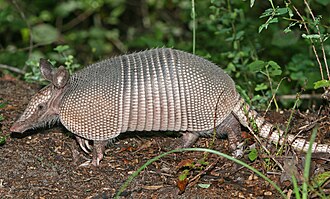
图:http://www.birdphotos.com · CC BY 3.0 · Wikimedia Commons
- 学名
- Dasypus novemcinctus
- 分类等级
- 种
- 英文名
- nine-banded armadillo
- 上级类群
- 犰狳属
- 大类
- 哺乳动物
- 命名
- 卡尔·林奈,1758 年
- 保护状况(IUCN)
- 无危物种
- 异名
- Dasypus novemcinctus novemcinctus
- 数据库
- NCBI 分类 · GBIF · IUCN 红色名录
百科正文
九带犰狳是独行及主要夜间活动的动物,在很多地方都可以见到它们,如雨林及草原。它们是吃昆虫的,主要吃蚁、白蚁及其他细小的无脊椎动物。
九带犰狳可以令其肠脏膨涨,方便渡河。它们亦可以闭气达6分钟,经底部穿过河流。每胎生产四只幼犰狳。九带犰狳若被惊吓,可以跳起达90-120厘米。
在美国内的分布
九带犰狳广泛分布在美国的东部及北部。它们于20世纪从墨西哥经过格兰德河,直至1995年在德克萨斯州、奥克拉荷马州、路易斯安那州、阿肯色州、密西西比州、阿拉巴马州及科罗拉多州都很普遍,而在堪萨斯州、密苏里州、田纳西州、乔治亚州及南卡罗莱纳州亦曾见其踪迹。十年后,九带犰狳继续它们的迁徙,远至内布拉斯加州南部、伊利诺伊州南部及肯塔基州西部都有其踪影。
九带犰狳的扩展主要是因没有或很少有天然的掠食者,并仰赖于自身的高繁殖率。有指它们会继续向北扩展,直至抵达俄亥俄州、宾夕法尼亚州及新泽西州,并沿美国东岸南下。向更北及西部的地区扩展则会因九带犰狳不能抵御寒冷天气而受到限制。
以上内容摘自维基百科「九帶犰狳」,按 CC BY-SA 4.0 使用,去掉了参考文献、外部链接等尾部小节,公式改写成了纯文本。全文、配图和出处见原文。
英文维基百科补充中文条目比较短,下面是英文条目「Nine-banded armadillo」的原文
The nine-banded armadillo (Dasypus novemcinctus), also called the nine-banded long-nosed armadillo or common armadillo, is a species of armadillo native to South America. The Mexican long-nosed armadillo of North America was formerly treated as a subspecies of the nine-banded armadillo.
The nine-banded armadillo is a solitary, mainly nocturnal animal, found in many kinds of habitats, from mature and secondary rainforests to grassland and dry scrub. It is an insectivore, feeding chiefly on ants, termites, and other small invertebrates. The armadillo can jump 91–120 cm (3–4 ft) straight in the air if sufficiently frightened, making it a particular danger on roads.
Subspecies
- D. n. aequatorialis Lönnberg, 1913
- D. n. fenestratus Peters, 1864
- D. n. hoplites Allen, 1911
- D. n. mexianae (Hagmann, 1908)
- D. n. novemcinctus Linnaeus, 1758
Description
Nine-banded armadillos generally weigh from 2.5–6.5 kg (5.5–14.3 lb), though the largest specimens can scale up to 10 kg (22 lb). They are one of the largest species of armadillos. Head and body length is 38–58 cm (15–23 in), which combines with the 26–53 cm (10–21 in) tail, for a total length of 64–107 cm (25–42 in). They stand 15–25 cm (5.9–9.8 in) tall at the top of the shell. The outer shell is composed of ossified dermal scutes covered by nonoverlapping, keratinized epidermal scales, which are connected by flexible bands of skin.
Habitat
The nine-banded armadillo evolved in a warm, rainy environment, and is still most commonly found in regions resembling its ancestral home. As a very adaptable animal, though, it can also be found in scrublands, open prairies, and tropical rainforests. It cannot thrive in particularly cold or dry environments, as its large surface area, which is not well insulated by fat, makes it especially susceptible to heat and water loss.
Range
The nine-banded armadillo ranges through most of South America except for the Guiana Shield area where the Guianan long-nosed armadillo Dasypus guianensis, a new species of armadillo officially described in June 2024, exists.
Diet
Nine-banded armadillos are generally insectivores. They forage for meals by thrusting their snouts into loose soil and leaf litter and frantically digging in erratic patterns, stopping occasionally to dig up grubs, beetles (perhaps the main portion of this species' prey selection), ants, termites, grasshoppers, other insects, millipedes, centipedes, arachnids, worms, and other terrestrial invertebrates, which their sensitive noses can detect through 8 in (20 cm) of soil. They then lap up the insects with their sticky tongues.
Behavior
Nine-banded armadillos are solitary, largely nocturnal animals that come out to forage around dusk. They are extensive burrowers, with a single animal sometimes maintaining up to 12 burrows on its range. These burrows are roughly 20 cm (8 in) wide, 210 cm (7 ft) deep, and 760 cm (25 ft) long. Armadillos mark their territory with urine, feces, and excretions from scent glands found on the eyelids, nose, and feet. Males hold breeding territories and may become aggressive in order to keep other males out of their home range to increase chances of pairing with a female.
Reproduction
Mating takes place during a two-to-three month long mating season, which occurs from November–January. A single egg is fertilized and develops into a blastocyst, but implantation is delayed for three to four months to ensure the young will not be born during an unfavorable time. Once the blastocyst does implant in the uterus it splits into four identical embryos via collapse of the common amnion and subsequent division of the embryonic shield. Each of the four embryos has a separate amnion and umbilical cord, but all four are attached to a common placenta. The gestation period is four months.
Effect on the environment
The foraging of nine-banded armadillo can cause mild damage to the root systems of certain plants. Skunks, cotton rats, burrowing owls, and rattlesnakes can be found living in abandoned armadillo burrows.
They are typically hunted for their meat, which is said to taste like pork, but are more frequently killed as a result of their tendency to steal the eggs of poultry and game birds. This has caused certain populations of the nine-banded armadillo to become threatened, although the species as a whole is under no immediate threat.
以上节选摘自英文维基百科「Nine-banded armadillo」,按 CC BY-SA 4.0 使用,去掉了参考文献、外部链接等尾部小节,公式改写成了纯文本。篇幅所限,较长的小节只摘了开头一部分,有的小节没有收;全文、配图和出处见原文。