 格物
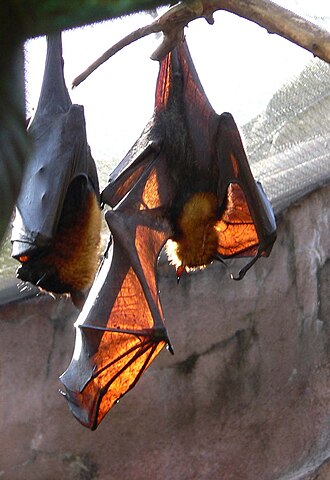
图:user:Raul654 · CC BY-SA 3.0 · Wikimedia Commons
- 学名
- Pteropus vampyrus
- 分类等级
- 种
- 上级类群
- 狐蝠属
- 大类
- 哺乳动物
- 命名
- 卡尔·林奈,1758 年
- 保护状况(IUCN)
- 濒危 (保育状况)
- 数据库
- NCBI 分类 · GBIF · IUCN 红色名录
百科正文
英文维基百科补充中文条目比较短,下面是英文条目「Large flying fox」的原文
The large flying fox (Pteropus vampyrus), also known as the greater flying fox, Malayan flying fox, Malaysian flying fox, large fruit bat, kalang, or kalong, is a southeast Asian species of megabat in the family Pteropodidae. Despite its scientific name, it feeds exclusively on fruits, nectar, and flowers, like the other flying foxes of the genus Pteropus. It is noted for being one of the largest bats. As with nearly all other Old World fruit bats, it lacks the ability to echolocate but compensates for it with well-developed eyesight.
Taxonomy
The large flying fox was one of the many mammal species originally described by Carl Linnaeus in the landmark 1758 10th edition of his Systema Naturae, receiving the name Vespertilio vampyrus. The holotype was collected on Java. Its species name "vampyrus" is derived from Slavic "wampir" meaning "blood-sucking ghost or demon: vampire". This name was chosen in reference to its "alleged blood-sucking habits", although it is entirely vegetarian and largely frugivorous.
Description
The large flying fox is among the largest species of bat. It weighs 0.65–1.1 kg (1.4–2.4 lb) and has a wingspan of up to 1.5 m (4 ft 11 in). Its head-body length is 27–32 cm (11–13 in). Its forearm length is 180–220 mm (7.1–8.7 in). As is common with most megabats, it has a fox-like face. It lacks a tail and has pointed ears. The hairs on much of its body are long and woolly, but are shorter and more erect on the upper back. The mantle hairs tend to be the longest. The color and texture of the coat differ between sexes and age classes.
Biology and ecology
This species primarily feeds on flowers, nectar and fruit. When all three food items are available, flowers and nectar are preferred. The pollen, nectar, and flower of coconut and durian trees, as well as the fruits of rambutan, fig and langsat trees, are consumed. Flying foxes will also eat mangoes and bananas. With fruit, the flying fox prefers the pulp, and slices open the rind to get it. With durian tree flowers, the flying fox can lick up the nectar without doing apparent damage to the flower.
Behavior and life history
Colonies of large flying foxes fly in a scattered stream. They may fly up to 50 km (31 mi) to their feeding grounds in one night. Vocalizations are not made during flight. Large flocks fuse into family or feeding groups upon arrival at feeding grounds. Flying foxes may circle a fruit tree before landing, and usually land on the tips of branches in an upright position, then fall into a head-down position from which they feed. Feeding aggregations tend to be very noisy.
Range and habitat
The large flying fox ranges from Malay Peninsula, to the Philippines in the east and Indonesian Archipelago of Sumatra, Java, Borneo and Timor in the south. In certain areas, the bat prefers coastal regions, but it can also be found at elevations up to 1,370 m (4,490 ft).
Flying foxes inhabit primary forest, mangrove forest, coconut groves, mixed fruit orchards, and a number of other habitats. During the day, trees in mangrove forests and coconut groves may be used as roosts. In Malaysia, flying foxes prefer lowland habitats below 365 m.
Relationship to humans
The large flying fox is hunted for bushmeat. In Peninsular Malaysia, 1,756 hunting licenses were issued for the large flying fox from 2002–2006. In total, these hunting licenses permitted the hunting of 87,800 large flying foxes, or about 22,000 each year. Based on population modeling, the loss of the estimated 22,000 large flying foxes annually is unlikely to be sustainable. A 2009 study predicted extinction of the Peninsular Malaysian population within 6–81 years if 22,000 individuals are lost to hunting each year.
Conservation
As of 2022, the large flying fox is evaluated as an endangered species by the International Union for Conservation of Nature. It meets the criteria for this designation because it is likely experiencing significant population decline. The bushmeat trade is resulting in unsustainable harvest of this species. Additionally, it is experiencing habitat loss through deforestation.
The large flying fox is on Appendix II of CITES, which restricts international trade.
以上节选摘自英文维基百科「Large flying fox」,按 CC BY-SA 4.0 使用,去掉了参考文献、外部链接等尾部小节,公式改写成了纯文本。篇幅所限,较长的小节只摘了开头一部分,有的小节没有收;全文、配图和出处见原文。