 格物
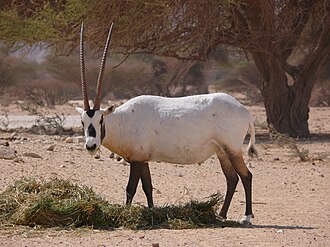
图:MathKnight · CC BY-SA 3.0 · Wikimedia Commons
- 学名
- Oryx
- 分类等级
- 属
- 上级类群
- 马羚亚科
- 大类
- 哺乳动物
- 命名
- 亨利·马里·迪克罗泰·德·布兰维尔,1816 年
- 数据库
- NCBI 分类 · GBIF
下级类群(4)


百科正文
字源
属名“Oryx”来自希腊语“Ὂρυξ”,指一种羚羊,字义上为镐。
种
- 阿拉伯剑羚
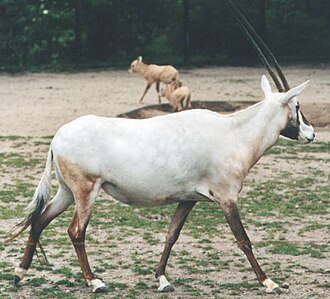
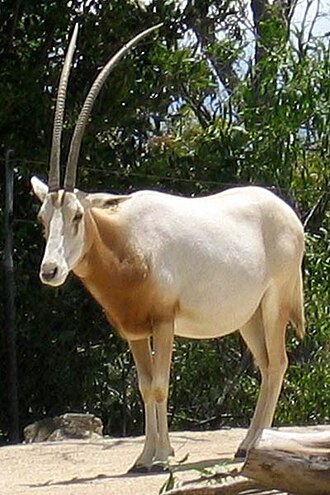
- 弯角剑羚
- 东非剑羚
- 南非剑羚
以上内容摘自维基百科「劍羚」,按 CC BY-SA 4.0 使用,去掉了参考文献、外部链接等尾部小节,公式改写成了纯文本。全文、配图和出处见原文。
英文维基百科补充中文条目比较短,下面是英文条目「Oryx」的原文
Oryx ( ORR-iks) is a genus consisting of four large antelope species called oryxes. Their pelage is pale with contrasting dark markings in the face and on the legs, and their long horns are almost straight and annulated. The exception is the scimitar oryx, which lacks dark markings on the legs, only has faint dark markings on the head, has an ochre neck, and has horns that are clearly decurved. All oryx species prefer near-desert conditions and can survive without water for long periods.
The Arabian oryx was only saved from extinction through a captive-breeding program and reintroduction to the wild. The scimitar oryx, which was listed as extinct in the wild, also relied on a captive-breeding program for its survival.
Etymology
The term "oryx" comes from the Greek word ὄρυξ óryx meaning "pickaxe", because its long and pointed horns look similar to the tool's end. The Greek plural form is ὄρυγες óryges, although "oryxes" has been established in English. Herodotus mentions a type of gazelle in Libya called ὄρυς, orus, probably related to the verb ὀρύσσω, orussō, or ὀρύττω, oruttō, meaning "to dig". White oryxes are known to dig holes in the sand.
Species
Arabian oryx
The Arabian oryx (Oryx leucoryx, Arabic: المها), became extinct in the wild in 1972 in the Arabian Peninsula. It was reintroduced in 1982 in Oman, but poaching has reduced its numbers there. One of the largest populations of Arabian oryxes exists on Sir Bani Yas Island in the United Arab Emirates. Additional populations have been reintroduced in Qatar, Bahrain, Israel, Jordan, and Saudi Arabia. As of 2011, the total wild population is over 1,000, and 6,000–7,000 are being held in captivity. In 2011, the IUCN downgraded its threat category from extinct in the wild to vulnerable, the first species to have changed back in this way.
Scimitar oryx
The scimitar oryx, also called the scimitar-horned oryx (Oryx dammah), of North Africa used to be listed as extinct in the wild, but it is now declared as endangered. Unconfirmed surviving populations have been reported in central Niger and Chad, and a semi-wild population currently inhabiting a fenced nature reserve in Tunisia is being expanded for reintroduction to the wild in that country. Several thousand are held in captivity around the world.
Classification
- Family Bovidae
- Subfamily Hippotraginae
- Genus Oryx
- Scimitar oryx, O. dammah
- Gemsbok, O. gazella
- East African oryx, O. beisa (formerly in O. gazella)
- Common beisa oryx, O. b. beisa
- Fringe-eared oryx, O. b. callotis
- Arabian oryx, O. leucoryx
Ecology
They live in herds of up to 600 animals. Newborn calves are able to run with the herd immediately after birth. Both males and females possess permanent horns. The horns are narrow and straight except in the scimitar oryx, where they curve backwards like a scimitar. The horns can be lethal: oryxes have been known to kill lions with them, and they are thus sometimes called sabre antelopes (not to be confused with the sable antelope). The horns also make the animals a prized game trophy, which has led to the near-extinction of the two northern species.
As an introduced species
Between 1969 and 1977, the New Mexico Department of Game and Fish in the US intentionally released 95 gemsbok into its state's White Sands Missile Range and that population is now estimated between 3,000 and 6,000 animals. Within the state of New Mexico, oryxes are classified as "big game" and can be hunted.
Oryxes in popular culture
The oryx is the national animal of Namibia and Qatar. Qatar's airline company Qatar Airways has an oryx as its logo.
The main boss of the MMO game Realm of the Mad God is Oryx the Mad God, named after the creator of the original sprite sheets, Oryx. His four direct subordinates also bear the names of four South African species of oryx.
Oryxes appear briefly, along with many other species of animal, in the Talk Talk music video It's My Life.
In the video game Tom Clancy's Rainbow Six Siege, a playable defending operator nicknamed Oryx was introduced in Year 5 Season 1. His ability is called "Remah Dash," where he can charge to break holes in walls and knock down enemies.
Oryx is a nickname for a character in Margaret Atwood's book Oryx and Crake.
Oryx is also the main antagonist's name in the video game Destiny: The Taken King, a god who seeks vengeance on the player, known as a Guardian, after they killed his son Crota. He is killed by the player in the raid "King's Fall". He is portrayed as "Oryx, the Taken King".
以上节选摘自英文维基百科「Oryx」,按 CC BY-SA 4.0 使用,去掉了参考文献、外部链接等尾部小节,公式改写成了纯文本。篇幅所限,较长的小节只摘了开头一部分,有的小节没有收;全文、配图和出处见原文。