格物
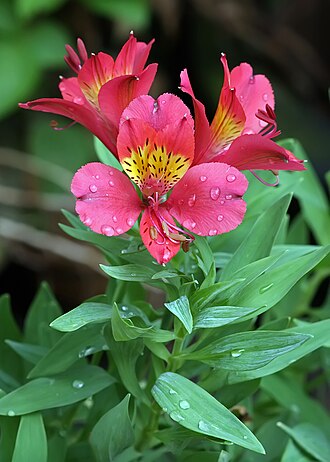
图:Muhammad Mahdi Karim · GFDL 1.2 · Wikimedia Commons
- 学名
- Alstroemeriaceae
- 分类等级
- 科
- 上级类群
- 百合目
- 大类
- 被子植物
- 命名
- 巴泰勒米·夏尔·约瑟夫·杜莫蒂尔,1829 年
- 异名
- 菝葜木科
- 数据库
- NCBI 分类 · GBIF
百科正文
本科为多年生草本植物,多具类似球茎的地下的膨大营养器官,其中竹叶吊钟属为藤本植物。本科植物花色美丽,被广泛用于栽培观赏。
- 属
- 六出花属 Alstroemeria
- 竹叶吊钟属 Bomarea,也称百合水仙属
- 狮爪花属 Leontochir
- Schickendantzia(部分植物学家将其和六出花属合并)
以上内容摘自维基百科「六出花科」,按 CC BY-SA 4.0 使用,去掉了参考文献、外部链接等尾部小节,公式改写成了纯文本。全文、配图和出处见原文。
英文维基百科补充中文条目比较短,下面是英文条目「Alstroemeriaceae」的原文
Alstroemeriaceae is a family of flowering plants, with 254 known species in four genera, almost entirely native to the Americas, from Central America to southern South America. One species of Luzuriaga occurs in New Zealand, and the genus Drymophila is endemic to south-eastern Australia.
The genus Alstroemeria, commonly called the Peruvian lilies, is popular florist's and garden flower. The genus Bomarea is a vine that produces clusters of variously-colored, bell-shaped flowers.
Classification
The APG II system, of 2003 (unchanged from the APG system, of 1998), treats the family in the order Liliales, in the clade monocots. The APG III system, of 2009, merged the obscure family Luzuriagaceae into the Alstroemeriaceae, since the former group included only two genera, was the sister group of the Alstroemeriaceae, and possessed the same distinctive twisted petioles.
Distribution
Alstroemeriaceae is distributed in tropical and temperate America, from Mexico and the Antilles to Tierra del Fuego. Luzuriageae is distributed from Peru to the Falkland Islands and Tierra del Fuego, New Zealand and Australia (NSW to Tasmania).
Uses
As food
Bomarea edulis is distributed from Mexico to Argentina. Its tubers have been used from pre-Columbian times as a food source. A single plant can have up to 20 tubers each 5 cm in diameter.
As ornamental plants
Some of the Alstroemeriaceae species used for ornamental purposes are:
Alstroemeria aurea: endemic to Southern Chile. Flowers in the summer. Flowers are 3–4 cm in diameter, they're yellow and orange, tinged with green.
Alstroemeria haemantha: endemic to Chile, especially near Valparaíso. It grown near rocks and flowers at the beginning of summer. It has red flowers that can grow up to 5 cm in diameter.
Alstroemeria ligtu: endemic to Chile, it grows in stoney, sand, dry soil. It flowers at the end of spring and the beginning of summer and has a height of 60 cm–1 m. Its flowers present several colours, usually lilac and pink, red or white.
Alstroemeria psittacina: distributed in the Brazilian swamp, Peru and the Misiones Province in Argentina. Its flowers have a length of 4–5 cm, and grow in bunches of 5 to 6 flowers. Its petals are red and green.
Bomarea ovallei (syn.: Leontochir ovallei): endemic to Chile, grows in stoney soil in full sunlight in the 3rd Region of Chile. It has red flowers, which can also be yellow, although rarely. They can have a diameter of up to 10 cm. It is an endangered species due to its modest distribution and its use as food by wild animals.
Other species, such as Luzuriaga radicans, also endemic to Chile, have potential as ornamental plants.
以上内容摘自英文维基百科「Alstroemeriaceae」,按 CC BY-SA 4.0 使用,去掉了参考文献、外部链接等尾部小节,公式改写成了纯文本。全文、配图和出处见原文。