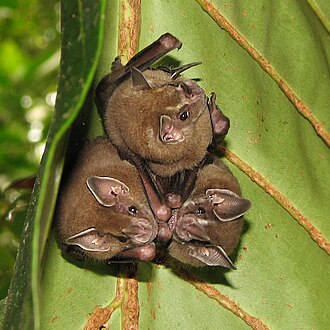
格物
- 学名
- Molossidae
- 分类等级
- 科
- 上级类群
- 翼手目
- 大类
- 哺乳动物
- 命名
- 保罗·热尔韦,1855 年
- 数据库
- NCBI 分类 · GBIF
下级类群(12)
百科正文
下级分类
- 本科包括以下属:
- 犬吻蝠亚科 Molossinae Gervais, 1856
- 非洲犬吻蝠属 Chaerephon Dobson, 1874
- 裸蝠属 Cheiromeles Horsfield, 1824
- Cynomops Thomas, 1920
- 真蝠属 Eumops Miller, 1906
- 加勒比海犬吻蝠属 Molossops Peters, 1866
- 獒蝠属 Molossus E. Geoffroy, 1805
- 马来犬吻蝠属 Mops Lesson, 1842
- 怪翼犬吻蝠属 Mormopterus Peters, 1865
- 蝇蝠属 Myopterus E. Geoffroy, 1818
- 美洲犬吻蝠属 Nyctinomops Miller, 1902
- 游尾蝠属 Otomops Thomas, 1913
- Platymops Thomas, 1906
- 穹腭蝠属 Promops Gervais, 1856
- Sauromys Roberts, 1917
- 犬吻蝠属 Tadarida Rafinesque, 1814
- 锥蝠亚科 Tomopeatinae Miller, 1907
- 锥蝠属 Tomopeas Miller, 1900
以上内容摘自维基百科「犬吻蝠科」,按 CC BY-SA 4.0 使用,去掉了参考文献、外部链接等尾部小节,公式改写成了纯文本。全文、配图和出处见原文。
英文维基百科补充中文条目比较短,下面是英文条目「Free-tailed bat」的原文
The Molossidae, or free-tailed bats, are a family of bats within the order Chiroptera.
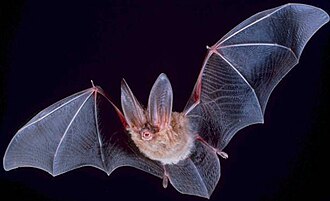
Molossidae is the fourth-largest family of bats, containing about 110 species as of 2012. They are generally quite robust, and consist of many strong-flying forms with relatively long and narrow wings with wrinkled lips shared through their genus. Their strong flying form allows them to fly 60 miles per hour using tail winds and at altitudes over 10,000 feet. This makes them unique among bats, as they are the only bat family that withstands the elevation. They are widespread, being found on every continent except Antarctica. They are typically found in caves, abandoned mines, or tunnels.
Common ancestry
The family's scientific name comes from the type genus Molossus, which in turn is from the Molossus breed of dogs.
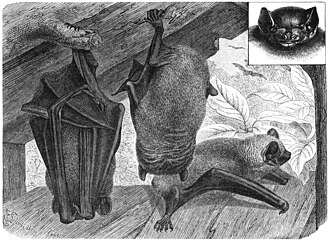
The family's common name is derived from a length of "free" tail, projecting beyond the end of the uropatagium—the membrane that connects the base of the tail to the hind legs.
Another common name for some members of this group, and indeed a few species from other families, is mastiff bat. The western mastiff bat (Eumops perotis), a large species from the Southwestern United States and Mexico, with wings over 0.5 m (1.6 ft) across, is perhaps one of the best-known with this name. They are widespread, being found on every continent except Antarctica.
Anatomy
The tail is usually best seen when resting. A special ring of cartilage slides up or down the tail vertebrae by muscular action to stretch or retract the tail membrane. This gives many species a degree of fine tuning in their flight maneuvers to rival their day-flying ecological equivalents, such as swifts, swallows, and martins. As a result, these animals include the fastest-flying of all bat species among their number. The dental formula of free-tailed bats varies between species: 1.1.1-2.2-31-3.1.2.3
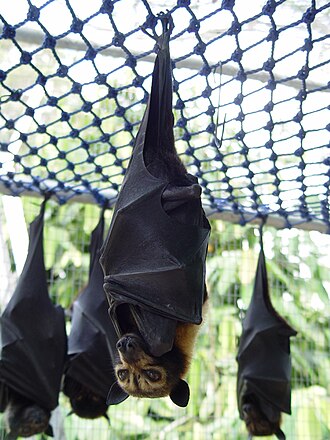
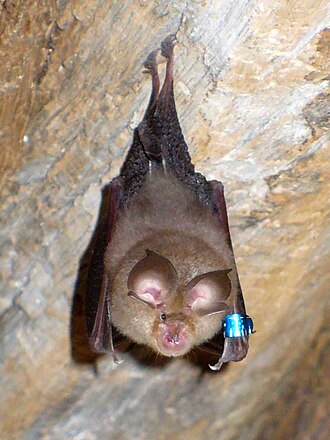
Free-tailed bats are usually grey, brown, or black in color, with some exceptions. They range from 4 to 12 cm (1.6 to 4.7 in) in length, excluding the tail, and can weigh from 8 to 220 g (0.28 to 7.76 oz), depending on species. They are insectivorous and catch their food on the wing. While some species roost in small groups in hollow trees or rocky crevices, some cave-dwelling species form vast colonies of up to 50 million individuals.
Molecular sequence data support the monophyly of the Molossidae as a whole, but not that of many of its genera, such as Chaerephon, Mops, Mormopterus, and Tadarida. The grouping of Chaerephon minus C. jobimena plus Mops was found to be monophyletic, as was Otomops.
Systematics
A 2012 study attempted to show the relationships of genera within the subfamily Molossinae (the other subfamily of Molossidae, Tomopeatinae, only contains the blunt-eared bat).
This study used genetic data to create a phylogeny, which contrasted from previous phylogenies constructed using morphological data.
Traits that were previously used to group species, such as having a flat skull, were shown to have no relation to evolutionary relationship, meaning that flat-headedness evolved multiple times within the family.
Of the 16 genera of Molossinae, 15 were used to create the phylogeny (left), with researchers unable to include Peters's flat-headed bat, the only member of Platymops.
The results of this study showed that Chaerephon is paraphyletic, forming a clade with Mops.
Support for Old World and New World clades was strong. While the genus Tadarida has one New World species, the Mexican free-tailed bat, the genus itself has its origins in the Old World. The most recent common ancestor of Tadarida with New World genera was 29 million years ago. Several tribes have been proposed within the Molossinae. Ammerman et al. proposed Molossini (containing Molossus, Eumops, Molossops, Cynomops, Neoplatymops, Nyctinomops, and Promops); Tadarini (containing Tadarida, Chaerephon, Mops, Platymops, Sauromys, Myopterus, and Otomops); Cheiromelini (containing Cheiromeles); and Mormopterini (containing Mormopterus)
Classification
- The 19 genera contain about 100 species:
- Family Mollosidae
- Genus †Cuvierimops
- Genus †Nyctinomus
- Genus †Petramops
- Genus †Potamops
- Genus †Rhizomops
- Genus †Wallia
- Subfamily Molossinae
- Genus Cabreramops – dog-faced bat
- Equatorial dog-faced bat, Cabreramops aequatorianus
- Genus Chaerephon – lesser mastiff bats
- Duke of Abruzzi's free-tailed bat, Chaerephon aloysiisabaudiae
- Ansorge's free-tailed bat, Chaerephon ansorgei
- Gland-tailed free-tailed bat, Chaerephon bemmeleni
- Spotted free-tailed bat, Chaerephon bivittata
以上节选摘自英文维基百科「Free-tailed bat」,按 CC BY-SA 4.0 使用,去掉了参考文献、外部链接等尾部小节,公式改写成了纯文本。篇幅所限,较长的小节只摘了开头一部分,有的小节没有收;全文、配图和出处见原文。