 格物
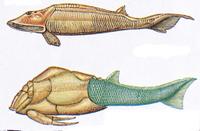
图:다음 글로벌 세계대백과 · CC BY-SA 3.0 · Wikimedia Commons
- 学名
- Ostracodermi
- 分类等级
- 纲
- 英文名
- Ostracoderm
- 上级类群
- 无颔总纲
- 大类
- 鱼类
百科正文
甲胄鱼是最先只使用鳃来呼吸,而不用来摄食的动物。所有其他之前的生物都是以鳃来同时呼吸及摄食的。它们的头两侧有另外的咽鳃囊,是开启而没有鳃盖。甲胄鱼不像其他的脊椎动物以纤毛来运送食物,而是以肌肉鳃囊来吸入细小的猎物。
自从有颔类(即现代鱼类)开始兴盛之后,无颔甲胄鱼的数量大幅下降,而最终在泥盆纪末期灭绝。
分类
甲胄鱼与圆口纲(包括八目鳗及盲鳗纲)一同被分类在无颔总纲之下。甲胄鱼这个分类现在已经很少使用。不过甲胄鱼亦是古生代有覆有甲板及没有下颚的鱼类的非正式名称。
- †鳍甲鱼纲 Pteraspidomorphi
- †阿兰达鱼亚纲 Arandaspida
- †异甲亚纲 Heterostracomorphi
- †花鳞鱼纲 Thelodonti
- †缺甲鱼纲 Anaspida
- †盔甲鱼纲 Galeaspida
- †茄甲鱼纲 Pituriaspida
- †骨甲鱼纲 Osteostraci
- 有颔类 Gnathostomata
以上内容摘自维基百科「甲冑魚」,按 CC BY-SA 4.0 使用,去掉了参考文献、外部链接等尾部小节,公式改写成了纯文本。全文、配图和出处见原文。
英文维基百科补充中文条目比较短,下面是英文条目「Ostracoderm」的原文
Ostracodermi (lit. 'shell-skins') or ostracoderms is an informal group of vertebrate animals that include all armored jawless fish of the Paleozoic Era. The term does not often appear in classifications today because it is paraphyletic (excluding jawed fishes and possibly the cyclostomes if anaspids are closer to them) and thus does not correspond to one evolutionary lineage. However, the term is still used as an informal way of loosely grouping together the armored jawless fishes.
An innovation of ostracoderms was the use of gills not for feeding, but exclusively for respiration. Earlier chordates with gill precursors used them for both respiration and feeding. Ostracoderms had separate pharyngeal gill pouches along the side of the head, which were permanently open with no protective operculum. Unlike invertebrates that use ciliated motion to move food, ostracoderms used their muscular pharynx to create a suction that pulled small and slow-moving prey into their mouths.
Swiss anatomist Louis Agassiz received some fossils of bony armored fish from Scotland in the 1830s,. He had difficulty classifying them, as they did not resemble any living creature. He compared them at first with extant armored fish such as catfish and sturgeon, but later realized that they lacked movable jaws. He classified them in the newly named genus Cephalaspis. In a later 1844 study he recognised that their anatomy was fundamentally very different from sturgeons and catfish and that they were not closely related. In 1889, Edward Drinker Cope erected the grouping Ostracodermi to house them meaning 'shell-skinned' (from Greek ὄστρακον óstrakon + δέρμα dérma).
Ostracoderm headshields are partially composed of enameloid.
It was long assumed that pteraspidomorphs and thelodonts were the only ostracoderms with paired nostrils, while the other groups have just a single median nostril. It has since been revealed that even if galeaspidans have just one external opening, it has two internal nasal organs.
Following their first appearance in the Ordovician-Silurian, ostracoderms reached their apex of diversity during the Early Devonian, subsequently declining afterwards during the Middle and Late Devonian, with the last species becoming extinct in the end-Devonian mass extinction. The decline of the ostracoderms corresponds with the emergence and diversification of jawed vertebrates, though the idea that the decline of ostracoderms was driven by direct competition with jawed fish has been questioned.
The Subclass Ostracodermi has been placed in the division Agnatha along with the extant Subclass Cyclostomata, which includes lampreys and hagfishes.
Phylogeny
Phylogeny of "ostracoderm" groups and other jawless fish after Reeves and colleagues (2023)
以上内容摘自英文维基百科「Ostracoderm」,按 CC BY-SA 4.0 使用,去掉了参考文献、外部链接等尾部小节,公式改写成了纯文本。全文、配图和出处见原文。