格物
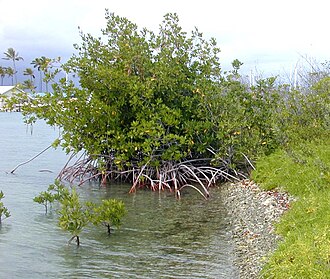
图:Marshman at English Wikipedia / Eric Guinther · CC BY-SA 3.0 · Wikimedia Commons
- 学名
- Rhizophoraceae
- 分类等级
- 科
- 上级类群
- 金虎尾目
- 大类
- 被子植物
- 命名
- 克里斯蒂安·亨德里克·佩尔松,1806 年
- 数据库
- NCBI 分类 · GBIF
下级类群(3)
百科正文
克朗奎斯特分类法单独分出一个红树目,只包括一科;APG分类法将其列入金虎尾目。
形态
单叶,交互对生,有早落的托叶,罕无托叶而互生。
花为两性,很少单性、杂性,单生、丛生于叶腋,或排成聚伞花序,裂片4~16,宿存;花瓣与萼裂片同数或为倍数;雄蕊位于花盘的外缘上,多与花瓣同数,与花瓣对生;花药4室,纵裂,或多室而瓣裂;子房下位或半下位,很少上位,2~6(8)室,有时因隔膜萎缩成1室,每室有下垂胚珠2或多数。
果革质,肉质,不开裂,稀为蒴果而开裂。
生长在海滩的红树果实在母树上发芽,幼苗长大坠落到海滩淤泥中生根,谓“胎生植物”,生长在山区的种类不能在母树上发芽,要依靠种子繁殖。
分类
- 本科18个属如下:
- 楝红树属 Anopyxis
- 睫瓣红树属 Blepharistemma
- 木榄属 Bruguiera
- Bruguieria
- 竹节树属Carallia
- 苏瓣红树属 Cassipourea
- 角果木属Ceriops
- 裂瓣红树属 Comiphyton
- 桃红树属 Crossostylis
- 谷红树属 Gynotroches
- 秋茄树属Kandelia
- 岛红树属 Macarisia
- 贴梗桐属 Paradrypetes
- 山红树属Pellacalyx
- 红树属Rhizophora
- 彩穗木属 Richea
- 叉瓣红树属 Sterigmapetalum
- 马岛红树属 Weihea
用途
红树科植物木质耐腐蚀,有些品种的木材可以用做水下建筑,树皮可以提炼丹宁酸。生长在海滩的红树林是沿海生态的重要组成部分,可以防护海滩不被海浪侵蚀。
以上内容摘自维基百科「红树科」,按 CC BY-SA 4.0 使用,去掉了参考文献、外部链接等尾部小节,公式改写成了纯文本。全文、配图和出处见原文。
英文维基百科补充中文条目比较短,下面是英文条目「Rhizophoraceae」的原文
The Rhizophoraceae is a family of tropical or subtropical flowering plants. It includes around 147 species distributed in 15 genera. Under the family, there are three tribes, Rhizophoreae, Gynotrocheae, and Macarisieae. Even though Rhizophoraceae is known for its mangrove members, only the genera under Rhizophoreae grow in the mangrove habitats and the remaining members live in inland forests.
Taxonomy
This family is now placed in the order Malpighiales, though under the Cronquist system, they formed an order in themselves (Rhizophorales). It is sister group to Erythroxylaceae. The sister group to the tribe Rhizophoreae is Gynotrocheae. The generic relationships within the Macarisiae are not fully resolved.
Within the mangrove tribe Rhizophoreae, there are four genera: Rhizophora, Kandelia, Ceriops, and Bruguiera. Bruguiera is the basal genus and Rhizophora the most derived genus in the tribe. Rhizophora is the only pan-tropical genus that is distributed along the intertidal zones of both the Indo-West Pacific (IWP) and Atlantic-East Pacific (AEP) regions. The remaining mangrove genera are restricted to the IWP region.
Genera
As of September 2024, Plants of the World Online accepted these genera:
Anopyxis (Pierre) Engl.
Blepharistemma Wall. ex Benth.
Bruguiera Lam. ex Savigny
Carallia Roxb.
Cassipourea Aubl.
Ceriops Arn.
Comiphyton Floret
Crossostylis J.R.Forst. & G.Forst.
Gynotroches Blume
Kandelia Wight & Arn.
Macarisia Thouars
Paradrypetes Kuhlm.
Pellacalyx Korth.
Rhizophora L.
Sterigmapetalum Kuhlm.
Morphological Characteristics
The tribe Macarisieae is characterized by a few plesiomorphies unknown in the rest of the family, such as superior ovary position, the presence of a seed appendage, and the absence of aerial roots.
Within Gynotrocheae, Crossostylis is morphologically distinct from other Gynotrocheae in having capsular fruits that split open at maturity and an appendage on a mature seed. In addition, Crossostylis possesses a multi-celled archesporium in ovules just like members in Macarisieae, while the archesporium is one-celled in the other Gynotrocheae.
Among Rhizophoreae, there are three distinctive characters known as the adaptive features to the mangrove habitats: viviparous embryogenesis, high salt tolerance and aerial roots.
Vivipary: The embryo of Rhizophoreae starts germination without dormancy. It grows out of the seed coat and the fruit while still remain attached to the parent plant. Although vivipary is found in other unrelated mangrove taxa such as Avicennia (Acanthaceae), Nypa (Arecaceae), and Pelliciera (Tetrameristaceae), they only break the seed coat but not the fruit wall before they split open. Vivipary in Rhizophoreae include several embryological characteristics: (1) the active growth of a hypocotyl meristem in the cotyledonary body, with endosperm overflow from the embryo sac. The growth of an endosperm can force open the micropyle, so that the embryo develops out of the integument. 2) The development of cotyledons as a cylindrical body.
Evolutionary history
The ancestor of Rhizophoraceae experienced two whole genome duplication events. The first duplication event corresponds to the triplication shared among angiosperms. The second duplication event was dated to ~74.6 million years ago (mya). Around 66 mya, the planet underwent the Cretaceous–Tertiary mass extinction. Then around 56.4 mya, the mangrove lineage diverged from its terrestrial relatives. The divergence happened to occur in the time frame with in the extreme global warming event, the Paleocene-Eocene Thermal Maximum (PETM). During this time period, there is a shift from a terrestrial to a marine, potentially anoxic, sedimentary depositional environment, suggesting a sea level rise. After the dramatic global warming period, the mangrove species within Rhizophoraceae diversified within 10 mya, which is relatively short in evolutionary sense. Although the sequence of the events does not suggest an absolute causal relationships between the former and the latter, a reasonable hypothesis for the diversification of Rhizophoraceae could be formulated: The second event of whole genome duplication increased the adaptability of the ancestor of Rhizophoraceae and chances of survival during the Cretaceous-Tertiary mass extinction by generating novel genetic materials for evolution to work on. During the PETM global warming period, the terrestrial ancestors of Rhizophoraceae living close to the shore were forced into the intertidal zone because of a large-scale sea-level rise.
以上节选摘自英文维基百科「Rhizophoraceae」,按 CC BY-SA 4.0 使用,去掉了参考文献、外部链接等尾部小节,公式改写成了纯文本。篇幅所限,较长的小节只摘了开头一部分,有的小节没有收;全文、配图和出处见原文。