 格物
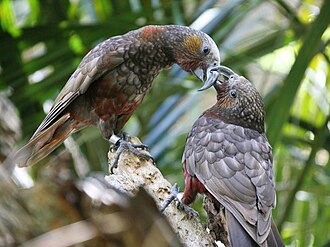
图:Small · CC BY-SA 2.0 · Wikimedia Commons
生命之树 › 真核生物 › 动物界 › 真后生动物亚界 › 两侧对称动物 › 后口动物总门 › 脊索动物门 › 脊椎动物亚门 › 有颌下门 › 肉鳍鱼总纲 › 四足形类 › 希望螈目 › 四足总纲 › 爬行动物 › 坚尾龙类 › 鸟纲 › 今鸟亚纲 › 今颚下纲 › 新鸟总目 › 鹦形目
鸮面鹦鹉科科
Strigopidae
鸮面鹦鹉科 是鸟纲鹦鹉目的一个科,现存2属3种,根据世界鸟类学家联合会的分类,本科是鸮面鹦鹉总科的唯一一科。包含鸮面鹦鹉属的鸮面鹦鹉及啄羊鹦鹉属的啄羊鹦鹉和白顶啄羊鹦鹉共三种。已灭绝的属Nelepsittacus也属于本科,与啄羊鹦鹉属近缘,已灭绝的大力神鹦鹉属分类地位有争议,可能也是本科的成员。所有现存物种均为新西兰特有物种。
摘自维基百科「鸮面鹦鹉科」,CC BY-SA 4.0
- 学名
- Strigopidae
- 分类等级
- 科
- 上级类群
- 鹦形目
- 大类
- 鸟类
- 命名
- 夏尔·吕西安·波拿巴,1849 年
- 数据库
- GBIF
百科正文
查塔姆啄羊鹦鹉和诺福克啄羊鹦鹉在现代灭绝,而Nelepsittacus则在1600万年前就已经灭绝。现存的全部3个物种都有种群下降甚至绝灭之虞。人类活动——包括入侵物种的引入和栖息地丧失等是它们灭绝及受威胁的主要原因。
本科与近缘类群在大约8200万年前,新西兰与冈瓦纳古陆分离时分开,鸮面鹦鹉属与啄羊鹦鹉属的祖先在6000到8000万年前分道扬镳。
以上内容摘自维基百科「鸮面鹦鹉科」,按 CC BY-SA 4.0 使用,去掉了参考文献、外部链接等尾部小节,公式改写成了纯文本。全文、配图和出处见原文。
英文维基百科补充中文条目比较短,下面是英文条目「New Zealand parrot」的原文
The New Zealand parrot family, Strigopidae, consists of at least three genera of parrots – Nestor, Strigops, the fossil Nelepsittacus, and probably the fossil Heracles. The genus Nestor consists of the kea, kākā, Norfolk kākā and Chatham kākā, while the genus Strigops contains the kākāpō. All extant species are endemic to New Zealand. The species of the genus Nelepsittacus were endemics of the main islands, while the two extinct species of the genus Nestor were found at the nearby oceanic islands such as Chatham Island of New Zealand, and Norfolk Island and adjacent Phillip Island.
The Norfolk kākā and the Chatham kākā have become extinct in recent times, while the species of the genus Nelepsittacus have been extinct for 16 million years. All extant species, the kākāpō, kea, and the two subspecies of the kākā, are threatened. Human activity caused the two extinctions and the decline of the other three species. Settlers introduced invasive species, such as pigs, cats, foxes, weasels, rats and possums, which eat the eggs of ground-nesting birds, and additional declines have been caused by hunting for food, killing as agricultural pests, habitat loss, and introduced wasps.
The family diverged from the other parrots around 82 million years ago when New Zealand broke off from Gondwana, while the ancestors of the genera Nestor and Strigops diverged from each other between 60 and 80 million years ago.
Systematics
No consensus existed regarding the taxonomy of Psittaciformes until recently. The placement of the Strigopoidea species has been variable in the past. The family belongs to its own superfamily Strigopoidea. This superfamily is one of three superfamilies in the order Psittaciformes; the other two families are Cacatuoidea (cockatoos) and Psittacoidea (true parrots).
Phylogeography
An unproven hypothesis for the phylogeography of this group has been proposed, providing an example of various speciation mechanisms at work. In this scenario, ancestors of this group became isolated from the remaining parrots when New Zealand broke away from Gondwana about 82 million years ago, resulting in a physical separation of the two groups. This mechanism is called allopatric speciation. Over time, ancestors of the two surviving genera, Nestor and Strigops, adapted to different ecological niches.
Species
Very little is known about the Chatham kākā. The genus Nelepsittacus consists of three described and one undescribed species recovered from early Miocene deposits in Otago. The genus Heracles consists of a giant species also described from the early Miocene of Otago.
Common names
All common names for species in this family are the same as the traditional Māori names. The Māori word kākā derives from the ancient Proto-Polynesian word meaning parrot. Kākāpō is a logical extension of that name, as pō means night, resulting in kākā of the night or night parrot, reflecting the species' nocturnal behaviour. (In modern orthography of the Māori language, the long versions of the vowels a and o are written with macrons; i.e., ā and ō. Note that a long ā in Maori should be pronounced like the a in English "father".
Ecology
The isolated location of New Zealand has made it difficult for mammals to reach the island. This is reflected in the absence of land mammals other than bats. The main predators were birds: harriers, falcons, owls, and the massive, extinct Haast's eagle. Many of the adaptations found in the avifauna reflect the unique context in which they evolved. This unique balance was disrupted with the arrival of the Polynesians, who introduced the Polynesian rat and the kurī (Polynesian dog) to the island.
Relationship with humans
Importance to the Māori
The parrots were important to the Māori in various ways. They hunted them for food, kept them as pets, and used their feathers in weaving such items as their kahu huruhuru (feather cloak). Feathers were also used to decorate the head of the taiaha, a Māori weapon, but were removed prior to battle. The skins of the kākāpō with the feathers attached were used to make cloaks (kākahu) and dress capes (kahu kākāpō), especially for the wives and daughters of chiefs.
以上节选摘自英文维基百科「New Zealand parrot」,按 CC BY-SA 4.0 使用,去掉了参考文献、外部链接等尾部小节,公式改写成了纯文本。篇幅所限,较长的小节只摘了开头一部分,有的小节没有收;全文、配图和出处见原文。