 格物
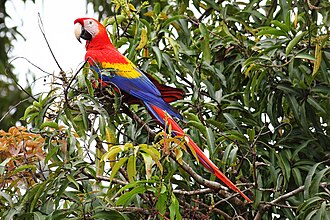
图:Benjamint444 · GFDL 1.2 · Wikimedia Commons
- 学名
- Psittacidae
- 分类等级
- 科
- 上级类群
- 鹦鹉总科
- 大类
- 鸟类
- 命名
- 约翰·卡尔·威廉·伊利格,1811 年
- 数据库
- NCBI 分类 · GBIF
下级类群(6)
百科正文
分布地区
虽然其名称被认为是分布于新大陆地区的鹦鹉,但实际上本科鸟类在非洲也有所分布,但都分布在热带或亚热带地区。包括墨西哥、中美洲、南美洲、加勒比海岛屿、撒哈拉以南的非洲。
演化
金刚鹦鹉科的起源据研究可能来自约6550万—5600年万前的古新世,当时冈瓦纳大陆西半部已逐渐分裂形成非洲和南美洲。
鹦鹉目的多样性据研究约始于4000万年前,即在澳大利亚自南极洲和南美洲西侧分离之后发生的。而所有鹦鹉的最后一个共同祖先约3300万年前,该祖先自存在于古新世时期的陆桥抵达南美洲及非洲,此后便逐渐辐射演化成各科的鹦鹉。
分类学
本科由法国生物学家康斯坦丁·萨米埃尔·拉菲内克-施马尔茨于1815年建立,虽然为自行出版的书籍,但该书中部分名称被国际动物命名法委员会所承认。
该科原本是一个囊括世界各地约330种鹦鹉的大型科,但在近期其地位有所变更。1997年的《世界鸟类手册》中,除了凤头鹦鹉科之外的所有鹦鹉都被内入此分类下,但已经承认其下部分物种与当时仍未升格为一个亚科的金刚鹦鹉族呈姊妹关系。自2012年起被建议分为三科:分别是金刚鹦鹉科、鹦鹉科及Psittrichasiidae科。但世界鸟类学家联合会在随后的更新并不承认Psittrichasiidae科,并将其并入了鹦鹉科内。
整个金刚鹦鹉科共有37个属及179个物种在内,但当中已有4个物种(包含古巴红鹦鹉、蓝绿金刚鹦鹉、卡罗莱纳长尾鹦鹉及波多黎各鹦哥)被认为已经绝灭,故现存175个物种。但据2023年的分子研究指出现有部分属的分类并非单系,并建议了数个新属。
以上内容摘自维基百科「金刚鹦鹉科」,按 CC BY-SA 4.0 使用,去掉了参考文献、外部链接等尾部小节,公式改写成了纯文本。全文、配图和出处见原文。
英文维基百科补充中文条目比较短,下面是英文条目「Psittacidae」的原文
The family Psittacidae or holotropical parrots is one of three families of true parrots. It comprises the 12 species of subfamily Psittacinae (the Afrotropical parrots) and 167 of subfamily Arinae (the New World or Neotropical parrots) including several species that have gone extinct in recent centuries. Some of the most iconic birds in the world are represented here, such as the blue-and-yellow macaw among the New World parrots and the grey parrot among the Afrotropical parrots.
Distribution
All of the parrot species in this family are found in tropical and subtropical zones and inhabit Mexico, Central and South America, the Caribbean islands, and sub-Saharan Africa. Three parrots, one extinct and another extirpated, once inhabited the United States.
Evolutionary history
This family probably had its origin early in the Paleogene period, 66–23 million years ago (Mya), after the western half of Gondwana had separated into the continents of Africa and South America, before the divergence of African and New World lineages around 30–35 Mya. The New World parrots, and by implication Old World parrots, last shared a common ancestor with the Australian cockatoos in the family the Cacatuidae approximately 33 Mya.
The data place most of the diversification of psittaciformes around 40 Mya, after the separation of Australia from West Antarctica and South America. Divergence of the Psittacidae from the ancestral parrots resulted from a common radiation event from what was then West Antarctica into South America, then Africa, via late Cretaceous land bridges that survived through the Paleogene.
Taxonomy
The family Psittacidae was introduced (as Psittacea) by French polymath Constantine Samuel Rafinesque in 1815. The recently revised taxonomy of the family Psittacidae, based on molecular studies, recognizes the sister clade relationship of the Old World Psittacini and New World Arini tribes of subfamily Psittacinae, which have been raised to subfamily ranking and renamed Psittacinae and Arinae. Subfamily Loriinae and the other tribes of subfamily Psittacinae are now placed in superfamily Psittacoidea of all true parrots, which includes family Psittacidae.
The following phylogeny shows how the family Psittacidae relates to the three other families in the order Psittaciformes. The tree is based on the work by Leo Joseph and collaborators published in 2012 but with the choice of families and the number of species in each family taken from the list maintained by Frank Gill, Pamela Rasmussen and David Donsker on behalf of the International Ornithological Committee (IOC), now the International Ornithologists' Union.
The family contains 179 species and is divided into 37 genera. Included are four species that have become extinct in historical times: the glaucous macaw, the Carolina parakeet, the Cuban macaw and the Puerto Rican parakeet. The following cladogram is based on a phylogenetic study by Brian Smith and collaborators that was published in 2023. In the analysis the genera Nannopsittaca, Bolborhynchus and Psilopsiagon were found not to be monophyletic. The number of species in each genus is taken from the IOC list.
- Subfamily Psittacinae
- Genus Psittacus – African grey parrots (two species)
- Genus Poicephalus
- Genus Bavaripsitta†
- Subfamily Arinae
- Tribe Arini – macaws and parakeets
- Genus Anodorhynchus
- Genus Cyanopsitta
- Genus Ara
- Genus Orthopsittaca
- Genus Primolius
- Genus Diopsittaca
- Genus Rhynchopsitta
- Genus Ognorhynchus
- Genus Guaruba
- Genus Leptosittaca
- Genus Psittacara
- Genus Aratinga
- Genus Eupsittula
- Genus Thectocercus
- Genus Cyanoliseus
- Genus Pyrrhura
- Genus Enicognathus
- Genus Conuropsis†
- Tribe Androglossini – Amazon and related parrots
- Genus Pyrilia
- Genus Pionopsitta
- Genus Graydidascalus
- Genus Alipiopsitta
- Genus Pionus
- Genus Amazona
- Genus Triclaria
- Clade (proposed tribe Amoropsittacini)
- Genus Nannopsittaca
- Genus Psilopsiagon
- Genus Bolborhynchus
- Genus Touit
- Clade (proposed tribe Forpini) – parrotlets
- Genus Forpus
- Clade including Arini
- Genus Pionites – caiques (four species)
- Genus Deroptyus – red-fan parrot
- Clade including Androglossini
- Genus Hapalopsittaca
- Genus Brotogeris
- Genus Myiopsitta
以上内容摘自英文维基百科「Psittacidae」,按 CC BY-SA 4.0 使用,去掉了参考文献、外部链接等尾部小节,公式改写成了纯文本。全文、配图和出处见原文。