 格物
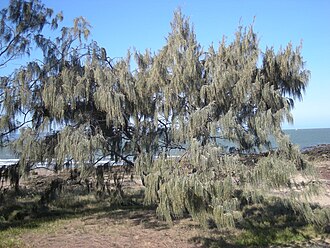
图:Ethel Aardvark · CC BY 3.0 · Wikimedia Commons
- 学名
- Casuarina equisetifolia
- 分类等级
- 种
- 上级类群
- 木麻黄属
- 大类
- 被子植物
- 命名
- 卡尔·林奈,1759 年
- 中文别名
- 马尾树、短枝木麻黄、驳骨树、木麻黄种子
- 保护状况(IUCN)
- 无危物种
- 用途
- 植树造林、木材、药用植物、饲料
- 数据库
- NCBI 分类 · GBIF · IUCN 红色名录
百科正文
形态
常绿乔木,高可达20米;灰绿色小枝细软,颇似针叶,多节,每节有极退化的苞片状叶6-8枚;初夏开花,雌雄同株或异株;球形果实,直径10-16毫米,小坚果,上部有翅。
分布
原产于澳大利亚,分布于亚洲东南部沿海地区、美洲热带地区、台湾以及中国大陆的广东、广西、福建等地,目前已由人工引种栽培。
用途
最佳的防风林,可植于海边,树高且坚硬。因生长迅速,抗风力强,是中国南方滨海防风固林的常见树种之一。可作为建筑、家具、造纸用材。树皮可提制栲胶,也有用来制备染料用来染渔网的。因为木麻黄生长迅速,而且能够耐受土壤中相对较高的盐环境,在被重金属污染的土壤中木麻黄也能生长,因此木麻黄在土壤修复方面也有重要的应用价值。兰屿由于引进木麻黄导致入侵原生植物栖地所造成的威胁。
别名
马毛树(中国种子植物分类学)、短枝木麻黄、驳骨树(广州)
以上内容摘自维基百科「木麻黄」,按 CC BY-SA 4.0 使用,去掉了参考文献、外部链接等尾部小节,公式改写成了纯文本。全文、配图和出处见原文。
英文维基百科补充中文条目比较短,下面是英文条目「Casuarina equisetifolia」的原文
Casuarina equisetifolia, commonly known as coastal she-oak, horsetail she-oak, ironwood, beach sheoak, beach casuarina, whistling tree or Australian pine is a species of flowering plant in the family Casuarinaceae and is native to the Western Pacific, Australia, New Guinea, Southeast Asia and India. It is a small to medium-sized, monoecious tree with scaly or furrowed bark on older specimens, drooping branchlets, the leaves reduced to scales in whorls of 7 or 8, the fruit 10–24 mm (0.4–0.9 in) long containing winged seeds (samaras) 6–8 mm (0.2–0.3 in) long.
Description
Habit
Casuarina equisetifolia is an evergreen tree typically growing to a height of 6–12 m (20–39 ft), sometimes to 35 m (115 ft) tall. The bark of young specimens is smooth and greyish, older trees have scaly, greyish-brown to black bark.
Foliage
The foliage consists of slender, drooping branchlets up to 30 cm (12 in) long, the leaves reduced to scale-like teeth 0.3–0.5 mm (0.01–0.02 in) long, arranged in whorls of 7 or 8 (occasionally 6) around the branchlets. The sections of branchlet between the leaf whorls (the "articles") are 5–13 mm (0.2–0.5 in) long and 0.5–1.0 mm (0.02–0.04 in) wide.
Flowers
This species of Casuarina is monoecious with male and female flowers produced on the same tree, unlike most other species of its same genus which are dioecious. Its male and female inflorescences are both shaped like catkins.
Taxonomy and naming
The genus Casuarina was first formally described in 1759 by Carl Linnaeus in Amoenitates Academicae and the first species he described was Casuarina equisetifolia. The specific epithet equisetifolia means 'horsehair-leaved'.
In 1873, George Bentham described Casuarina equisetifolia var. equisetifolia and C. equisetifolia var. incana in Flora Australiensis, and in 1982, Lawrie Johnson changed the names to subspecies equisetifolia and incana respectively, in the Journal of the Adelaide Botanic Gardens:
Casuarina equisetifolia L. subsp. equisetifolia, a tree 7–35 m (23–115 ft) high, the articles 5–8 mm (0.2–0.3 in) long and 0.5–0.7 mm (0.02–0.03 in) wide with 8 to 10 teeth 0.3–0.8 mm (0.01–0.03 in) long, the male spikes 7–40 mm (0.3–1.6 in) long, the cones 12–24 mm (0.5–0.9 in) long and 9–11 mm (0.35–0.43 in) wide on a peduncle 3–10 mm (0.1–0.4 in) long.
Distribution and habitat
Casuarina equisetifolia subsp. equisetifolia grows near the sea, behind beaches and near estuaries, sometimes on rocky headlands in Australia, New Guinea, Southeast Asia and India. The species is native to India and Bangladesh in South Asia; Myanmar, the Andaman Islands, Nicobar Islands, Vietnam, Thailand, Cambodia, Peninsular Malaysia, the Philippines, Borneo, Java and the Lesser Sunda Islands, islands in the South China Sea, Sulawesi and Sumatra in Southeast Asia; the Carolines, Fiji, the Marianas, the Marshall Islands, New Caledonia, Samoa, Solomon Islands, Tonga, Tuvalu and Vanuatu in the Pacific Ocean; New Guinea; and New South Wales, the Northern Territory, and Queensland in Australia.
Subspecies incana grows on rocky headlands near the coasts of eastern Queensland and New South Wales as far south as Laurieton.
Ecology
Casuarina equisetifolia is an actinorhizal plant able to fix atmospheric nitrogen through a symbiotic relationship with strains of Frankia, a actinomycete hosted in nodules on its roots.
Uses
Besides its ornamental uses, Casuarina equisetifolia has also been explored for its potential in remediation of textile dye wastewater. The leaves were found to be useful as absorbent material for the removal of textile dyes such as reactive orange 16, rhodamine B, methylene blue, malachite green and methyl violet 2B. Similarly, the dried cone was also reported to be able to remove rhodamine B and methyl violet 2B. The bark was reported to be able to remove methylene blue. Even the seed was found to be useful in dye removal of neutral red and malachite green. The carbon derived from the cones of C. equisetifolia was found to be a good absorbent for landfill leachate, while another laboratory also reported good absorbency for copper ions from aqueous solution. Line planting of C. equisetifolia trees in coastal areas has been known to help control the force of the wind.
Culture
In the Philippines, the town of Agoo is named after the tree (known as agoho or aroo in the Ilocano language).
以上节选摘自英文维基百科「Casuarina equisetifolia」,按 CC BY-SA 4.0 使用,去掉了参考文献、外部链接等尾部小节,公式改写成了纯文本。篇幅所限,较长的小节只摘了开头一部分,有的小节没有收;全文、配图和出处见原文。