 格物
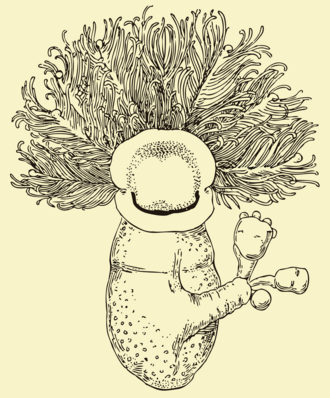
图:Luis Fernández García · CC BY-SA 4.0 · Wikimedia Commons
- 学名
- Pterobranchia
- 分类等级
- 纲
- 上级类群
- 半索动物门
- 大类
- 其他动物
- 命名
- 雷·兰克斯特,1877 年
- 异名
- 笔石纲
- 数据库
- NCBI 分类 · GBIF
下级类群(1)
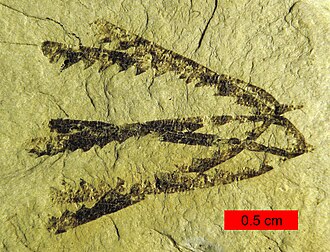
- 笔石纲 Graptolithina 亚纲
百科正文
在电子显微镜下的研究表明,羽鳃纲和已经灭绝的笔石纲属于同一演化支,系统发育分析(phylogenetic analysis)表明,羽鳃纲是活的笔石纲演化支成员。
分类
羽鳃纲 Pterobranchia Lankester 1877
头盘虫亚纲 Cephalodiscida Fowler 1892 stat. nov.
头盘虫目 Cephalodiscida Fowler 1892
笔石亚纲 Graptolithina Bronn 1849
?†腔笔石目 Camaroidea Kozlowski 1928 sensu Kozlowski 1949
?†甲壳笔石目 Crustoidea Bulman 1970
Order ?†Dithecoidea Obut, 1960
?†管笔石目 Tuboidea Kozlowski 1938 sensu Kozlowsk 1949
杆壁虫目 Rhabdopleurida Fowler 1892 sensu Beklemishev 1951
Clade †Eugraptolithina Mitchell et al., 2013
†树形笔石目 Dendroidea Nicholson 1872
†正笔石目 Graptoloidea Maletz, Carlucci and Mitchell 2009
以上内容摘自维基百科「羽鳃纲」,按 CC BY-SA 4.0 使用,去掉了参考文献、外部链接等尾部小节,公式改写成了纯文本。全文、配图和出处见原文。
英文维基百科补充中文条目比较短,下面是英文条目「Pterobranchia」的原文
Pterobranchia, members of which are often called pterobranchs, is a class of small worm-shaped animals. They belong to the Hemichordata, and live in secreted tubes on the ocean floor. Pterobranchia feed by filtering plankton out of the water with the help of cilia attached to tentacles. There are about 25 known living pterobranch species in three genera, which are Rhabdopleura, Cephalodiscus, and Atubaria. On the other hand, there are several hundred extinct genera, some of which date from the Cambrian Period.
The class Pterobranchia was established by Ray Lankester in 1877. It contained, at that time, the single genus Rhabdopleura. Rhabdopleura was at first regarded as an aberrant polyzoon, but when the Challenger report on Cephalodiscus was published in 1887, it became clear that Cephalodiscus, the second genus now included in the order, had affinities with the Enteropneusta.
Electron microscope studies have suggested that pterobranchs belong to the same clade as the extinct graptolites, and phylogenetic analysis suggests that the pterobranchs are living members of the graptolite clade.
Biology
Pterobranchs are small worm-like filter feeders living on the ocean floor, often in relatively deep waters. Like their relatives, the acorn worms, their body is divided into three parts: an anterior proboscis, a collar, and a trunk. The proboscis is wide and flattened at the tip, and in most species contains glands that secrete a tube of organic material in which the pterobranch spends its adult life. The animals are mostly colonial, with several zooids living together in a cluster of tubes. In some species, the individual zooids within the colony are connected by stolons. The single member in the genus Atubaria is unusual in lacking the tubes typical of other pterobranchs, living as a naked zooid on corals. Recently, Atubaria has been regarded as a questionable species by Tassia et al. (2016) and is no longer considered valid.
The collar bears a number of large arms, each of which includes a row of tentacles along one side. The number of arms varies between species, with anything from one to nine pairs. The tentacles are covered in cilia and aid in filtering food from the water. The trunk includes a simple tubular gut, and is curved over so that the anus projects upwards, lying dorsal to the collar. Cephalodiscus and Atubaria have a single pair of gill slits in the pharynx, although Rhabdopleura has none.
Development of pterobranchs have been studied only in Rhabdopleura from Plymouth (Rhabdopleura compacta) and from Bermuda (Rhabdopleura normani). Both of these species are dioecious, with the fertilised egg hatching to produce a free-swimming ciliated larva. Despite the close relationship between the two groups, the larva does not resemble that of the acorn worms; they are "planula-like", and do not feed (lecithotrophic). Eventually, the larva settles onto the substrate and metamorphoses to an adult. Alternatively, they also reproduce asexually by budding to create a new colony.
Evolution
Paleontology
The earliest pterobranchs, including Yuknessia and Galeaplumosus, are known from mid-Cambrian Lagerstätten. Earlier small carbonaceous fossils are known from the Buen Formation.
Taxonomy
Comparison of 18S ribosomal RNA sequences indicated that pterobranchs are closely related to enteropneust hemichordates.
Class Pterobranchia Lankester 1877
Subclass Cephalodiscida Fowler 1892 stat. nov.
- Order Cephalodiscida Fowler 1892
- Subclass Graptolithina Bronn 1849
- Order ?†Camaroidea Kozlowski 1928 sensu Kozlowski 1949
- Order ?†Crustoidea Bulman 1970
- Order ?†Dithecoidea Obut, 1960
- Order ?†Tuboidea Kozlowski 1938 sensu Kozlowsk 1949
- Order Rhabdopleurida Fowler 1892 sensu Beklemishev 1951
- Clade †Eugraptolithina Mitchell et al., 2013
- Order †Dendroidea Nicholson 1872
- Order †Graptoloidea Maletz, Carlucci and Mitchell 2009
Genomics
Genetic code
The two pterobranch taxa Rhabdopleura compacta and Cephalodiscus use alternative genetic codes in their mitochondrial genome.
以上内容摘自英文维基百科「Pterobranchia」,按 CC BY-SA 4.0 使用,去掉了参考文献、外部链接等尾部小节,公式改写成了纯文本。全文、配图和出处见原文。