格物

图:Eurocommuter~commonswiki · CC BY-SA 3.0 · Wikimedia Commons
- 类型
- 共振海王星外天体、海王星外天体、小行星
- 发现 / 发明时间
- 2002 年
- 发现者 / 提出者
- 帕洛马天文台
- 前一项
- (84521) 2002 TE300
- 后一项
- (84523) 2002 UF2
百科正文
轨道
以39.058 至70.983 天文单位环绕着太阳运转,由于共振的缘故,它每绕太阳二圈,海王星会绕太阳五圈。以如此长的轨道周期环绕太阳的外海王星天体 2002 TC302上回在10月抵达冲的位置时,视星等只有20.5等。
表面
偏红的光谱表示2002 TC302的表面只有非常少量的冰,这也可以解释它的反照率为何会偏低。
相关资料
- 小行星
- 海王星外天体
- 离散盘
以上内容摘自维基百科「小行星84522」,按 CC BY-SA 4.0 使用,去掉了参考文献、外部链接等尾部小节,公式改写成了纯文本。全文、配图和出处见原文。
英文维基百科补充中文条目比较短,下面是英文条目「(84522) 2002 TC302」的原文
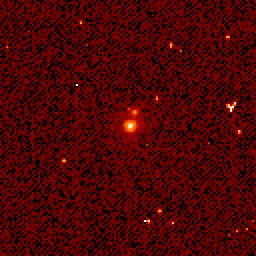
(84522) 2002 TC302 is an unnamed trans-Neptunian object in the scattered disk, orbiting the Sun on a highly distant and elliptical orbit. It is in a 2:5 orbital resonance with Neptune, meaning its orbital period is exactly 5⁄2 times that of Neptune's. It was discovered at Palomar Observatory on 9 October 2002, during a search for trans-Neptunian objects by Chad Trujillo, Michael E. Brown, and the Near-Earth Asteroid Tracking program. The object measures approximately 500 km (310 mi) in diameter and has a shape resembling a flattened sphere, making it a possible dwarf planet.
2002 TC302 has a cold and icy surface made of frozen water, carbon dioxide, carbon monoxide, methanol, and various complex organic compounds. These complex organic compounds, called tholins, color the object's surface red and are thought to be byproducts of ice irradiated by solar and cosmic rays. 2002 TC302 rotates slowly, with a rotation period of approximately 56 hours, and may possess a large unresolved moon based on indirect evidence from telescope observations.
Observational history
Discovery
2002 TC302 was discovered on 9 October 2002 by Palomar Observatory in California, United States. At the time, Chad Trujillo and Michael E. Brown were searching for trans-Neptunian objects using the observatory's 1.2-meter Samuel Oschin telescope. Their search had been operating jointly with the Near-Earth Asteroid Tracking (NEAT) program, which contributed to the discovery of 2002 TC302 using the same telescope.
Name
This object is currently known by its minor planet provisional designation 2002 TC302, given by the MPC upon its discovery. The MPC gave it the minor planet number of 84522 on 4 May 2004. As of May 2026, it has not been named. According to naming guidelines by the International Astronomical Union's Working Group for Small Bodies Nomenclature, trans-Neptunian objects should be given mythological names.
Orbit
2002 TC302 is a trans-Neptunian object (TNO) located in the scattered disk, a region of the Solar System beyond the orbits of Neptune and Pluto. It follows a highly tilted and elliptical orbit around the Sun (eccentricity 0.29, inclination 35°) at a distance ranging from 39.0 to 71.5 astronomical units (AU). With a semi-major axis or average distance of 55.3 AU, 2002 TC302 takes 411 years to complete one orbit around the Sun.
Physical characteristics
Size and shape
2002 TC302 has a mean diameter of approximately 500 km (310 mi), about one-fifth the diameter of Pluto. It is considered a medium-sized or mid-sized TNO, since its diameter lies halfway between those of small, irregularly-shaped bodies and dwarf planets. Stellar occultation observations from 2018 have shown that the shape of 2002 TC302 likely resembles an oblate spheroid, with a major diameter of 543 ± 18 km (337 ± 11 mi) and a minor diameter of 460 ± 11 km (285.8 ± 6.8 mi).
Possible satellite
2002 TC302 is not confirmed to have natural satellites or moons, although there is indirect evidence for one orbiting close by. Beginning in 2020, astronomers noticed that 2002 TC302 emits more thermal radiation than expected for its size. 2002 TC302's excess thermal emission does not fit models of a single, highly emissive object, but could be explained by the presence of a thermally-emitting moon.
Origin
Methanol- and organic-rich TNOs like 2002 TC302 are thought to have formed in the Sun's outer protoplanetary disk 4.5 billion years ago, at heliocentric distances beyond 20 AU where methanol, CO, and CO2 could solidify into ices. These ices presumably accreted into solid bodies until the protoplanetary disk dissipated, leaving behind planetesimals.
Exploration concepts
2002 TC302 has not been visited by a space probe. Although sending space probes to TNOs is expensive, their exploration is highly valuable for understanding the nature of TNOs and the history of Solar System. A 2013 study by the University of Tennessee identified several launch windows in 2020, 2033, and 2045 where a spacecraft could be launched to 2002 TC302, using a high-thrust Atlas V 551 rocket with a Star 48 upper stage and a gravity assist from Jupiter.
以上节选摘自英文维基百科「(84522) 2002 TC302」,按 CC BY-SA 4.0 使用,去掉了参考文献、外部链接等尾部小节,公式改写成了纯文本。篇幅所限,较长的小节只摘了开头一部分,有的小节没有收;全文、配图和出处见原文。