格物

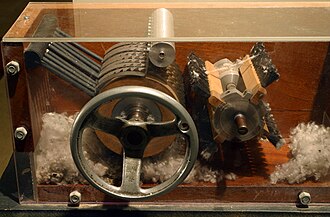
图:Paul Hermans · Public domain · Wikimedia Commons
- 发现 / 发明时间
- 1779 年
- 发现者 / 提出者
- 塞缪尔·克朗普顿
- 学科
- 工程与发明
- 上级概念
- textile arts tool
- 用途
- 纺织
- 基于
- 珍妮纺纱机、水力纺纱机
相关科学家
百科正文
英文维基百科补充中文条目比较短,下面是英文条目「Spinning mule」的原文
The spinning mule is a machine used to spin cotton and other fibres like wool. They were used extensively from the late 18th to the early 20th century in the mills of Lancashire and elsewhere. Mules were worked in pairs by a minder, with the help of two boys: the little piecer and the big or side piecer. The carriage carried up to 1,320 spindles and could be 150 feet (46 m) long, and would move forward and back a distance of 5 feet (1.5 m) four times a minute.
It was invented between 1775 and 1779 by Samuel Crompton. The self-acting (automatic) mule was patented by Richard Roberts in 1825. At its peak, there were 5,000,000 mule spindles in Lancashire alone. Modern versions are still in production and are used to spin woollen yarns from noble fibres such as cashmere, ultra-fine merino and alpaca for the knitted textile market.
The spinning mule spins textile fibres into yarn by an intermittent process. In the draw stroke, the roving is pulled through rollers and twisted; on the return it is wrapped onto the spindle. Its rival, the throstle frame or ring frame, uses a continuous process, where the roving is drawn, twisted and wrapped in one action. The mule was the most common spinning machine from 1790 until about 1900 and was still used for fine yarns until the early 1980s. In 1890, a typical cotton mill would have over 60 mules, each with 1,320 spindles, which would operate four times a minute for 56 hours a week.
History
Before the 1770s, textile production was a cottage industry using flax and wool. Weaving was a family activity. The children and women would card the fibre – break up and clean the disorganised fluff into long bundles. The women would then spin these rough rovings into yarn wound onto a spindle. The male weaver would use a frame loom to weave this into cloth. This was then tentered in the sun to bleach it. The invention by John Kay of the flying shuttle made the loom twice as productive, causing the demand for cotton yarn to vastly exceed what traditional spinners could supply.
Operation of a mule
Watch video demonstration #1
Mule spindles rest on a carriage that travels on a track a distance of 60 inches (1.5 m), while drawing out and spinning the yarn. On the return trip, known as putting up, as the carriage moves back to its original position, the newly spun yarn is wound onto the spindle in the form of a cone-shaped cop. As the mule spindle travels on its carriage, the roving which it spins is fed to it through rollers geared to revolve at different speeds to draw out the yarn.
Marsden in 1885 described the processes of setting up and operating a mule. Here is his description, edited slightly.
The creel holds bobbins containing rovings. The rovings are passed through small guide-wires, and between the three pairs of drawing-rollers.
Social and economic impact
The spinning inventions were significant in enabling a great expansion to occur in the production of textiles, particularly cotton ones. Cotton and iron were leading sectors in the Industrial Revolution. Both industries underwent a great expansion at about the same time, which can be used to identify the start of the Industrial Revolution.
The 1790 mule was operated by brute force: the spinner drawing and pushing the frame while attending to each spindle. Home spinning was the occupation of women and girls, but the strength needed to operate a mule caused it to be the activity of men. Hand loom weaving, however, had been a man's occupation but in the mill it could and was done by girls and women.
Mule-spinners' cancer
Circa 1900 there was a high incidence of scrotal cancer detected in former mule spinners. It was limited to cotton mule spinners and did not affect woollen or condenser mule spinners. The cause was attributed to the blend of vegetable and mineral oils used to lubricate the spindles. The spindles, when running, threw out a mist of oil at crotch height, that was captured by the clothing of anyone piecing an end. In the 1920s much attention was given to this problem. Mules had used this mixture since the 1880s, and cotton mules ran faster and hotter than the other mules, and needed more frequent oiling. The solution was to make it a statutory requirement to use only vegetable oil or white mineral oils, which were believed to be non-carcinogenic.
以上节选摘自英文维基百科「Spinning mule」,按 CC BY-SA 4.0 使用,去掉了参考文献、外部链接等尾部小节,公式改写成了纯文本。篇幅所限,较长的小节只摘了开头一部分,有的小节没有收;全文、配图和出处见原文。