格物
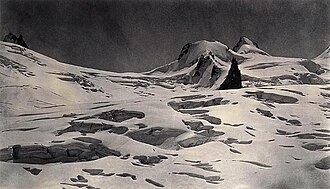
图:Bisson frères. Louis-Auguste (1814-1876) et Auguste-Rosalie … · Public domain · Wikimedia Commons
柯罗酊法1851
wet collodion process
这是一种使用火棉胶的照相工艺
The collodion process is an early photographic process for the production of grayscale images. The collodion process – mostly synonymized with the term "wet-plate process", requires the photographic material to be coated, sensitized, exposed, and developed within the span of about fifteen minutes, necessitating a portable darkroom for use in the field. Collodion is normally used in its wet form, but it can also be used in its dry form, at the cost of greatly increased exposure time. The increased exposure time made the dry form unsuitable for the usual portraiture work of most professional photographers of the 19th century. The use of the dry form was mostly confined to landscape photography and other special applications where exposure times sometimes longer than a half hour were tolerable.
摘自英文维基百科「Collodion process」(英文维基百科,暂无中文条目),CC BY-SA 4.0
- 发现 / 发明时间
- 1851 年
- 发现者 / 提出者
- 阿切尔
- 学科
- 工程与发明
- 上级概念
- 摄影处理
- 相对的概念
- dry collodion process
相关科学家
百科正文
本条目暂无中文维基百科条目,下面是英文维基百科原文。
History
Gustave Le Gray first theorized about the collodion process, publishing a method in 1850 that was "theoretical at best", but Frederick Scott Archer was credited with the invention of the process, which he created in 1848 and published in 1851. During the subsequent decades, many photographers and experimenters refined or varied the process. By the end of the 1860s, it had almost entirely replaced the first-announced photographic process, the daguerreotype.
During the 1870s, the collodion process was largely replaced by gelatin dry plates—glass plates with a photographic emulsion of silver halides suspended in gelatin. Invented by Dr.
21st century
The wet plate collodion process has undergone a revival as a historical technique in the twenty-first century. There are several practicing ambrotypes and tintypes who regularly set up and make images, for example at Civil War re-enactments and arts festivals. Fine art photographers use the process and its handcrafted individuality for gallery showings and personal work. There are several makers of reproduction equipment, and many artists work with collodion around the globe. The process is taught in workshops around the world and several workbooks and manuals are in print. Modern collodion artists include:
- David Emitt Adams
- Shane Balkowitsch
- Nitrate Fox (Britt Bradley)
- Ben Cauchi
- James O'Connell
- Jill Enfield
- Jack Lowe
- Sally Mann
- Paul d'Orléans / Susan McLaughlin
Advantages
The collodion process produced a negative image on a transparent support (glass). This was an improvement over the calotype process, discovered by Henry Fox Talbot, which relied on paper negatives, and the daguerreotype, which produced a one-of-a-kind positive image and could not be replicated. The collodion process thus combined desirable qualities of the calotype process (enabling the photographer to make a theoretically unlimited number of prints from a single negative) and the daguerreotype (creating a sharpness and clarity that could not be achieved with paper negatives). Collodion printing was typically done on albumen paper.
Disadvantages
The wet collodion process had a major disadvantage. The entire process, from coating to developing, had to be done before the plate dried. This gave the photographer no more than about 10-15 minutes to complete everything. This made it inconvenient for field use, as it required a portable darkroom. The plate dripped silver nitrate solution, causing stains and potentially explosive build-up of nitrate residue in the camera and plate holders.
The silver nitrate bath was also a source of problems. It gradually became saturated with alcohol, ether, iodide and bromide salts, dust, and various organic matter. It would lose effectiveness, causing plates to mysteriously fail to reproduce an image.
Use
Despite its disadvantages, wet plate collodion became enormously popular. It was used for portraiture, landscape work, architectural photography, and art photography. The largest collodion glass plate negatives produced in the nineteenth century were made in Sydney, Australia, in 1875. They were made by the professional photographer Charles Bayliss with the help of a wealthy amateur photographer Bernhard Otto Holtermann, who also funded the project.
Bayliss and Holtermann produced four known glass negatives all of which were taken from Holtermann's purpose-built camera in the tower of his mansion in North Sydney. Two were 160 x 96.5 cm (5.1 ft x 3.08 ft) and formed a panorama of Sydney Harbour from Garden Island to Miller's Point.
Search for a dry collodion process
The extreme inconvenience of exposing wet collodion in the field led to many attempts to develop a dry collodion process, which could be exposed and developed sometime after coating. A large number of methods were tried, though none were ever found to be truly practical and consistent in operation. Well-known scientists such as Joseph Sidebotham, Richard Kennett, Major Russell, and Frederick Charles Luther Wratten attempted but never met with good results.
Typically, methods involved coating or mixing the collodion with a substance that prevented it from drying quickly. As long as the collodion remained at least partially wet, it retained some of its sensitivity. Common processes involved chemicals such as glycerin, magnesium nitrate, tannic acid and albumen.
Collodion emulsion
In 1864 W. B. Bolton and B. J. Sayce published an idea for a process that would revolutionize photography. They suggested that sensitive silver salts be formed in a liquid collodion, rather than being precipitated, in-situ, on the surface of a plate. A light-sensitive plate could then be prepared by simply flowing this emulsion across the surface of a glass plate; no silver nitrate bath was required.
This idea was soon brought to fruition. First, a printing emulsion was developed using silver chloride. These emulsions were slow, and could not be developed, so they were mostly used for positive printing. Shortly later, silver iodide and silver bromide emulsions were produced. These proved to be significantly faster, and the image could be brought out by development.
Collodion emulsion preparation example
Below is an example of the preparation of a collodion emulsion, from the late 19th century. The language has been adapted to be more modern, and the units of measure have been converted to metric.
4.9 grams of pyroxylin are dissolved in 81.3 ml of alcohol, and 148 ml of ether.
13 grams of zinc bromide are dissolved in 29.6 ml of alcohol. Four or five drops of nitric acid are added. This is added to half the collodion made above.
21.4 grams of silver nitrate are dissolved in 7.4 ml of water. 29.6 ml of alcohol are added. This is then poured into the other half of the collodion; the brominated collodion is dropped in, slowly, while stirring.
The result is an emulsion of silver bromide. It is left to ripen for 10 to 20 hours until it attains a creamy consistency.
以上节选摘自英文维基百科「Collodion process」,按 CC BY-SA 4.0 使用,去掉了参考文献、外部链接等尾部小节,公式改写成了纯文本。篇幅所限,较长的小节只摘了开头一部分,有的小节没有收;全文、配图和出处见原文。