格物
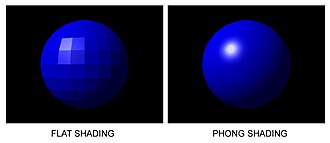
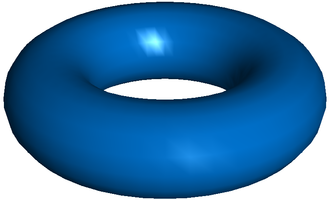
图:en:User:T-tus, Image taken from en.wiki (en:Phong-shading-sa… · Public domain · Wikimedia Commons
- 类型
- 算法
- 发现 / 发明时间
- 1973 年
- 发现者 / 提出者
- 裴祥风
- 命名来源
- 裴祥风
- 学科
- 计算机科学
- 上级概念
- 浓淡处理
相关科学家
百科正文
这个方法由美国越南裔学者裴祥风发明,于1973年的博士论文首度发表。
与Gouraud着色法比较,Phong着色法的效果更逼真,能够提供更好的光滑曲面的近似值。Phong着色法假设一个平滑变化的曲面为一矢量。在对于有较小的高光曲线区的反射模型,例如PHONG模型时,Phong着色法比Gouraud着色法更优。但运算程序也比前者为复杂。Gouraud着色法在遇到在较大的多边形模型中央有高光曲线区时会产生严重的问题。因为这些高光曲线区在多边形的顶点处会产生缺失,而Gouraud着色法是基于顶点的颜色的,这些高光曲线区会从多边形的内部缺失。这个问题在Phong着色法中得到了解决。不同于通过多边形差值的Gouraud着色法,Phong着色法中一个矢量是从多边形顶点的法线到多边形表面进行差值的。为了或得到最后的像素颜色,面的法线被差值,应用于一个反射模型。由于Phong着色法需要逐像素点进行计算,因此运算量远大于Gouraud着色法。
以上内容摘自维基百科「Phong著色法」,按 CC BY-SA 4.0 使用,去掉了参考文献、外部链接等尾部小节,公式改写成了纯文本。全文、配图和出处见原文。
英文维基百科补充中文条目比较短,下面是英文条目「Phong shading」的原文
In 3D computer graphics, Phong shading, Phong interpolation, or normal-vector interpolation shading is an interpolation technique for surface shading invented by computer graphics pioneer Bui Tuong Phong. Phong shading interpolates surface normals across rasterized polygons and computes pixel colors based on the interpolated normals and a reflection model. Phong shading may also refer to the specific combination of Phong interpolation and the Phong reflection model.
History
Phong shading and the Phong reflection model were developed at the University of Utah by Bui Tuong Phong, who published them in his 1973 Ph.D. dissertation and a 1975 paper. Phong's methods were considered radical at the time of their introduction, but have since become the de facto baseline shading method for many rendering applications. Phong's methods have proven popular due to their generally efficient use of computation time per rendered pixel.
Phong interpolation
Phong shading improves upon Gouraud shading and provides a better approximation of the shading of a smooth surface. Phong shading assumes a smoothly varying surface normal vector. The Phong interpolation method works better than Gouraud shading when applied to a reflection model with small specular highlights such as the Phong reflection model.
The most serious problem with Gouraud shading occurs when specular highlights are found in the middle of a large polygon. Since these specular highlights are absent from the polygon's vertices and Gouraud shading interpolates based on the vertex colors, the specular highlight will be missing from the polygon's interior. This problem is fixed by Phong shading.
Unlike Gouraud shading, which interpolates colors across polygons, in Phong shading, a normal vector is linearly interpolated across the surface of the polygon from the polygon's vertex normals. The surface normal is interpolated and normalized at each pixel and then used in a reflection model, e.g. the Phong reflection model, to obtain the final pixel color. Phong shading is more computationally expensive than Gouraud shading since the reflection model must be computed at each pixel instead of at each vertex.
In modern graphics hardware, variants of this algorithm are implemented using pixel or fragment shaders.
Phong reflection model
Phong shading may also refer to the specific combination of Phong interpolation and the Phong reflection model, which is an empirical model of local illumination. It describes the way a surface reflects light as a combination of the diffuse reflection of rough surfaces with the specular reflection of shiny surfaces. It is based on Bui Tuong Phong's informal observation that shiny surfaces have small intense specular highlights, while dull surfaces have large highlights that fall off more gradually. The reflection model also includes an ambient term to account for the small amount of light that is scattered about the entire scene.
以上内容摘自英文维基百科「Phong shading」,按 CC BY-SA 4.0 使用,去掉了参考文献、外部链接等尾部小节,公式改写成了纯文本。全文、配图和出处见原文。