格物
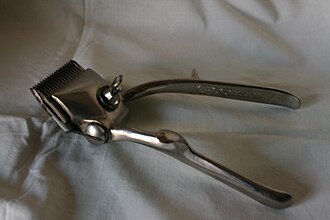
图:Tamorlan · CC BY 3.0 · Wikimedia Commons
- 发现 / 发明时间
- 1855 年
- 发现者 / 提出者
- 尼古拉·比祖米奇
- 上级概念
- 刮胡刀、hairstyling tool
- 用途
- 发型、剃光头、剪羊毛
百科正文
英文维基百科补充中文条目比较短,下面是英文条目「Hair clipper」的原文
A hair clipper, often individually called the apparent plurale tantum hair clippers (in a similar way to scissors), is a specialised tool used to cut human hair. Hair clippers work on the same principle as scissors, but are distinct from scissors themselves and razors. Similar but heavier-duty implements are used to shear sheep, but are called handpieces or machine shears.
Operating principle
Hair clippers are made up of a pair of sharpened comb-like blades in close contact, one above the other, and the sides which slide sideways relative to each other, a mechanism which may be manual or electrical to make the blades oscillate from side to side, and a handle. The clipper is moved so that hair is positioned between the teeth of the comb, and cut with a scissor action when one blade slides sideways relative to the other. Friction between the blades needs to be as low as possible, which is attained by choice of material and finish, and frequent lubrication.
Manual clippers
Hair clippers are operated by a pair of handles which are alternately squeezed together and released. Barbers used them to cut hair close and fast. The hair was picked up in locks and the head was rapidly depilated. Such haircuts became popular among boys, mostly in schools, and young men in the military and in prisons.
Manual clippers were invented around 1855 by Nikola Bizumić, a Serbian barber. While they were widely used in the distant past, the advent and reduction in cost of electric hair clippers has led to them largely replacing manual clippers. Some barbers in Western countries continue to use them for trimming. They are also used in the Russian army: when conscripts enter boot camp, they cut their hair close to the skin, sometimes using manual clippers.
Culture and religion
In Greece, male students had their heads shaved with manual hair clippers from the early 20th century until it was abolished in 1982. The same practice was used in the military, where recruits had their heads shaved as they set foot in boot camp. In the 1950s and 1960s a law was implemented in Greece whereby head shaving with manual clippers was to be used as a punishment for young people caught by police, such as teddyboys and prostitutes. This practice was extended to Greek hippies and leftist youths during the 1967-73 military regime. Obligatory hair clipping was abolished in Greece in 1982.
Manual hair clippers are used extensively by barbers in India to give short back and sides haircuts. Orthodox Jews tend to avoid clipping the side of their heads. Among Muslim men, some consider it haram to clip more than a fistful of the beard.
Electric clippers
Electric hair clippers work in a similar way as manual ones, but are driven by an electric motor which makes the blades oscillate from side to side. They have gradually displaced manual hair clippers in many countries. Three different motor types are used in clipper production: magnetic, rotary and pivot. Rotary style may be driven by direct current or alternating current electricity source. Both magnetic and pivot style clippers use magnetic forces derived from winding copper wire around steel. Alternating current creates a cycle attracting and relaxing to a spring to create the speed and torque to drive the clipper cutter across the combing blade.
Leo J. Wahl invented the first electric hair clipper. He first designed a hand-held massager for his uncle, Dr. Frank Wahl. Frank Wahl opened a manufacturing plant in Sterling, Illinois to produce and sell Leo's massager. During this time, Leo would sell massagers to various barbers and noticed an opportunity to improve upon the tools barbers were using at the time.
Leo Wahl took over his uncle's manufacturing business after Frank left to serve in the Spanish–American War in 1898. Leo continued to work on his inventions and by 1921, he patented his final design of an invention more than a decade in the making- the first electric hair clipper. Within a year, Wahl Manufacturing had manufactured and sold thousands of clippers all over the United States and in 1921 Leo renamed the company the Wahl Clipper Corporation. When Leo J. Wahl died on May 20, 1957, he had over 100 patent applications to his name. His descendants still operate the company today.
Blade material
Blades are usually made of rust-resistant stainless steel.
Ceramic cutters are available; they are not subject to corrosion, and stay sharper longer because of a higher resistance to wear than metal blades. However, ceramic blades are brittle and easily broken, and more expensive to replace than metal blades.
以上节选摘自英文维基百科「Hair clipper」,按 CC BY-SA 4.0 使用,去掉了参考文献、外部链接等尾部小节,公式改写成了纯文本。篇幅所限,较长的小节只摘了开头一部分,有的小节没有收;全文、配图和出处见原文。