格物
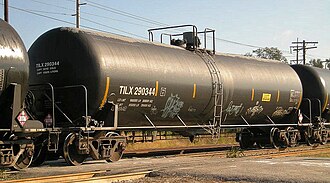
图:NorthWoodsHiawatha · Attribution · Wikimedia Commons
- 发现 / 发明时间
- 1865 年
- 上级概念
- 铁路货车、tanker vehicle
百科正文
中国铁路货车基本型号用“G”表示罐车。在主型号后面再附加一到两个字母表示装载介质。
台湾铁路管理局使用“T”,并在前面加一字母表示装载物,例如“GT”为汽油罐车、“ST”为硫酸罐车。例外有“W”为水罐车、“L”为油罐车。
日本货物铁道(JR货物)以“タキ”(TaKi)表示罐车。
中国罐车
- 中国铁路G6型罐车
- 中国铁路G9型罐车
- 中国铁路G10型罐车
- 中国铁路G11型酸碱罐车
- 中国铁路G12型食油罐车
- 中国铁路G14型罐车
- 中国铁路G15型罐车
- 中国铁路G16型罐车
- 中国铁路G17型罐车
- 中国铁路G18型罐车
- 中国铁路G19型罐车
- 中国铁路G50型罐车
- 中国铁路G60型罐车
- 中国铁路G70型罐车
- 中国铁路G73型罐车
- 中国铁路G75型罐车
- 中国铁路GF型腐蚀品罐车
- 中国铁路GH型化学品罐车
- 中国铁路GJ型液碱罐车
- 中国铁路GL型沥青罐车
- 中国铁路GN型粘油罐车
- 中国铁路GQ型轻油罐车
- 中国铁路GS型食油罐车
- 中国铁路GS70型浓酸罐车
- 中国铁路GW型有毒品罐车
- 中国铁路GY型液化气体罐车
以上内容摘自维基百科「铁路罐车」,按 CC BY-SA 4.0 使用,去掉了参考文献、外部链接等尾部小节,公式改写成了纯文本。全文、配图和出处见原文。
英文维基百科补充中文条目比较短,下面是英文条目「Tank car」的原文
A tank car (International Union of Railways (UIC): tank wagon) or tanker is a type of railroad car (UIC: railway car) or rolling stock designed to transport liquid and gaseous commodities.
History
Timeline
The following major events occurred in the years noted:
1863: Samuel J. Seely, an inventor from Brooklyn, New York, patented the very first railroad cylindrical body petroleum tank car in the United States, which is a predecessor of the railroad tank car that we see today. On June 2, 1863, he received patent number 38,765 for the "Improved car for carrying petroleum." In his invention, the tank is a cylinder made of metal, and it is positioned horizontally, parallel to the tracks. Exactly like in modern tank cars.
1865: Flatcars with banded wooden planks or decking mounted on top are employed for the first time to transport crude oil from the fields of Pennsylvania during the Pennsylvanian oil rush. Laurence Myers of Philadelphia invented the Rotary Oil Car, as he named it. It was an improvement on a patent from 1851 of a freight car for transporting coal. The new invention patented on July 18, 1865, was for the transportation of crude oil and petroleum. It was the first appearance of an oil tank on a railroad flatcar. Three books mention his invention.
Usage
North America
Many variants exist due to the wide variety of liquids and gases transported. Tank cars can be pressurized or non-pressurized, insulated or non-insulated, and designed for single or multiple commodities. Non-pressurized cars have various fittings on the top and may have fittings on the bottom. Some of the top fittings are covered by a protective housing. Pressurized cars have a pressure plate, with all fittings, and a cylindrical protective housing at the top. Loading and unloading are done through the protective housing.
Tank cars are specialized pieces of equipment. As an example, the interior of the car may be lined with a material, such as glass, or other specialized coatings to isolate the tank contents from the tank shell. Care is taken to ensure that tank contents are compatible with tank construction.
As a result of this specialization, tank cars have generally been "one-way" cars. Other cars, like boxcars, can easily be reloaded with other goods for the return trip.
Specialized applications
DOT-111
The DOT-111 tank car, designed to carry liquids such as denatured fuel ethanol, is built to a US standard. The design has been criticized on safety grounds. The train in the Lac-Mégantic derailment of 2013 was made up of 72 of these cars.
DOT-112
DOT-112 tank cars are used in North America to carry pressurized gases. One of these tank cars exploded in Waverly, Tennessee, killing 16, when a Louisville & Nashville train derailed. While the clean up efforts were under way, the tank car, UTLX 83013, ended up exploding from a BLEVE.
DOT-114
DOT-114 tank cars are used in North America to carry pressurized gases.
Milk cars
A milk car is a specialized type of tank car designed to carry raw milk between farms, creameries, and processing plants.
Milk is now commonly chilled, before loading, and transported in a glass-lined tank car. Such tank cars are often placarded as "Food service use only".
Liquid hydrogen tank car
Tank cars of this type are designed to carry cryogenic liquid Hydrogen (LH2). North American cars are classified as DOT113, AAR204W, and AAR204XT
Safety
Where AAR couplers are fitted, the AAR type "F" coupler is preferred as these are less likely to become separated in a derailment and become a puncture hazard for other tank cars. A type "E" coupler that has shelves over and under the coupler that prevent the coupler sliding out of position after a derailment is used on some hazardous materials tank cars.
In addition, some types of tank cars have a second end plate visible from the exterior, to further avoid end punctures.
It is also preferable if each tap (valve) is recessed within the body of the tank so as to present a reduced knock-off hazard during a derailment.
Tank cars have been involved in many rail disasters, including the Lac-Mégantic derailment in Quebec in 2013, the Nishapur train disaster in Iran in 2004, and the Viareggio train derailment in Italy in 2009.
Outside North America
Outside of North America, tank cars are also known as tank wagons or tanker wagons. In the United Kingdom tank wagons were traditionally four-wheel vehicles. Some long-wheelbase four-wheelers are still in use but bogie vehicles are now used as well.
以上节选摘自英文维基百科「Tank car」,按 CC BY-SA 4.0 使用,去掉了参考文献、外部链接等尾部小节,公式改写成了纯文本。篇幅所限,较长的小节只摘了开头一部分,有的小节没有收;全文、配图和出处见原文。