格物
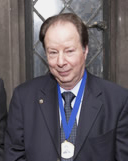
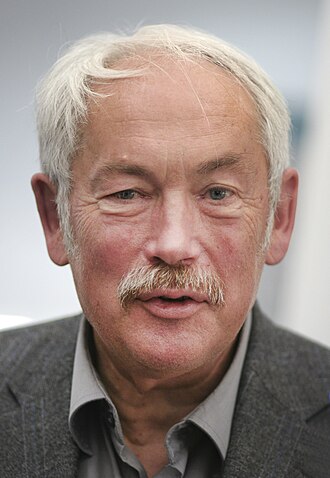
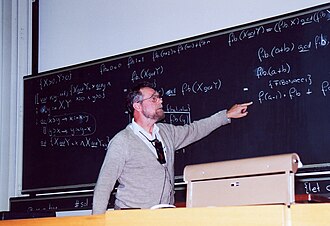
图:NIH · Public domain · Wikimedia Commons
西德尼·奥尔特曼1939—2022
Sidney Altman
生物学家, 美国
西德尼·奥尔特曼,加拿大分子生物学家,耶鲁大学分子、细胞和发育生物学及化学斯特林教授。1989年,他和托马斯·切赫因为对RNA的催化作用的研究共同获得诺贝尔化学奖。
摘自维基百科「西德尼·奥尔特曼」,CC BY-SA 4.0
- 出生
- 1939 年 5 月 7 日,蒙特利尔
- 逝世
- 2022 年 4 月 5 日,罗克利
- 国籍
- 美国、加拿大
- 学科
- 物理学、化学、生物学、博物与综合
- 职业
- 化学家、分子生物学家、生物化学家、物理学家
- 母语 / 工作语言
- 英语
- 母校
- 哥伦比亚大学、麻省理工学院、科罗拉多大学博尔德分校
- 工作单位
- 哈佛大学
研究领域
师承
博士生1
来自 Wikidata 的「博士导师」「师从」「博士生」「学生」记录,可能不全。
所获奖项(6)
学会与院士
百科正文
生平
1939年生于加拿大魁北克。他的父母在1920年代从东欧移民到加拿大。1960年在麻省理工学院获得学士学位。1967年在科罗拉多大学波德分校获得生物物理学博士学位。1971年进入耶鲁大学工作。1988年当选美国文理科学院院士。1990年当选美国国家科学院院士以及美国哲学会会士。
2022年4月5日逝世。
以上内容摘自维基百科「西德尼·奥尔特曼」,按 CC BY-SA 4.0 使用,去掉了参考文献、外部链接等尾部小节,公式改写成了纯文本。全文、配图和出处见原文。
英文维基百科补充中文条目比较短,下面是英文条目「Sidney Altman」的原文
Sidney Altman (May 7, 1939 – April 5, 2022) was a Canadian-American molecular biologist, who was the Sterling Professor of Molecular, Cellular, and Developmental Biology and Chemistry at Yale University. In 1989, he shared the Nobel Prize in Chemistry with Thomas R. Cech for their work on the catalytic properties of RNA.
Family and education
Altman was born on May 7, 1939, in Montreal, Quebec, Canada. His parents, Ray (Arlin), a textile worker, and Victor Altman, a grocer, were Jewish immigrants to Canada, each coming from Eastern Europe as a young adult, in the 1920s. Altman's mother was from Białystok in Poland, and had come to Canada with her sister at the age of eighteen, learning English and working in a textile factory to earn money to bring the rest of their family to Quebec. Altman's father, born in Ukraine, had been a worker on a collective farm in the Soviet Union. He was sponsored to come to Canada as a farm worker, but later, as a husband and a father of two sons, he supported the family by running a small grocery store in Montreal. Sidney Altman was later to look back on his parents' lives as an illustration of the value of the work ethic: "It was from them I learned that hard work in stable surroundings could yield rewards, even if only in infinitesimally small increments."
As Altman reached adulthood, the family's financial situation had become secure enough that he was able to pursue a college education. He went to the United States to study physics at the Massachusetts Institute of Technology. While at MIT, he was a member of the ice hockey team. After achieving his bachelor's degree from MIT in 1960, Altman spent 18 months as a graduate student in physics at Columbia University. Due to personal concerns and the lack of opportunity for beginning graduate students to participate in laboratory work, he left the program without completing the degree. Some months later, he enrolled as a graduate student in biophysics at the University of Colorado Medical Center. His project was a study of the effects of acridines on the replication of bacteriophage T4 DNA. He received his Ph.D.
Career
After receiving his Ph.D., Altman embarked upon the first of two research fellowships. He joined Matthew Meselson's laboratory at Harvard University to study a DNA endonuclease involved in the replication and recombination of T4 DNA. Later, at the MRC Laboratory of Molecular Biology in Cambridge, England, Altman started the work that led to the discovery of RNase P and the enzymatic properties of the RNA subunit of that ribozyme. John D. Smith, as well as several postdoctoral colleagues, provided Altman with very good advice that enabled him to test his ideas. "The discovery of the first radiochemically pure precursor to a tRNA molecule enabled me to get a job as an assistant professor at Yale University in 1971, a difficult time to get any job at all".
Altman's career at Yale followed a standard academic pattern with promotion through the ranks until he became Professor in 1980. He was Chairman of his department from 1983 to 1985 and in 1985 became the Dean of Yale College for four years. On July 1, 1989, he returned to the post of Professor on a full-time basis. His doctoral students include Ben Stark.
While at Yale, Altman's Nobel Prize work came with the analysis of the catalytic properties of the ribozyme RNase P, a ribonucleoprotein particle consisting of both a structural RNA molecule and one (in prokaryotes) or more (in eukaryotes) proteins. Originally, it was believed that, in the bacterial RNase P complex, the protein subunit was responsible for the catalytic activity of the complex, which is involved in the maturation of tRNAs. During experiments in which the complex was reconstituted in test tubes, Altman and his group discovered that the RNA component, in isolation, was sufficient for the observed catalytic activity of the enzyme, indicating that the RNA itself had catalytic properties, which was the discovery that earned him the Nobel Prize.
Recognition
Altman was elected a Fellow of the American Academy of Arts and Sciences in 1988 and a member of both the National Academy of Sciences and the American Philosophical Society in 1990.
Death
Altman died on April 5, 2022, in Rockleigh, New Jersey, after a long illness.
以上节选摘自英文维基百科「Sidney Altman」,按 CC BY-SA 4.0 使用,去掉了参考文献、外部链接等尾部小节,公式改写成了纯文本。篇幅所限,较长的小节只摘了开头一部分,有的小节没有收;全文、配图和出处见原文。
同年获同一奖项
同一学科、同时代的科学家


同一学科的科学家
更多 ›