格物
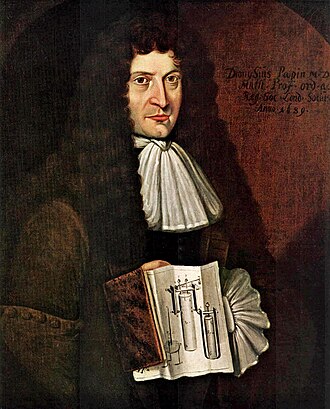
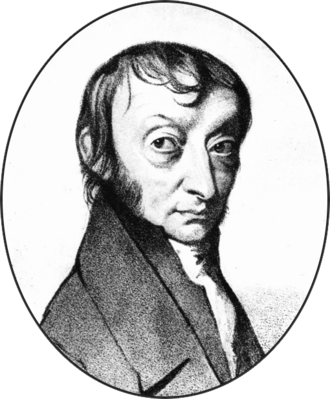
图:Johann Peter Engelhard · Public domain · Wikimedia Commons
- 出生
- 1647 年 8 月 22 日,希特奈
- 逝世
- 1713 年 8 月 26 日,伦敦
- 国籍
- 法兰西王国
- 学科
- 物理学、数学、医学、工程与发明、博物与综合
- 职业
- 数学家、物理学家、发明家、大学教师
- 母语 / 工作语言
- 英语、法语
- 母校
- 昂热大学(1669 年)、Academy of Saumur(1661 年)
- 工作单位
- 克里斯蒂安·惠更斯(1671—1674)、罗伯特·波义耳(1674—1679)、罗伯特·胡克(1680—1681)、Giovanni Ambrosio Sarotti(1681—1684)、英国皇家学会(1684—1687)、马尔堡大学(1687—1696)、黑森-卡塞尔(1696—1707)
研究领域
主要贡献
代表成就
师承
来自 Wikidata 的「博士导师」「师从」「博士生」「学生」记录,可能不全。
所获奖项(1)
- 1680英国皇家学会院士
学会与院士
百科正文
法国期间
帕潘生于希特奈,入读一耶稣会学校。1661年在昂热读大学,在1663年获得医学学位。1673年,帕潘在巴黎与克里斯蒂安·惠更斯和戈特弗里德·莱布尼茨做助手期间,逐渐对利用真空产生动力感兴趣。
初访伦敦
1675年,帕潘第一次到达伦敦。1676年——1679年为波义耳做助手。在此期间,帕潘发明了蒸汽蒸煮器,一种带有安全阀的压力锅。1679年,帕潘向皇家学会报告了他发明的蒸汽蒸煮器。1687年,帕潘离开伦敦赴德国接受一个学术职位。
就职德国
1690年,德尼·帕潘在马尔堡观察了大气压力对他的蒸煮器产生机械作用后,他建造了一个活塞式蒸汽机的模型,这是人类已知第一个活塞式蒸汽机。
重返伦敦
1707年,帕潘返回伦敦,但是妻子还留在德国。1707年至1712年间,帕潘多篇论文被皇家学会发表但没有通知他本人或没有付稿费,这令帕潘极为不满。
据信,他在1712年在穷困潦倒中去世,并葬在一个没有标记的地方。
纪念
法国卡尔卡松将一条街道命名为德尼·帕潘大道。法国布卢瓦有他的雕像。
外部来源
约翰·J·奥康纳; 埃德蒙·F·罗伯逊, Papin, MacTutor数学史档案 (英语)
以上内容摘自维基百科「德尼·帕潘」,按 CC BY-SA 4.0 使用,去掉了参考文献、外部链接等尾部小节,公式改写成了纯文本。全文、配图和出处见原文。
英文维基百科补充中文条目比较短,下面是英文条目「Denis Papin」的原文
Denis Papin FRS (French pronunciation: [dəni papɛ̃]; 22 August 1647 – 26 August 1713) was a French Huguenot physicist, mathematician and inventor, best known for his pioneering invention of the steam digester, the forerunner of the pressure cooker, the steam engine, the centrifugal pump, and a submersible boat.
He started his career in his native France, before emigrating to London, in 1675, and rising to being on the staff of the Royal Society, in 1684. As a Huguenot, he was stripped of his French citizenship, and denied a return to France after Louis XIV invoked the Edict of Fontainebleau in 1685. From 1687-1707 he held a position as a mathematics professor of the University of Marburg, Germany, before returning to England the last 5 years of his life. In spite of his many discoveries he died a pauper, and the date of his death and burial site were lost for 303 years.
Early life and education
Denis Papin was born into a Calvinist family in Chitenay (Loir-et-Cher, Centre-Val de Loire Région), but attended a Jesuit school there. In 1661, he attended the University of Angers, from which he graduated with a medical degree in 1669.
Career
In 1673 in Paris, Papin worked with Christiaan Huygens and learnt to know Gottfried Leibniz, who was about the same age as him. Papin became interested in using a vacuum to generate motive power.
Due to increasing repression on the Huguenots in France, he first visited London in 1675, where he worked with Robert Boyle from 1676 to 1679, publishing an account of his work in Continuation of New Experiments (1680). During this period, Papin invented the steam digester, a type of pressure cooker with a safety valve. He first addressed the Royal Society in 1679 on the subject of his digester, and remained mostly in London.
In 1681, Papin rose to become head of the experimental department at the accademia publica di scienze in Venice and in 1684 became a member of the staff of the Royal Society, whose chairman was Robert Boyle. During this time he also worked on steam cannons in Venice. Papin was denied return to France after Louis XIV invoked the Edict of Fontainebleau ending religious freedom for Protestants in 1685.
In about 1687, he left France to take up an academic post in Marburg Germany, one of the few calvinist territories in germany at the time, joining fellow Huguenot exiles from France.
In 1689, Papin suggested that a force pump or bellows could maintain the pressure and fresh air inside a diving bell. (Engineer John Smeaton utilised this design in 1789.)
In 1690, having observed the mechanical power of atmospheric pressure on his 'digester', Papin built a model of a piston steam engine, the first of its kind. In 1705 while teaching mathematics at the University of Marburg, he developed a second steam engine with the help of Gottfried Leibniz, based on an invention by Thomas Savery, but this used steam pressure rather than atmospheric pressure. Details of the engine were published in 1707.
In 1705, Papin constructed a ship powered by hand-cranked paddles to return to London with his wife and children.
Personal life and death
Papin married at the age of 44 in 1691 in Marburg.
The last surviving evidence of Papin's whereabouts came in a letter he wrote dated 23 January 1712. At the time he was destitute ("I am in a sad case") [Royal Society Archives, 1894, Vol. 7, 74]. Until 2016, it was believed that he died that year and was buried in an unmarked grave in London.
In 2016, a record for the burial of a “Denys Papin” was discovered in an 18th-century Register of Marriages & Burials, It originally came from St Bride's Church, Fleet Street, London, but is stored in the London Metropolitan Archives. The record states that Denys Papin was buried at St Bride's on 26 August 1713 – just a few days after his 66th birthday – and that he was buried in the Lower Ground, one of the two burial areas belonging to the church at the time.
Since the 2016 discovery of the place and date of Papin's burial in 1713, a memorial plaque has been erected in the West Entrance of St Bride's Church, Fleet Street, London, to commemorate his life and his achievements.
Legacy
Boulevard Denis Papin in Carcassonne is named after him as well as a street in Saint-Michel, Montreal. There is also a statue of Papin with his invention in Blois, at the top of the Escalier Denis Papin, a stairway.
以上节选摘自英文维基百科「Denis Papin」,按 CC BY-SA 4.0 使用,去掉了参考文献、外部链接等尾部小节,公式改写成了纯文本。篇幅所限,较长的小节只摘了开头一部分,有的小节没有收;全文、配图和出处见原文。
同一学科、同时代的科学家




同一学科的科学家
更多 ›