格物
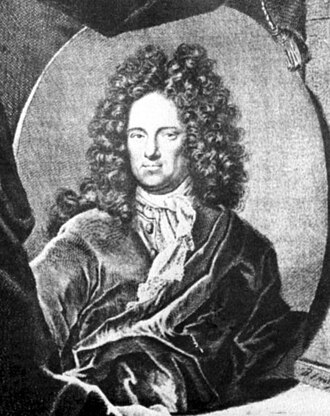
图:Martin Bernigeroth · Public domain · Wikimedia Commons
- 出生
- 1651 年 4 月 10 日,Sławnikowice, Lower Silesia
- 逝世
- 1708 年 10 月 11 日,德累斯顿
- 国籍
- 萨克森选帝侯
- 学科
- 物理学、数学、博物与综合
- 职业
- 数学家、物理学家、哲学家
- 母语 / 工作语言
- 德语
- 母校
- 莱顿大学(1672 年)、Augustum-Annen-Gymnasium(1668 年)
主要贡献
代表成就
师承
师从3
博士生1
来自 Wikidata 的「博士导师」「师从」「博士生」「学生」记录,可能不全。
学术谱系
往上:老师的老师7 代
- 埃伦弗里德·瓦尔特·冯·切恩豪斯
- 师从Arnold Geulincx
- 师从西尔维斯 1614—1672
- 博士导师Adolphus Vorstius 1597—1663
- 博士导师Gilbert Jack
- 博士导师Duncan Liddel 1561—1613
- 博士导师Paul Wittich 1546—1586
- 博士导师John Craig
- 师从Theodor Zwinger 1533—1588
- 博士导师彼得吕斯·拉米斯
- 师从Vittore Trincavelli
- 师从Bassiano Landi
- 师从Theodor Zwinger 1533—1588
- 博士导师Duncan Liddel 1561—1613
- 博士导师Adriaan van den Spiegel 1578—1625
- 博士导师西罗尼姆斯·法布里休斯 1533—1619
- 博士导师加布里瓦·法罗皮奥 1523—1562
- 博士导师Antonio Musa Brassavola 1500—1555
- 博士导师Niccolò Leoniceno 1428—1524
- 博士导师Johannes Manardus 1462—1536
- 博士导师雷尔多·科伦坡 1516—1559
- 师从Johannes Baptista Montanus 1489—1551
- 师从Niccolò Leoniceno 1428—1524
- 师从马库斯·穆苏鲁斯
- 师从伯多禄·蓬波纳齐
- 博士导师Antonio Musa Brassavola 1500—1555
- 博士导师加布里瓦·法罗皮奥 1523—1562
- 博士导师西罗尼姆斯·法布里休斯 1533—1619
- 师从Daniel Heinsius
- 博士导师Gilbert Jack
- 师从Emmanuel Stupanus
- 博士导师Adolphus Vorstius 1597—1663
- 师从Pieter van Schooten
- 师从弗兰斯·范斯霍滕 1615—1660
- 博士导师Jacobus Golius 1596—1667
- 博士导师威理博·斯涅尔 1580—1626
- 博士导师鲁道夫·范·科伊伦 1540—1610
- 博士导师鲁道夫·司乃耳 1546—1613
- 师从Valentin Naboth
- 师从埃拉斯穆斯·赖因霍尔德 1511—1553
- 师从Immanuel Tremellius
- 师从Valentin Naboth
- 博士导师Thomas van Erpe
- 博士导师威理博·斯涅尔 1580—1626
- 博士导师马兰·梅森 1588—1648
- 博士导师Jacobus Golius 1596—1667
- 师从弗兰斯·范斯霍滕 1615—1660
往下:学生的学生3 代 · 19 人
- 埃伦弗里德·瓦尔特·冯·切恩豪斯
- 克里斯蒂安·沃尔夫
- 米哈伊尔·瓦西里耶维奇·罗蒙诺索夫 1711—1765
- 斯捷潘·鲁莫夫斯基 1734—1812
- 约翰·萨穆埃尔·柯尼希 1712—1757
- Antonius Brugmans
- Jean-Jacques Blassière
- Samuel Klingenstierna 1698—1765
- 佩尔·W·瓦尔延廷 1717—1783
- Jakob Gadolin
- Mårten Strömer
- Bengt Ferner
- Georg Bernhard Bilfinger 1693—1750
- Jakob Friedrich Müller
- Wilhelm Ludwig Oetinger
- Jeremias David Reuß
- Ernst Friedrich Beerlin
- Jeremias Friedrich Reuß
- 约翰·马蒂亚斯·哈泽 1684—1742
- J. A. 厄内斯提
- 米哈伊尔·瓦西里耶维奇·罗蒙诺索夫 1711—1765
- 克里斯蒂安·沃尔夫
按 Wikidata 的「博士导师」「师从」「博士生」「学生」记录逐代连起来(往上每人最多列 3 位老师、最多 7 代;往下最多 3 代、每人最多列 12 位学生)。记录不全,只是能查到的部分。
学会与院士
百科正文
英文维基百科补充中文条目比较短,下面是英文条目「Ehrenfried Walther von Tschirnhaus」的原文
Ehrenfried Walther von Tschirnhaus or Tschirnhauß (German: [ˈeːʁənfʁiːt ˈvaltɐ fɔn ˈtʃɪʁnhaʊs]; 10 April 1651 – 11 October 1708) was a German mathematician, physicist, physician, and philosopher. He introduced the Tschirnhaus transformation and is considered by some to have been the inventor of European porcelain, an invention long accredited to Johann Friedrich Böttger, while others claim porcelain had been made by English manufacturers at an even earlier date.
Education
Tschirnhaus attended the Gymnasium at Görlitz. Thereafter he studied mathematics, philosophy, and medicine at the University of Leiden. He travelled considerably in France, Italy, and Switzerland, and served in the army of Holland (1672–1673). During his travels, he met Baruch de Spinoza and Christiaan Huygens in the Netherlands, Isaac Newton in England, and Gottfried Wilhelm Leibniz (with whom he maintained a lifelong correspondence) in Paris. He became a member of the Académie Royale des Sciences in Paris.
Mathematician
The Tschirnhaus transformation, by which he removed certain intermediate terms from a given algebraic equation, is well known. It was published in the scientific journal Acta Eruditorum in 1683.
In 1682, Tschirnhaus worked out the theory of catacaustics and showed that they were rectifiable. This was the second case in which the envelope of a moving line was determined. One of the catacaustics of a parabola is still known as Tschirnhausen cubic.
In 1696, Johann Bernoulli posed the problem of the brachistochrone to the readers of Acta Eruditorum. Tschirnhaus was one of only five mathematicians to submit a solution. Bernoulli published these contributions (including Tschirnhaus') along with his own in the journal in May of the following year.
Tschirnhaus produced various types of lenses and mirrors; some of them are displayed in museums. He erected a large glassworks in Saxony, where he constructed burning glasses of unusual perfection and carried on his experiments (1687–1688).
His work Medicina mentis sive artis inveniendi praecepta generali (1687) combines methods of deduction with empiricism and shows him to be philosophically connected to the Enlightenment.
Philosopher
Tschirnhaus was for many years forgotten as a philosopher and the studies treating the subject often discuss Tschirnhaus' connection to other philosophers and scientists at the time. During his time at the University of Leiden, he started correspondence with Spinoza and later also Leibniz. Tschirnhaus was one of the first to get a copy of Spinoza's masterpiece Ethics; it is thought that the copy now in the Vatican Library, the only extant pre-publication copy, may have been Tschirnhaus'. In his correspondence with Spinoza, which has been preserved, he raises several objections to some of the claims in the Ethics, such as what exactly constitutes the immediate infinite causes of the attributes.
Inventor of porcelain
After he returned home to Saxony, Tschirnhaus initiated systematic experiments, using mixtures of various silicates and earths at different temperatures to develop porcelain, which at the time was available only as a costly import from China and Japan. As early as 1704, he showed porcelan to Leibniz's secretary. He proposed the establishment of a porcelain factory to Augustus II of Poland, Elector of Saxony, but was denied. Also in 1704, Tschirnhaus became the supervisor of Johann Friedrich Böttger, a nineteen-year-old alchemist who claimed to be able to make gold. Böttger only reluctantly and under pressure started to participate in Tschirnhaus' work by 1707. The use of kaolin (from Schneeberg, Saxony) and alabaster advanced the work, so that August II named him the director of the porcelain factory he intended to establish. The Elector ordered payment of 2,561 thalers to Tschirnhaus, but the recipient requested postponement until the factory was producing. When Tschirnhaus died suddenly, on 11 October 1708, the project came to a halt.
Three days after Tschirnhaus' death, there was a burglary at his house and, according to a report by Böttger, a small piece of porcelain was stolen. This report suggests that Böttger himself recognized that Tschirnhaus already knew how to make porcelain, a key piece of evidence that Tschirnhaus and not Böttger was the inventor. Work resumed on 20 March 1709, by which time Melchior Steinbrück had arrived to assess the dead man's estate, which included the notes about making porcelain, and had met with Böttger.
以上节选摘自英文维基百科「Ehrenfried Walther von Tschirnhaus」,按 CC BY-SA 4.0 使用,去掉了参考文献、外部链接等尾部小节,公式改写成了纯文本。篇幅所限,较长的小节只摘了开头一部分,有的小节没有收;全文、配图和出处见原文。
同一学科、同时代的科学家


同一学科的科学家
更多 ›