格物
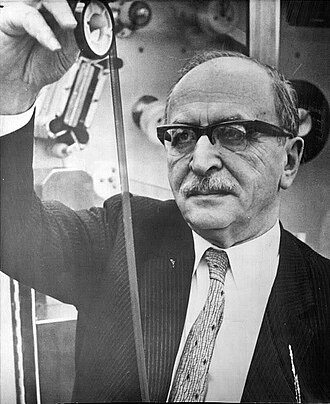
图:Associated Press · Public domain · Wikimedia Commons
丹尼斯·加博尔1900—1979
Dennis Gabor
物理学家, 匈牙利
加博尔·德奈什,英语名丹尼斯·加博尔,英国籍匈牙利裔犹太人物理学家,因发明全息摄影而获得1967年的英国物理学会杨氏奖及1971年诺贝尔物理学奖。
摘自维基百科「加博尔·德奈什」,CC BY-SA 4.0
- 出生
- 1900 年 6 月 5 日,布达佩斯
- 逝世
- 1979 年 2 月 8 日,伦敦
- 国籍
- 英国、匈牙利
- 学科
- 物理学、工程与发明、博物与综合
- 职业
- 物理学家、发明家、大学教师
- 母语 / 工作语言
- 英语、匈牙利语
- 母校
- 柏林洪堡大学(1924 年)、布达佩斯技术与经济大学(1921 年)、柏林工业大学(哲学博士,1927 年)
- 工作单位
- 柏林工业大学、伦敦帝国学院
研究领域
师承
博士生3
来自 Wikidata 的「博士导师」「师从」「博士生」「学生」记录,可能不全。
所获奖项(8)
学会与院士
百科正文
2010年6月5日,Google主页的LOGO为一个全息摄影的Google图标,以纪念丹尼斯诞辰110周年。
以加博尔·德奈什命名的奖项
每年一次的加博尔·德奈什奖,由SPIE(International Society for Optical Engineering)颁发。
以上内容摘自维基百科「加博尔·德奈什」,按 CC BY-SA 4.0 使用,去掉了参考文献、外部链接等尾部小节,公式改写成了纯文本。全文、配图和出处见原文。
英文维基百科补充中文条目比较短,下面是英文条目「Dennis Gabor」的原文
Dennis Gabor (5 June 1900 – 9 February 1979) was a Hungarian-British physicist who received the Nobel Prize in Physics in 1971 for his invention of holography. He obtained British citizenship in 1946 and spent most of his life in England.
Life and career
Gabor was born as Günszberg Dénes, into a Jewish family in Budapest, Austria-Hungary. In 1900, his family converted to Lutheranism. Dennis was the first-born son of Günszberg Bernát and Jakobovits Adél. Despite having a religious background, religion played a minor role in his later life and he considered himself agnostic. In 1902, the family received permission to change their surname from Günszberg to Gábor. He served with the Hungarian artillery in northern Italy during World War I.
He began his studies in engineering at the Budapest University of Technology and Economics in 1918, later in Germany, at the Technische Hochschule Charlottenburg in Berlin, now known as Technische Universität Berlin. At the start of his career, he analysed the properties of high voltage electric transmission lines by using cathode-beam oscillographs, which led to his interest in electron optics. Studying the fundamental processes of the oscillograph, Gabor was led to other electron-beam devices such as electron microscopes and TV tubes. He eventually wrote his PhD thesis on Recording of Transients in Electric Circuits with the Cathode Ray Oscillograph in 1927, and worked on plasma lamps.
In 1933 Gabor fled from Nazi Germany, where he was considered Jewish, and was invited to Britain to work at the development department of the British Thomson-Houston company in Rugby, Warwickshire. During his time in Rugby, he met Marjorie Louise Butler, and they married in 1936. He became a British citizen in 1946, and it was while working at British Thomson-Houston in 1947 that he invented holography, based on an electron microscope, and thus electrons instead of visible light. He experimented with a heavily filtered mercury arc light source. The earliest visual hologram was only realised in 1964 following the 1960 invention of the laser, the first coherent light source. After this, holography became commercially available.
Gabor's research focused on electron inputs and outputs, which led him to the invention of holography. The basic idea was that for perfect optical imaging, the total of all the information has to be used; not only the amplitude, as in usual optical imaging, but also the phase. In this manner, a complete holo-spatial picture can be obtained. Gabor published his theories of holography in a series of papers between 1946 and 1951.
Personal life
On 8 August 1936, he married Marjorie Louise Butler. They did not have any children.
Legacy and commemoration
1983 – the International Society for Optical Engineering (SPIE) established the annual Dennis Gabor Award, "in recognition of outstanding accomplishments in diffractive wavefront technologies, especially those which further the development of holography and metrology applications."
1989 – the Royal Society of London began issuing the Gabor Medal for "acknowledged distinction of interdisciplinary work between the life sciences with other disciplines".
1992 – Dennis Gabor University (until 2023, Gábor Dénes College), was founded in Budapest, Hungary, named after Gabor.
1993 – the NOVOFER Foundation of the Hungarian Academy of Sciences established its annual International Dennis Gabor Award, for outstanding young scientists researching in the fields of physics and applied technology.
2000 – the asteroid 72071 Gábor is named after Gabor.
2006 – English Heritage erected a blue plaque at Gabor's former residence, 79 Queen's Gate, South Kensington, London.
2008 – the Institute of Physics renamed its Duddell Medal and Prize, established in 1923, into the Dennis Gabor Medal and Prize.
2009 – Imperial College London opened the Gabor Hall, named in the scientist's honour.
Dennis-Gabor-Straße in Potsdam is named in his honour and is the location of the Potsdamer Centrum für Technologie.
In popular culture
The Gabor family from the animated TV series Jem and The Holograms was named after Dennis Gabor.
On 5 June 2010, the logo for the Google website was drawn to resemble a hologram in honour of Dennis Gabor's 110th birthday.
In David Foster Wallace's Infinite Jest, Hal suggests that "Dennis Gabor may very well have been the Antichrist."
以上节选摘自英文维基百科「Dennis Gabor」,按 CC BY-SA 4.0 使用,去掉了参考文献、外部链接等尾部小节,公式改写成了纯文本。篇幅所限,较长的小节只摘了开头一部分,有的小节没有收;全文、配图和出处见原文。
同一学科、同时代的科学家


同一学科的科学家
更多 ›