格物
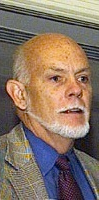
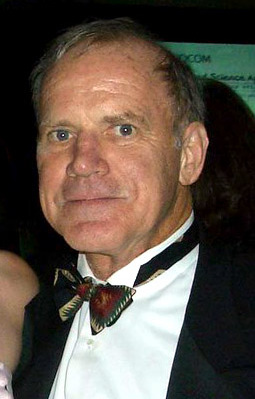
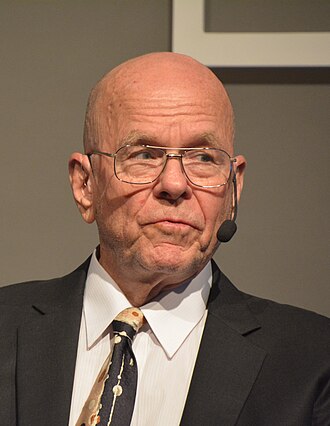
图:RonnieV · CC BY-SA 4.0 · Wikimedia Commons
理查德·斯莫利1943—2005
Richard Smalley
化学家, 美国
理查德·埃利特·斯莫利,是一位美国化学家,曾任莱斯大学化学、物理学和天文学教授。1996年,他与莱斯大学化学教授罗伯特·柯尔(Robert Curl)、苏塞克斯大学教授哈罗德·克罗托 一起,因发现了碳的一种新形式,即巴克明斯特富勒烯,也被昵称“巴克球”(buckyball),而荣获得诺贝尔化学奖。 他是纳米技术及其应用的倡导者。
摘自维基百科「理查德·斯莫利」,CC BY-SA 4.0
- 出生
- 1943 年 6 月 6 日,阿克伦
- 逝世
- 2005 年 10 月 28 日,休斯敦
- 国籍
- 美国
- 学科
- 化学、博物与综合
- 职业
- 化学家、教授、科学家
- 母语 / 工作语言
- 英语
- 母校
- 普林斯顿大学(哲学博士,1973 年)、芝加哥大学、密歇根大学(理学士,1965 年)、霍普学院、Southwest High School、Southwest Early College Campus
- 工作单位
- 莱斯大学
研究领域
所获奖项(15)
- 1991朗缪尔奖
- 1991欧内斯特·奥兰多·劳伦斯奖
- 1992韦尔奇化学奖
- 1992詹姆斯·麦格罗蒂新材料奖
- 1993约翰·斯科特奖
- 1993里克特迈耶纪念奖
- 1993威廉·H·尼克尔斯奖
- 1994欧洲物理学会欧洲物理奖
- 1996诺贝尔化学奖
- 1996富兰克林奖
- 1997Carbon Medal
- 1998honorary doctorate from University of Montpellier-II
- 2002格伦·西奥多·西博格奖章
- 2003美国科学促进会会士
- —美国物理学会会士
学会与院士
百科正文
2005年,理查德·埃利特·斯莫利因白血病在休斯敦逝世。
以上内容摘自维基百科「理查德·斯莫利」,按 CC BY-SA 4.0 使用,去掉了参考文献、外部链接等尾部小节,公式改写成了纯文本。全文、配图和出处见原文。
英文维基百科补充中文条目比较短,下面是英文条目「Richard Smalley」的原文
Richard Errett Smalley (June 6, 1943 – October 28, 2005) was an American chemist who was the Gene and Norman Hackerman Professor of Chemistry, Physics, and Astronomy at Rice University. In 1996, along with Robert Curl, also a professor of chemistry at Rice, and Harold Kroto, a professor at the University of Sussex, he was awarded the Nobel Prize in Chemistry for the discovery of a new form of carbon, buckminsterfullerene, also known as buckyballs. He was an advocate of nanotechnology and its applications.
Early life and education
Smalley, the youngest of 4 siblings, was born in Akron, Ohio on June 6, 1943, to Frank Dudley Smalley, Jr., and Esther Virginia Rhoads. He grew up in Kansas City, Missouri. Richard Smalley credits his father, mother and aunt as formative influences in industry, science and chemistry. His father, Frank Dudley Smalley, Jr. worked with mechanical and electrical equipment and eventually became CEO of a trade journal for farm implements called Implement and Tractor. His mother, Esther Rhoads Smalley, completed her B.A. Degree while Richard was a teenager. She was particularly inspired by mathematician Norman N. Royall Jr., who taught Foundations of Physical Science, and communicated her love of science to her son through long conversations and joint activities.
Career
In 1976, Smalley joined Rice University. In 1982, he was appointed to the Gene and Norman Hackerman Chair in Chemistry at Rice. He helped to found the Rice Quantum Institute in 1979, serving as chairman from 1986 to 1996. In 1990, he became also a professor in the department of physics. In 1990, he helped to found the Center for Nanoscale Science and Technology. In 1996, he was appointed its director.
He became a member of the National Academy of Sciences in 1990, and the American Academy of Arts and Sciences in 1991.
Fullerenes
Smalley's research in physical chemistry investigated the formation of inorganic and semiconductor clusters using pulsed molecular beams and time-of-flight mass spectrometry.
Advocacy
Starting in the late 1990s, Smalley advocated for the need for cheap, sustainable energy, which he described as the number one problem facing humanity in the 21st century. He described what he called "The Terawatt Challenge", the need to develop a new power source capable of increasing "our energy output by a minimum factor of two, the generally agreed-upon number, certainly by the middle of the century, but preferably well before that."
He also presented a list entitled "Top Ten Problems of Humanity for Next 50 Years". It can be interesting to compare his list, in order of priority, to the Ten Threats formulated by the U.N.'s High Level Threat Panel in 2004. Smalley's list, in order of priority, was:
- Energy
- Water
- Food
- Environment
- Poverty
- Terrorism & war
- Disease
- Education
- Democracy
- Population
Personal life
Smalley was married four times, to Judith Grace Sampieri (1968–1978), Mary L. Chapieski (1980–1994), JoNell M. Chauvin (1997–1998) and Deborah Sheffield (2005), and had two sons, Chad Richard Smalley (born June 8, 1969) and Preston Reed Smalley (born August 8, 1997).
In 1999, Smalley was diagnosed with cancer. Smalley died of leukemia, variously reported as non-Hodgkin's lymphoma and chronic lymphocytic leukemia, on October 28, 2005, at M.D. Anderson Cancer Center in Houston, Texas, at the age of 62.
Upon Smalley's death, the US Senate passed a resolution to honor Smalley, crediting him as the "Father of Nanotechnology."
Honors
Fellowships
- Harold W. Dodds Fellow, Princeton University, 1973
- Alfred P. Sloan Fellow, 1978–1980
- Fellow of the American Physical Society, 1987
- Fellow of the American Association for the Advancement of Science, 2003
Awards and prizes
- Irving Langmuir Prize in Chemical Physics, American Physical Society, 1991
- Popular Science Magazine Grand Award in Science & Technology, 1991
- APS International Prize for New Materials, 1992 (Joint with R. F. Curl & H. W. Kroto)
- Ernest O. Lawrence Memorial Award, U.S. Department of Energy, 1992
- Welch Award in Chemistry, Robert A. Welch Foundation, 1992
- Auburn-G.M. Kosolapoff Award, Auburn Section, American Chemical Society, 1992
- Southwest Regional Award, American Chemical Society, 1992
- William H. Nichols Medal, New York Section, American Chemical Society, 1993
以上节选摘自英文维基百科「Richard Smalley」,按 CC BY-SA 4.0 使用,去掉了参考文献、外部链接等尾部小节,公式改写成了纯文本。篇幅所限,较长的小节只摘了开头一部分,有的小节没有收;全文、配图和出处见原文。