格物
- 出生
- 1893 年 10 月 28 日,森林盖特
- 逝世
- 1970 年 12 月 8 日,埃奇韦尔
- 国籍
- 英国、大不列颠及爱尔兰联合王国
- 学科
- 化学
- 职业
- 化学家
- 母语 / 工作语言
- 英语
- 母校
- 伦敦帝国学院、伦敦大学
- 工作单位
- 利兹大学(1924—1930)、伦敦大学学院
研究领域
师承
博士生2
来自 Wikidata 的「博士导师」「师从」「博士生」「学生」记录,可能不全。
所获奖项(13)
- 1922Meldola Medal and Prize
- 1924英国皇家学会院士
- 1938贝克演讲
- 1946戴维奖章
- 1951Longstaff Prize
- 1952皇家奖章
- 1954honorary doctorate of the University of Montpellier
- 1955doctor honoris causa from the University of Paris
- 1958下级勋位爵士
- 1961法拉第讲座奖
- 1964Paracelsus Prize
- 1965James Flack Norris Award in Physical Organic Chemistry
- —英帝国奖章
学会与院士
百科正文
贡献
对反应机理研究的贡献
他和罗宾逊一起开始了有机反应机理的研究。现在有机化学里的很多概念,比如亲核、亲电、SN1、SN2、E1、E2等等都是他们首创的。这些概念的提出对揭示有机反应内在机理从而实现控制有机反应起到了巨大的促进作用。
中介论和共振论
英果尔德是中介论的创立者。
当鲍林和威兰特的关于共振论论文发表之后,英果尔德立即于1934年对共振论表示赞同,并称为“物理学原理”,而他把自己的理论称之为“化学原理”,而他表示,“中介”一词是更为合理的概念。
以上内容摘自维基百科「克里斯托夫·英果尔德」,按 CC BY-SA 4.0 使用,去掉了参考文献、外部链接等尾部小节,公式改写成了纯文本。全文、配图和出处见原文。
英文维基百科补充中文条目比较短,下面是英文条目「Christopher Kelk Ingold」的原文
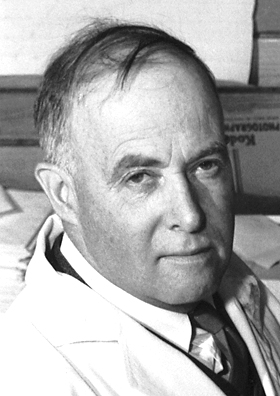
Sir Christopher Kelk Ingold (28 October 1893 – 8 December 1970) was a British chemist based in Leeds and London. His groundbreaking work in the 1920s and 1930s on reaction mechanisms and the electronic structure of organic compounds was responsible for the introduction into mainstream chemistry of concepts such as nucleophile, electrophile, inductive and resonance effects, and such descriptors as SN1, SN2, E1, and E2 now known as the Hughes–Ingold symbols. He also was a co-author of the Cahn–Ingold–Prelog priority rules. Ingold is regarded as one of the chief pioneers of physical organic chemistry.
Early life and education
Born in London to a silk merchant who died of tuberculosis when Ingold was five years old, Ingold began his scientific studies at Hartley University College at Southampton (now Southampton University) taking an external BSc in 1913 with the University of London. He then joined the laboratory of Jocelyn Field Thorpe at Imperial College, London, with a brief hiatus from 1918–1920 during which he conducted research into chemical warfare and the manufacture of poison gas with Cassel Chemical at Glasgow. Ingold received an MSc from the University of London and returned to Imperial College in 1920 to work with Thorpe. He was awarded a PhD in 1918 and a DSc in 1921.
Academic career
In 1924 Ingold moved to the University of Leeds where he spent six years as Professor of Organic Chemistry working alongside his wife, Dr. Edith Hilda Ingold (Usherwood). He returned to London in 1930, and served for 24 years as head of the chemistry department at University College London, from 1937 until his retirement in 1961.
During his study of alkyl halides, Ingold found evidence for two possible reaction mechanisms for nucleophilic substitution reactions. He found that tertiary alkyl halides underwent a two-step mechanism (SN1) while primary and secondary alkyl halides underwent a one-step mechanism (SN2). This conclusion was based on the finding that reactions of tertiary alkyl halides with nucleophiles were dependent on the concentration of the alkyl halide only. Meanwhile, he discovered that primary and secondary alkyl halides, when reacting with nucleophiles, depend on both the concentration of the alkyl halide and the concentration of the nucleophile.
Starting around 1926, Ingold and Robert Robinson carried out a heated debate on the electronic theoretical approaches to organic reaction mechanisms. See, for example, the summary by Saltzman.
Ingold authored and co-authored 443 papers. Notable students include Peter de la Mare, Ronald Gillespie and Ronald Nyholm.
Honours
In 1920, Ingold was awarded the British Empire Medal (BEM) for his wartime research involving "great courage in carrying out work in a poisonous atmosphere, and risking his life on several occasions in preventing serious accidents," though he subsequently never discussed the award or this period in his life.
Ingold was elected a Fellow of the Royal Society (FRS) in 1924. He received the Longstaff Medal of the Royal Society of Chemistry in 1951, the Royal Medal of the Royal Society in 1952, and was knighted in 1958.
The chemistry department of University College London is now housed in the Sir Christopher Ingold building, opened in 1969.
Personal life
Ingold married Dr. Edith Hilda Ingold (Usherwood) in 1923. She was a fellow chemist with whom he collaborated. They had two daughters and a son, the chemist Keith Ingold.
Death
Ingold died in London in 1970, aged 77.
以上内容摘自英文维基百科「Christopher Kelk Ingold」,按 CC BY-SA 4.0 使用,去掉了参考文献、外部链接等尾部小节,公式改写成了纯文本。全文、配图和出处见原文。
同一学科、同时代的科学家