格物
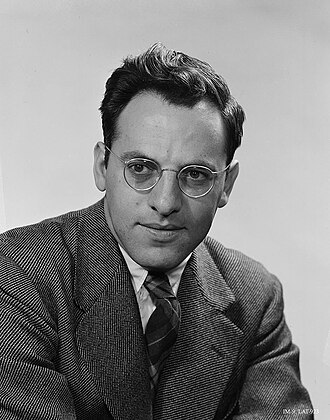
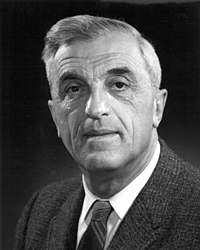
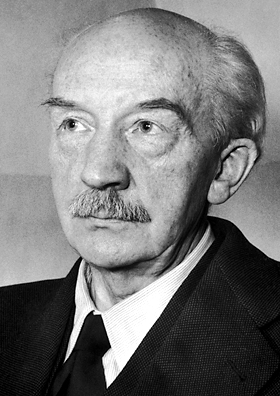
图:Los Alamos National Laboratory · Attribution · Wikimedia Commons
弗雷德里克·莱因斯1918—1998
Frederick Reines
物理学家, 美国
弗雷德里克·莱因斯 是一名美国物理学家。他因在中微子实验中与克莱德·科温共同探测到中微子而获得1995年诺贝尔物理学奖。他可能是历史上唯一一位“与基本粒子的发现和随后对其基本属性的彻底调查有如此密切关系的科学家”。
摘自维基百科「弗雷德里克·莱因斯」,CC BY-SA 4.0
- 出生
- 1918 年 3 月 16 日,帕特森
- 逝世
- 1998 年 8 月 26 日,奥兰治
- 国籍
- 美国
- 学科
- 物理学、博物与综合
- 职业
- 物理学家、大学教师、诺贝尔奖获得者
- 母语 / 工作语言
- 英语
- 母校
- 纽约大学、斯蒂文斯理工学院、Union Hill High School
- 工作单位
- 凯斯西储大学、加利福尼亚大学欧文分校、洛斯阿拉莫斯国家实验室
研究领域
主要贡献
代表成就
师承
博士生1
来自 Wikidata 的「博士导师」「师从」「博士生」「学生」记录,可能不全。
所获奖项(7)
- 1981J·罗伯特·奥本海默纪念奖
- 1983美国国家科学奖章
- 1992富兰克林奖
- 1992潘诺夫斯基实验粒子物理学奖
- 1995诺贝尔物理学奖
- —古根海姆学者奖
- —鹰级童军
学会与院士
百科正文
莱因斯毕业于史蒂文斯理工学院和纽约大学,1944年加入曼哈顿计划的洛斯阿拉莫斯实验室,在理论部理查德·费曼的小组中工作。1946年,他成为那里的小组长。他参加了多次核试验,最终于1951年成为太平洋地区温室行动系列试验的负责人。
1950年代初,在汉福德区和萨凡纳河基地工作的莱因斯和科温开发了设备和程序,他们在1956年6月首次探测到所谓的无法探测的中微子。莱因斯将其职业生涯的主要部分用于研究中微子的特性和相互作用,这项工作将影响未来许多研究人员对中微子的研究。这包括探测宇宙射线在大气中产生的中微子,以及1987年对超新星SN 1987A发出的中微子的探测,这开启了中微子天文学的领域。
以上内容摘自维基百科「弗雷德里克·莱因斯」,按 CC BY-SA 4.0 使用,去掉了参考文献、外部链接等尾部小节,公式改写成了纯文本。全文、配图和出处见原文。
英文维基百科补充中文条目比较短,下面是英文条目「Frederick Reines」的原文
Frederick Reines ( RY-nəs; March 16, 1918 – August 26, 1998) was an American physicist. He was awarded the 1995 Nobel Prize in Physics for his co-detection of the neutrino with Clyde Cowan in the neutrino experiment. He may be the only scientist in history "so intimately associated with the discovery of an elementary particle and the subsequent thorough investigation of its fundamental properties."
A graduate of Stevens Institute of Technology and New York University, Reines joined the Manhattan Project's Los Alamos Laboratory in 1944, working in the Theoretical Division in Richard Feynman's group. He became a group leader there in 1946. He participated in a number of nuclear tests, culminating in his becoming the director of the Operation Greenhouse test series in the Pacific in 1951.
In the early 1950s, working in Hanford and Savannah River Sites, Reines and Cowan developed the equipment and procedures with which they first detected the supposedly undetectable neutrinos in June 1956. Reines dedicated the major part of his career to the study of the neutrino's properties and interactions, which work would influence study of the neutrino for many researchers to come. This included the detection of neutrinos created in the atmosphere by cosmic rays, and the 1987 detection of neutrinos emitted from Supernova SN1987A, which inaugurated the field of neutrino astronomy.
Early life
Frederick Reines was born in Paterson, New Jersey, one of four children of Gussie (née Cohen) and Israel Reines. His parents were Jewish emigrants from the same town in Russia, but only met in New York City, where they were later married. He had an older sister, Paula, who became a doctor, and two older brothers, David and William, who became lawyers. He said that his "early education was strongly influenced" by his studious siblings. He was the great-nephew of the Rabbi Yitzchak Yaacov Reines, the founder of Mizrachi, a religious Zionist movement.
The family moved to Hillburn, New York, where his father ran the general store, and he spent much of his childhood. He was an Eagle Scout.
Los Alamos Laboratory
In 1944 Richard Feynman recruited Reines to work in the Theoretical Division at the Manhattan Project's Los Alamos Laboratory, where he would remain for the next fifteen years. He joined Feynman's T-4 (Diffusion Problems) Group, which was part of Hans Bethe's T (Theoretical) Division. Diffusion was an important aspect of critical mass calculations. In June 1946, he became a group leader, heading the T-1 (Theory of Dragon) Group. An outgrowth of the "tickling the Dragon's tail" experiment, the Dragon was a machine that could attain a critical state for short bursts of time, which could be used as a research tool or power source.
Reines participated in a number of nuclear tests, and writing reports on their results. These included Operation Crossroads at Bikini Atoll in 1946, Operation Sandstone at Eniwetok Atoll in 1948, and Operation Ranger and Operation Buster–Jangle at the Nevada Test Site.
Discovery of the neutrino and the inner workings of stars
The neutrino is a subatomic particle first proposed by Wolfgang Pauli on December 4, 1930. The particle was required to resolve the problem of missing energy in observations of beta decay, when a neutron decays into a proton and an electron. The new hypothetical particle was required to preserve the fundamental law of conservation of energy. Enrico Fermi renamed it the neutrino, Italian for "little neutral one", and in 1934, proposed his theory of beta decay by which the electrons emitted from the nucleus were created by the decay of a neutron into a proton, an electron, and a neutrino:
n0 → p+ + e− + νe
The neutrino accounted for the missing energy, but Fermi's theory described a particle with little mass and no electric charge that appeared to be impossible to observe directly.
Death
Reines died after a long illness at the University of California, Irvine Medical Center in Orange, California, on August 26, 1998. He was survived by his wife and children. His papers are compiled in the UCI Libraries. Frederick Reines Hall, which houses the Physics and Astronomy Department at the University of California, Irvine, was named in his honor.
以上节选摘自英文维基百科「Frederick Reines」,按 CC BY-SA 4.0 使用,去掉了参考文献、外部链接等尾部小节,公式改写成了纯文本。篇幅所限,较长的小节只摘了开头一部分,有的小节没有收;全文、配图和出处见原文。
同年获同一奖项
同一学科、同时代的科学家


同一学科的科学家
更多 ›