格物
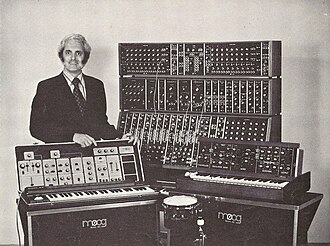
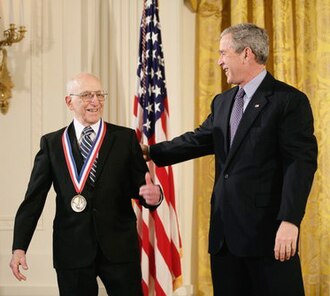
图:Moog Music / Norlin · Public domain · Wikimedia Commons
- 出生
- 1934 年 5 月 23 日,纽约
- 逝世
- 2005 年 8 月 21 日,阿什维尔
- 国籍
- 美国
- 学科
- 工程与发明
- 职业
- 发明家、大学教师、音乐家、乐器制造工
- 母语 / 工作语言
- 英语
- 母校
- 皇后学院、康奈尔大学、康乃尔大学工学院、哥伦比亚大学工学院、伯克利音乐学院、布朗克斯科学高级中学
研究领域
主要贡献
代表成就
所获奖项(3)
- 1970Grammy Trustees Award
- 2001保拉音乐奖
- 2013美国发明家名人堂
百科正文
生平
1934年出生于纽约,父亲是名工程师。他在皇后区法拉盛长大,1952年就读于布朗克斯科学高中。小时候他就对特雷门琴很感兴趣,1949年按著《电子世界》(Electronics World)杂志的说明自己造了一台特雷门琴。
他曾在纽约市立皇后学院修读物理学,在哥伦比亚大学修读电子学,最后在康乃尔大学修读工程物理系并取得博士学位。
1963年,穆格为自己设计的合成器命名为Moog Modular,并且在次年音响工程师交流大会上向众人展示出了自己的发明,从此改变了键盘在音乐中的地位,对披头士等乐队产生了非常大的影响。
1970年,格莱美理事会授予穆格终身成就奖。2001年,罗伯特·穆格还获得被称为瑞典音乐诺贝尔奖的保拉音乐奖。
2005年4月底起,穆格就被确诊患有脑癌(胶质母细胞瘤),去世前一直在医院接受放射和化学治疗。同年8月21日下午2时,穆格因患癌症在美国北卡罗莱纳的家中去世,享年71岁。当时穆格的有些新发明产品仍处于开发阶段,原型和数字电路图仍留在桌面上。
以上内容摘自维基百科「罗伯特·穆格」,按 CC BY-SA 4.0 使用,去掉了参考文献、外部链接等尾部小节,公式改写成了纯文本。全文、配图和出处见原文。
英文维基百科补充中文条目比较短,下面是英文条目「Robert Moog」的原文
Robert Arthur Moog ( MOHG; May 23, 1934 – August 21, 2005) was an American electronics engineer and electronic music pioneer. He was the founder of the synthesizer manufacturer Moog Music and the inventor of the first commercial synthesizer, the Moog synthesizer, which debuted in 1964. In 1970, Moog released a more portable model, the Minimoog, described as the most famous and influential synthesizer in history. Among Moog's honors are a Technical Grammy Award, received in 2002, and an induction into the National Inventors Hall of Fame.
By 1963, Moog had been designing and selling theremins for several years while working toward a PhD in engineering physics at Cornell University. He developed his synthesizer in response to demand for more practical and affordable electronic-music equipment, guided by suggestions and requests from composers. Moog's principal innovation was the voltage-controlled oscillator, which uses voltage to control pitch. He also introduced fundamental synthesizer concepts such as modularity, envelope generation and the pitch wheel. He is credited with introducing synthesizers to a wider audience and influencing the development of popular music.
Moog pursued his work as a hobby, and he is regarded as a poor businessman. His only patent was on his transistor ladder filter design; commentators have speculated that he would have become extremely wealthy had he patented his other innovations, but that their availability in the public domain helped the synthesizer industry flourish.
In 1971, Moog sold Moog Music to Norlin Musical Instruments, where he remained as a designer until 1977. In 1978, he founded the company Big Briar, and in 2002 he renamed it Moog Music after reacquiring the rights to the name. In later years, Moog taught at the University of North Carolina at Asheville and continued designing instruments for the revived Moog Music. He died at the age of 71 in Asheville from a brain tumor.
Early life and education
Robert Moog was born at Flushing Hospital in New York City on May 23, 1934. His father was George Conrad Moog, of German descent. His mother was Shirley (Jacobs) Moog, of Polish-Jewish descent. He was raised in Flushing, Queens.
When he was a boy, Moog's mother forced him to study the piano. He was active in the Boy Scouts, and especially enjoyed spending time with his father, a Consolidated Edison engineer, visiting Manhattan's Radio Row and working on radio and electronics projects. He became fascinated by the theremin, an electronic instrument controlled by moving the hands over radio antennae.
Career
Theremins and R.A. Moog Co.
In 1953, Moog produced his own theremin design, and in the following year, he published an article on the theremin in Radio and Television News. That same year, he founded R.A. Moog Co., building theremins and theremin kits in his parents' home and selling them via mail order. In 1956, Moog and his father visited Raymond Scott's Manhattan Research facility, and Scott purchased a Moog Model 305 theremin. Scott rewired the Moog theremin to be controlled by a keyboard, dubbing his creation the Clavivox.
Personal life and death
Moog married Shirley May Leigh on June 15, 1958. They had four children and divorced in 1994. On May 19, 1996 Moog married Ileana Grams.
In 2001, Moog was awarded the Polar Music Prize in Stockholm, often called the Nobel Prize of music. Polar is the label on which Swedish pop group ABBA published their music, and was owned by their manager and co-composer Stikkan Andersson.
Moog was diagnosed with a glioblastoma multiforme brain tumor on April 28, 2005. He died on August 21, 2005, at the age of 71 in Asheville, North Carolina. He was survived by his second wife Ileana, four children, one stepdaughter and five grandchildren.
Legacy
Moog has had a lasting influence on music. The BBC describes him as a pioneer of synthesized sound. According to the Guardian, his inventions "changed the complexion of the pop and classical music worlds." Moog's name became so associated with electronic music that it was sometimes used as a generic term for any synthesizer.
Moog's awards include honorary doctorates from Polytechnic Institute of New York University (New York City), Lycoming College (Williamsport, Pennsylvania) and Berklee College of Music.
以上节选摘自英文维基百科「Robert Moog」,按 CC BY-SA 4.0 使用,去掉了参考文献、外部链接等尾部小节,公式改写成了纯文本。篇幅所限,较长的小节只摘了开头一部分,有的小节没有收;全文、配图和出处见原文。