格物
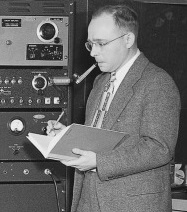
图:Photo is from US Atomic Energy Commission or Oak Ridge Natio… · CC BY 3.0 · Wikimedia Commons
- 出生
- 1915 年 9 月 23 日,匹兹堡
- 逝世
- 2001 年 3 月 31 日,梅特福德
- 国籍
- 美国
- 学科
- 物理学、博物与综合
- 职业
- 物理学家、核物理学家、大学教师
- 母语 / 工作语言
- 英语
- 母校
- 纽约大学、卡内基梅隆大学、Schenley High School
- 工作单位
- 麻省理工学院、橡树岭国家实验室、德士古
研究领域
师承
博士导师3
博士生2
来自 Wikidata 的「博士导师」「师从」「博士生」「学生」记录,可能不全。
所获奖项(6)
- 1956奥利弗·巴克利奖
- 1993爱明诺夫奖
- 1994诺贝尔物理学奖
- —Humboldt Research Fellowship
- —美国物理学会会士
- —洪堡奖
学会与院士
百科正文
生平
1915年出生于宾夕法尼亚州匹兹堡。2001年逝世于马萨诸塞州梅特福德。
以上内容摘自维基百科「克利福德·沙尔」,按 CC BY-SA 4.0 使用,去掉了参考文献、外部链接等尾部小节,公式改写成了纯文本。全文、配图和出处见原文。
英文维基百科补充中文条目比较短,下面是英文条目「Clifford Shull」的原文
Clifford Glenwood Shull (September 23, 1915 in Pittsburgh, Pennsylvania – March 31, 2001) was an American physicist.
Biography
Shull attended Schenley High School in Pittsburgh, received his BS from Carnegie Institute of Technology and PhD from New York University. He worked for The Texas Company at Beacon, New York during the wartime, followed by a position in the Clinton Laboratory (Oak Ridge National Laboratory), and finally joined MIT in 1955, and retired in 1986.
He died on March 31, 2001, at the age 85.
Research
Clifford G. Shull was awarded the 1994 Nobel Prize in Physics with Canadian Bertram Brockhouse. The two won the prize for the development of the neutron scattering technique. He also conducted research on condensed matter. Professor Shull's prize was awarded for his pioneering work in neutron scattering, a technique that reveals where atoms are within a material like ricocheting bullets reveal where obstacles are in the dark.
When a beam of neutrons is directed at a given material, the neutrons bounce off, or are scattered by, atoms in the sample being investigated. The neutrons' directions change, depending on the location of the atoms they hit, and a diffraction pattern of the atoms' positions can then be obtained. Understanding where atoms are in a material and how they interact with one another is the key to understanding a material's properties.
"Then we can think of how we can make better window glass, better semiconductors, better microphones. All of these things go back to understanding the basic science behind their operation," Professor Shull, then 79, said on the day of the Nobel announcement....
He started [his pioneering work] in 1946 at what is now Oak Ridge National Laboratory. At that time, he said, "Scientists at Oak Ridge were very anxious to find real honest-to-goodness scientific uses for the information and technology that had been developed during the war at Oak Ridge and at other places associated with the wartime Manhattan Project."
Professor Shull teamed up with Ernest Wollan, and for the next nine years they explored ways of using the neutrons produced by nuclear reactors to probe the atomic structure of materials.
In Professor Shull's opinion the most important problem he worked on at the time dealt with determining the positions of hydrogen atoms in materials.
"Hydrogen atoms are ubiquitous in all biological materials and in many other inorganic materials," he once said, "but you couldn't see them with other techniques. With neutrons it turned out that that was completely different, and we were very pleased and happy to find that we could learn things about hydrogen-containing structures."
As he refined the scattering technique, Professor Shull studied the fundamental properties of the neutron itself. He also initiated the first neutron diffraction investigations of magnetic materials.... "If there is a... 'Father of Neutron Scattering' in the United States, it is Professor Shull," wrote Anthony Nunes..., professor of physics at the University of Rhode Island....
Professor Shull came to MIT as a full professor in 1955 and retired in 1986, though he continued to visit and to "look over the shoulders" of students doing experiments in the "remnants of my old research laboratory."
Honors
Shull's Personal Awards, Honors and Prizes
- Awarded the Oliver E. Buckley Prize, American Physical Society, 1956
- Elected to the American Academy of Arts and Sciences, 1956
- Elected to the National Academy of Sciences, 1975
- Awarded the Gregori Aminoff Prize, Royal Swedish Academy of Sciences, 1993
Awarded the Nobel Prize in Physics, 1994, which he shared with Canadian physicist Bertram Brockhouse.
Shull Rocks, in Antarctica named in his honor
Press Releases Honoring Shull
Carroll, Cindy. "Carnegie Mellon University Receives Nobel Laureate Clifford Shull Papers Grant and Additional Gift Will Make the Collection Available to Researchers", (Mar. 12, 2004): Carnegie Mellon University.
Stevenson, Daniel C. "Shull wins Physics Nobel for work done 40 years ago" Archived 2012-05-27 at the Wayback Machine, The Tech-Online Edition. Vol. 114, no. 68, Feb. 7, 1995: Massachusetts Institute of Technology (MIT).
"Oak Ridge Pays Tribute to its Nobel Prize Winner"[link removed], Oak Ridge National Laboratory.
Prizes in Honor of Shull
The Clifford G. Shull Prize in Neutron Physics, The Neutron Scattering Society of America.
Clifford G. Shull Fellowship, Oak Ridge National Laboratory.
以上节选摘自英文维基百科「Clifford Shull」,按 CC BY-SA 4.0 使用,去掉了参考文献、外部链接等尾部小节,公式改写成了纯文本。篇幅所限,较长的小节只摘了开头一部分,有的小节没有收;全文、配图和出处见原文。
同年获同一奖项
同一学科、同时代的科学家

同一学科的科学家
更多 ›