格物
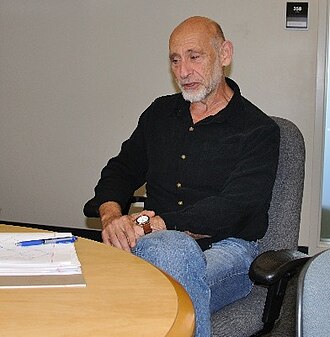
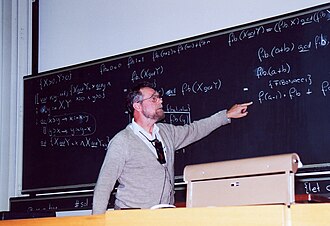
图:Jonathan Maltz · CC BY-SA 4.0 · Wikimedia Commons
伦纳德·萨斯坎德1940—
Leonard Susskind
美国物理学家
伦纳德·萨斯坎德,美国理论物理学家,美国斯坦福大学教授,美国国家科学院院士,美国艺术与科学院院士。
摘自维基百科「李奧納特·蘇士侃」,CC BY-SA 4.0
- 出生
- 1940 年 5 月 20 日,纽约
- 国籍
- 美国
- 学科
- 物理学、博物与综合
- 职业
- 物理学家、非虚构文学作家、大学教师、科学家
- 母语 / 工作语言
- 英语
- 母校
- 纽约市立学院、康奈尔大学(哲学博士,1965 年)
- 工作单位
- 斯坦福大学、莱顿大学、特拉维夫大学、叶史瓦大学、莱顿大学(2004—)
研究领域
主要贡献
代表成就
师承
博士导师1
博士生7
来自 Wikidata 的「博士导师」「师从」「博士生」「学生」记录,可能不全。
所获奖项(5)
- 1998樱井奖
- 2008波梅兰丘克奖
- 2023狄拉克奖章(ICTP)
- —Science Writing Award
- —Messenger Lectures
学会与院士
百科正文
生平
念中学时和父亲一起做水管工人,后来决定改行去纽约市立学院念物理,并在康乃尔大学取得物理博士。弦论的创始人之一,他和其所领导的研究小组并提出宇宙的发展需要一外在的力量(agent)来参与而非自身发展的看法。他也指出黑洞不会消灭信息,霍金后来也同意他的看法。
以上内容摘自维基百科「李奧納特·蘇士侃」,按 CC BY-SA 4.0 使用,去掉了参考文献、外部链接等尾部小节,公式改写成了纯文本。全文、配图和出处见原文。
英文维基百科补充中文条目比较短,下面是英文条目「Leonard Susskind」的原文
Leonard Susskind (; born June 16, 1940) is an American theoretical physicist, professor of theoretical physics at Stanford University and founding director of the Stanford Institute for Theoretical Physics. His research interests are string theory, quantum field theory, quantum statistical mechanics and quantum cosmology. He is a member of the US National Academy of Sciences, and the American Academy of Arts and Sciences, an associate member of the faculty of Canada's Perimeter Institute for Theoretical Physics, and a distinguished professor of the Korea Institute for Advanced Study.
Susskind is widely regarded as one of the fathers of string theory. He was the first to give a precise string-theoretic interpretation of the holographic principle in 1995 and the first to introduce the idea of the string theory landscape in 2003.
Susskind was awarded the 1998 J. J. Sakurai Prize, the 2018 Oskar Klein Medal, and the Dirac Medal of the International Centre for Theoretical Physics in 2023.
Early life and education
Leonard Susskind was born in the South Bronx in New York City to a poor Jewish family whose father was a plumber. He began working as a plumber himself at the age of 16, taking over from his father who had become ill. Later, he enrolled in the City College of New York as an engineering student and had planned to study mechanical engineering but he changed his mind and later graduated with a B.S. in physics in 1962. In an interview in the Los Angeles Times, Susskind recalls a discussion with his father that changed his career path: "When I told my father I wanted to be a physicist, he said, 'Hell no, you ain't going to work in a drug store.' I said, 'No, not a pharmacist.' I said, 'Like Einstein.' He poked me in the chest with a piece of plumbing pipe. 'You ain't going to be no engineer,' he said.
Career
Susskind was an assistant professor of physics, then an associate professor at Yeshiva University (1966–1970), after which he went for a year to the Tel Aviv University (1971–72), returning to Yeshiva to become a professor of physics (1970–1979). Since 1979 he has been professor of physics at Stanford University, and since 2000 has held the Felix Bloch professorship of physics.
Susskind was awarded the 1998 J. J. Sakurai Prize for his "pioneering contributions to hadronic string models, lattice gauge theories, quantum chromodynamics, and dynamical symmetry breaking." Susskind's hallmark, according to colleagues, has been the application of "brilliant imagination and originality to the theoretical study of the nature of the elementary particles and forces that make up the physical world."
The Theoretical Minimum lecture series
Susskind teaches a series of Stanford Continuing Studies courses about modern physics referred to as The Theoretical Minimum. The title of the series is a clear reference to Landau's famous comprehensive exam called the "Theoretical Minimum" which students were expected to pass before admission to his school. The Theoretical Minimum lectures later formed the basis for the books of the same name. The goal of the courses is to teach the basic but rigorous theoretical foundations required to study certain areas of physics. The sequence covers classical mechanics, relativity, quantum mechanics, statistical mechanics, and cosmology, including the physics of black holes.
These courses are available on The Theoretical Minimum website, on iTunes, and on YouTube.
Cornell Messenger Lectures
Susskind gave 3 lectures "The Birth of the Universe and the Origin of Laws of Physics" April 28-May 1, 2014 in the Cornell Messenger Lecture series which are posted on a Cornell website.
Smolin–Susskind debate
The Smolin–Susskind debate refers to the series of intense postings in 2004 between Lee Smolin and Susskind, concerning Smolin's argument that the "anthropic principle cannot yield any falsifiable predictions, and therefore cannot be a part of science". It began on July 26, 2004, with Smolin's publication of "scientific alternatives to the anthropic principle". Smolin e-mailed Susskind asking for a comment. Having not had the chance to read the paper, Susskind requested a summarization of his arguments.
Smolin obliged, and on July 28, 2004, Susskind responded, saying that the logic Smolin followed "can lead to ridiculous conclusions".
Personal life
He has been married twice, first in 1960, and has four children.
以上节选摘自英文维基百科「Leonard Susskind」,按 CC BY-SA 4.0 使用,去掉了参考文献、外部链接等尾部小节,公式改写成了纯文本。篇幅所限,较长的小节只摘了开头一部分,有的小节没有收;全文、配图和出处见原文。
同年获同一奖项
同一学科、同时代的科学家

同一学科的科学家
更多 ›