格物
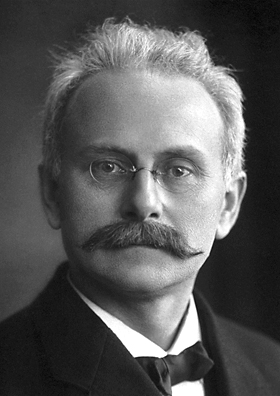
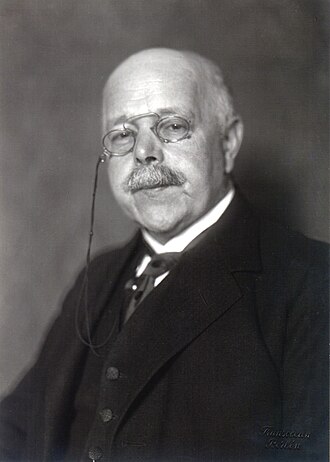
图:A. B. Lagrelius & Westphal, Stockholm · Public domain · Wikimedia Commons
约翰内斯·斯塔克1874—1957
Johannes Stark
物理学家, 巴伐利亚王国
约翰内斯·斯塔克,德国物理学家,1919年诺贝尔物理学奖获得者。
摘自维基百科「约翰内斯·斯塔克」,CC BY-SA 4.0
- 出生
- 1874 年 4 月 15 日,弗赖翁
- 逝世
- 1957 年 6 月 21 日,特劳恩施泰因
- 国籍
- 巴伐利亚王国、德国
- 学科
- 物理学、博物与综合
- 职业
- 物理学家、大学教师
- 母语 / 工作语言
- 德语
- 母校
- 慕尼黑大学
- 工作单位
- 维尔茨堡大学、哥廷根大学、亚琛工业大学、格赖夫斯瓦尔德大学、汉诺威莱布尼兹大学、联邦物理技术研究所
研究领域
主要贡献
代表成就
本站收录的发现与发明
以他 / 她命名
师承
博士导师1
来自 Wikidata 的「博士导师」「师从」「博士生」「学生」记录,可能不全。
所获奖项(3)
- 1915马泰乌奇奖章
- 1919诺贝尔物理学奖
- 1939歌德艺术与科学奖章
学会与院士
百科正文
生平
曾以精湛的研究成果在原子物理学领域里独领风骚数年。在研究阳射线过程中发现一种重要规律,并发现了“斯塔克效应”“斯坦克-爱因斯坦方程”“斯坦克数”等等。希特勒上台后加入纳粹党籍,被希特勒任命为德国物理技术研究所所长,成为莱纳德的同盟者,曾多次在公开场合批判和攻击海森堡。后因屡次干涉纳粹上层官员的事务,被开除纳粹党籍。1947年,继在第二次世界大战中战胜德国,斯塔克被列为"主要罪犯",并被盟国军事法庭法庭判决的四年刑期。服完苦役后于1957年在巴伐利亚老家的庄园里逝世。
斯塔克曾在母校的物理研究所的各个岗位中工作,直到1900年当他成为哥廷根大学的一个不支薪讲师。1906年在汉诺瓦大学当一个很不平凡的教授。1908年他在阿亨工业大学成为教授。他曾在好几所大学中的物理系工作与研究,包括在格赖夫斯瓦尔德大学一直到1922年。
斯塔克发表过300多篇的论文,其中主要是关于电力和其他的主题。
他与Luise Uepler结婚,育有五个孩子。他的嗜好是种植水果和树木。战后,他曾在他位于上巴伐力亚的私人实验室做研究。
在1934年8月21日斯塔克写信给物理学家和诺贝尔奖得奖者同胞马克斯·冯·劳厄。信中签署“希特勒万岁”
斯塔克1934年的书Nationalsozialismus und Wissenschaft中,他认为那些有优先权的科学家是要服务于全国人民的。因此,重要领域的研究是那些能帮助德国的军火生产与工业。
以上内容摘自维基百科「约翰内斯·斯塔克」,按 CC BY-SA 4.0 使用,去掉了参考文献、外部链接等尾部小节,公式改写成了纯文本。全文、配图和出处见原文。
英文维基百科补充中文条目比较短,下面是英文条目「Johannes Stark」的原文
Johannes Stark (German: [joˈhanəs ˈʃtaʁk]; 15 April 1874 – 21 June 1957) was a German physicist who received the Nobel Prize in Physics in 1919 for his discovery of the Stark effect.
A supporter of Adolf Hitler from 1924, Stark was one of the main figures, along with fellow Nobel laureate Philipp Lenard, in the antisemitic Deutsche Physik movement, which sought to remove Jewish physicists from German institutions. In 1947, he was found guilty as a "Major Offender" by a denazification court, but this was reduced to "Lesser Offender" in 1949 after appeal.
Education
Johannes Stark was born on 15 April 1874 in Schickenhof (now part of Freihung), Germany.
Stark was educated at the Gymnasium in Bayreuth, and later in Regensburg. In 1894, he entered the Ludwig-Maximilians-Universität München, where he studied physics, mathematics, chemistry, and crystallography. In 1897, he received his Ph.D. in Physics with a thesis, written under Eugen von Lommel, titled Untersuchungen über einige physikalische, vorzüglich optische Eigenschaften des Russes (Investigations into some physical, especially optical, properties of soot). Stark stayed at the Ludwig-Maximilians-Universität München as an assistant to von Lommel until 1900.
Career and research
In 1900, Stark became a Privatdozent at the University of Göttingen. In 1906, he was appointed Extraordinary Professor at Königliche Technische Hochschule in Hanover, and in 1909 became Professor at RWTH Aachen University. From 1917 to 1922, he worked as a professor at the University of Greifswald and the University of Würzburg.
In 1919, Stark was awarded the Nobel Prize in Physics "for his discovery of the Doppler effect in canal rays and the splitting of spectral lines in electric fields" (the latter is known as the Stark effect).
From 1933 until his retirement in 1939, Stark was President of the Physikalisch-Technische Reichsanstalt, while also President of the Notgemeinschaft der Deutschen Wissenschaft.
It was Stark who, as the editor of the Jahrbuch der Radioaktivität und Elektronik, asked in 1907, then still rather unknown, Albert Einstein to write a review article on the principle of relativity. Stark seemed impressed by relativity and Einstein's earlier work when he quoted "the principle of relativity formulated by H. A. Lorentz and A.
Affiliation with Nazism
From 1924 onwards, Stark supported Hitler. During the Nazi regime, Stark attempted to become the Führer of German physics through the Deutsche Physik (Aryan Physics) movement (along with fellow Nobel laureate Philipp Lenard) against the "Jewish physics" of Albert Einstein and Werner Heisenberg (who was not Jewish). After Werner Heisenberg defended Albert Einstein's theory of relativity, Stark wrote an angry article in the official SS newspaper Das Schwarze Korps, calling Heisenberg a "White Jew".
On August 21, 1934, Stark wrote to physicist and fellow Nobel laureate Max von Laue, telling him to toe the party line or suffer the consequences. The letter was signed off with "Heil Hitler."
In his 1934 book, Nationalsozialismus und Wissenschaft (National Socialism and Science), Stark maintained that the priority of the scientist was to serve the nation—thus, the important fields of research were those that could help German arms production and industry. He attacked theoretical physics as "Jewish" and stressed that scientific positions in Nazi Germany should only be held by pure-blooded Germans.
Personal life and death
Stark married Luise Uepler, with whom he had five children. His hobbies were the cultivation of fruit trees and forestry. He worked in his private laboratory, which he set up using his Nobel Prize money, on his country estate in Upper Bavaria after the Second World War. There, he studied the deflection of light in an electric field.
Stark spent the last years of his life on his estate (called Gut Eppenstatt) near Traunstein in Upper Bavaria, where he died on 21 June 1957 at the age of 83. He is buried at the mountain cemetery in Schönau am Königssee.
Awards and honors
In addition to the Nobel Prize, Stark received various awards, including the Baumgartner Prize of the Vienna Academy of Sciences (1910), the Vahlbruch Prize of the Göttingen Academy of Sciences (1914), and the Matteucci Medal of the Rome Academy. In 1970, the International Astronomical Union honored him with a crater on the far-side of the Moon, without knowing about his Nazi activities. The name was dropped on August 12, 2020.
以上节选摘自英文维基百科「Johannes Stark」,按 CC BY-SA 4.0 使用,去掉了参考文献、外部链接等尾部小节,公式改写成了纯文本。篇幅所限,较长的小节只摘了开头一部分,有的小节没有收;全文、配图和出处见原文。
同一学科、同时代的科学家



同一学科的科学家
更多 ›