格物
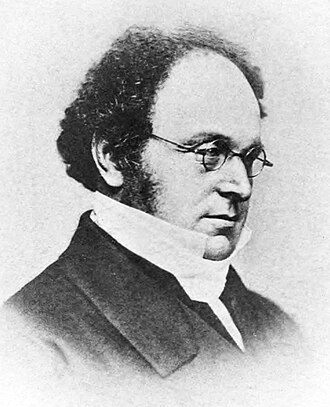
图:Sophia Elizabeth De Morgan · Public domain · Wikimedia Commons
- 出生
- 1806 年 6 月 27 日,马杜赖
- 逝世
- 1871 年 3 月 18 日,伦敦
- 国籍
- 大不列颠及爱尔兰联合王国
- 学科
- 数学、博物与综合
- 职业
- 数学家、哲学家、大学教师、律师
- 母语 / 工作语言
- 英语
- 母校
- 剑桥大学三一学院(1826 年)、林肯思皇家律师所(1827 年)
- 工作单位
- 伦敦大学学院(1828—1831)、伦敦大学学院(1836—1866)
研究领域
主要贡献
代表成就
以他 / 她命名
师承
博士生2
来自 Wikidata 的「博士导师」「师从」「博士生」「学生」记录,可能不全。
百科正文
生平
童年
他生于印度马德拉斯省。其父在东印度公司工作,母亲是詹姆斯·多德森(曾编制反对数表)的后代。
其姓氏中的“de”可作介词用,相当于英文的“of”;而“Morgan”本意为“早晨”。
在他7个月大时,全家迁回英国。10岁时,父亲去世,她母亲带他搬到英国西部。其数学才华一直未被发现,直至十四岁时,一位家庭的朋友意外发现他精心绘制的尺规作图。
他有一目失明。于是他求学时期没有参与任何体育活动,因此被同学取笑。
他的母亲是英国教会的活跃分子,寄望儿子成为牧师。而他的中学老师,毕业于牛津大学奥里尔学院的帕森斯,是个擅长古典文学多于数学的人。可是他都不受这些长辈的影响。
大学教育
1823年,16岁的他进入剑桥大学三一学院,与乔治·皮库克和威廉·修艾尔成为终身的好朋友。他受皮库克影响,引起了对代数和逻辑的兴趣。
他主要的娱乐是笛。
思想
18世纪时仍有数学家怀疑负数的合法性,德摩根是其中的代表。德摩根自己在解代数方程时也会算出负数,但他认为当算出的答案为负数时,必需作特殊的说明,以回避负数本身的数学实在性。德摩根使用负数和虚数,但他仍怀疑它们的数学意义。他认为如果一个问题的最终答案算出来是负数,那说明原问题的提法不对。当算出最终答案为负数后,把原问题反过来提就可以保证答案为正数,困难就解决了。因此,他不认为负数一无是处,计算结果出现负数可以告诉解题者其问题的陈述方式搞反了。
纪念
月球上的德摩根环形山
以上内容摘自维基百科「奧古斯塔斯·德摩根」,按 CC BY-SA 4.0 使用,去掉了参考文献、外部链接等尾部小节,公式改写成了纯文本。全文、配图和出处见原文。
英文维基百科补充中文条目比较短,下面是英文条目「Augustus De Morgan」的原文
Augustus De Morgan (27 June 1806 – 18 March 1871) was a British mathematician and logician. He is best known for De Morgan's laws relating logical conjunction, disjunction, and negation, and for coining the term "mathematical induction", the underlying principles of which he formalized. De Morgan's contributions to logic are heavily used in many branches of mathematics, including set theory and probability theory, as well as other related fields such as computer science.
Biography
Childhood
Augustus De Morgan was born in Madurai, in the Carnatic region of India, in 1806. His father was Lieutenant-Colonel John De Morgan (1772–1816), who held various appointments in the service of the East India Company, and his mother, Elizabeth (née Dodson, 1776–1856), was the granddaughter of James Dodson, who computed a table of anti-logarithms (inverse logarithms). Augustus De Morgan became blind in one eye within a few months of his birth. His family moved to England when Augustus was seven months old. As his father and grandfather had both been born in India, De Morgan used to say that he was neither English nor Scottish nor Irish, but a Briton "unattached," using the technical term applied to an undergraduate of Oxford or Cambridge who was not a member of any one of the colleges.
Mathematics
De Morgan is best known for his pioneering contributions to mathematical logic, specifically algebraic logic, and, to a lesser extent, for his contributions to the beginnings of abstract algebra.
Mathematical logic
De Morgan's contributions to logic are two-fold. Firstly, before De Morgan there was no mathematical logic—logic, including formal logic, was the domain of philosophers; De Morgan was the first to make formal logic a mathematical subject. Secondly, De Morgan would develop the calculus of relations, essentially abstracting logic via the application of algebraic principles.
De Morgan's first original paper on logic, "On the structure of the syllogism", appeared in the Transactions of the Cambridge Philosophical Society in 1846. The paper describes a mathematical system that formalizes Aristotelian logic, specifically the syllogism.
Spiritualism
Later in his life, De Morgan developed an interest in spiritualism. Initially intrigued by clairvoyance, he conducted paranormal investigations with the American medium Maria Hayden. The results of these investigations are documented in the book From Matter to Spirit: The Result of Ten Years Experience in Spirit Manifestations (1863), written by Sophia De Morgan and published anonymously to avoid repercussions.
Sophia was likely a convinced spiritualist, but De Morgan himself was neither a firm believer nor a skeptic. He maintained that the methodology of the physical sciences does not automatically exclude psychic phenomena, suggesting that such phenomena might eventually be explained by natural forces not yet identified by physicists. In the preface to From Matter to Spirit (1863), De Morgan writes:
Legacy
The headquarters of the London Mathematical Society are called De Morgan House, and the top prize awarded by the Society is the De Morgan Medal.
The student society of the Mathematics Department of University College London is called the Augustus De Morgan Society.
The lunar crater De Morgan is named after him.
Collections
De Morgan's extensive library of mathematical and scientific works, many historical, was acquired by Samuel Jones-Loyd for the University of London and is now part of the Senate House Libraries collection. The London Mathematical Society's archive (up until 1994) is held in University College London (UCL) Special Collections. The collection primarily contains letters to Thomas Archer Hirst, but also includes correspondence to other European mathematicians. UCL holds around 150 rare books from the Society which focus on the history of mathematics and were published between 1701 - 1850. UCL holds letters from James Smith to Hepworth Dixon, editor of The Athenaeum, arguing against De Morgan's theory on the quadrature of the circle.
以上节选摘自英文维基百科「Augustus De Morgan」,按 CC BY-SA 4.0 使用,去掉了参考文献、外部链接等尾部小节,公式改写成了纯文本。篇幅所限,较长的小节只摘了开头一部分,有的小节没有收;全文、配图和出处见原文。
同一学科、同时代的科学家




同一学科的科学家
更多 ›