格物
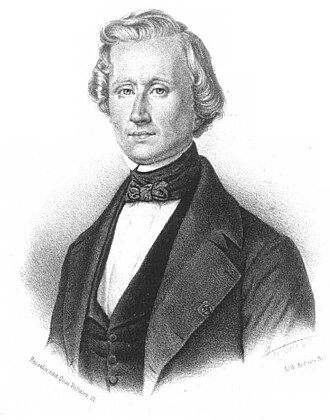
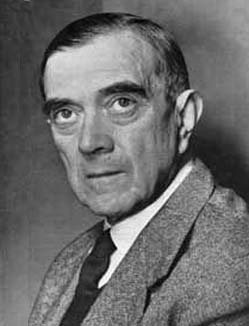
图:User Magnus Manske on en.wikipedia · Public domain · Wikimedia Commons
于尔班·勒维耶1811—1877
Urbain Le Verrier
法国数学家、天文学家
于尔班·让·约瑟夫·勒威耶,法国数学家、天文学家,其主要贡献是计算出了海王星的轨道,根据其计算,德国天文学家约翰·戈特弗里德·伽勒于1846年9月在柏林天文台观测到了海王星。
摘自维基百科「于尔班·勒威耶」,CC BY-SA 4.0
- 出生
- 1811 年 3 月 11 日,圣洛
- 逝世
- 1877 年 9 月 23 日,巴黎
- 国籍
- 法国
- 学科
- 数学、天文学、地球科学、博物与综合
- 职业
- 天文学家、数学家、政治人物、气象学家
- 母语 / 工作语言
- 法语
- 母校
- 巴黎综合理工学院(1833 年)、国家自然历史博物馆(1836 年)、马来尔布高中(1830 年)
- 工作单位
- 巴黎综合理工学院(1836—1854)、巴黎天文台(1854—1877)、巴黎大学(1847—1854)
研究领域
主要贡献
代表成就
本站收录的发现与发明

师承
学生1
来自 Wikidata 的「博士导师」「师从」「博士生」「学生」记录,可能不全。
所获奖项(7)
- 1831综合竞赛
- 1846科普利奖章
- 1846法国荣誉军团军官勋章
- 1847美国文理科学院院士
- 1847英国皇家学会外籍会员
- 1868英国皇家天文学会金质奖章
- —埃菲尔铁塔上所刻的72人列表
学会与院士
百科正文
发现海王星
勒威耶推测是因为存在一颗未知行星的引力作用,使天王星的轨道运动受到干扰,也就是天文学上所谓的“摄动”影响。他计算出这颗行星的轨道、位置、大小,然后请柏林天文台的伽勒寻找这颗未知的行星。1846年9月23日,伽勒根据勒威耶预言,只花了一个小时,就在离勒威耶预言的位置不到1度的地方,发现了一颗新的行星。后来这个新的行星被命名为海王星。
荣誉与纪念
1868和1876年英国皇家天文学会金质奖章。
月球和火星上各有一个撞击坑以他命名。此外海王星的一个环和小行星1997号也是以他的名字命名。
他是名字被刻在埃菲尔铁塔的七十二位法国科学家与工程师其中一位。
以上内容摘自维基百科「于尔班·勒威耶」,按 CC BY-SA 4.0 使用,去掉了参考文献、外部链接等尾部小节,公式改写成了纯文本。全文、配图和出处见原文。
英文维基百科补充中文条目比较短,下面是英文条目「Urbain Le Verrier」的原文
Urbain Jean Joseph Le Verrier (French: [yʁbɛ̃ ʒɑ̃ ʒozɛf lə vɛʁje]; 11 March 1811 – 23 September 1877) was a French astronomer and mathematician who specialized in celestial mechanics and is best known for predicting the existence and position of Neptune using only mathematics.
The calculations were made to explain discrepancies with Uranus's orbit and the laws of Johannes Kepler and Isaac Newton. Le Verrier sent the coordinates to Johann Gottfried Galle in Berlin, asking him to verify. Galle found Neptune the same night he received Le Verrier's letter, within 1° of the predicted position.
The discovery of Neptune is widely regarded as a dramatic validation of celestial mechanics, and is one of the most remarkable moments of 19th-century science.
Life
Early years
Urbain Le Verrier was born at Saint-Lô, Manche, France, to a modest bourgeois family, his parents being Louis-Baptiste Le Verrier and Marie-Jeanne-Josephine-Pauline de Baudre.
He studied at the École Polytechnique – briefly chemistry, under Gay-Lussac, writing papers on the combinations of phosphorus and hydrogen, and of phosphorus and oxygen.
He then switched to astronomy, particularly celestial mechanics, and accepted a job at the Paris Observatory. He spent most of his professional life there, eventually becoming director of the institution, from 1854 to 1870 and again from 1873 to 1877.
In 1846 Le Verrier became a member of the French Academy of Sciences, and in 1855 was elected a foreign member of the Royal Swedish Academy of Sciences. His name is one of the 72 inscribed on the Eiffel Tower.
Career
Early work
Le Verrier's first work in astronomy was presented to the Académie des Sciences in September 1839, entitled Sur les variations séculaires des orbites des planètes (On the Secular Variations of the Orbits of the Planets). This work addressed the then most-important question in astronomy: the stability of the Solar System, first investigated by Laplace. He was able to derive some important limits on the motions of the system, but due to the inaccurately-known masses of the planets, his results were tentative.
From 1844 to 1847, Le Verrier published a series of works on periodic comets, in particular those of Lexell, Faye and DeVico. He was able to show some interesting interactions with the planet Jupiter, proving that certain comets were actually the reappearance of previously-known comets flung into different orbits.
Discovery of Neptune
Le Verrier's most famous achievement is his prediction of the existence of the then unknown planet Neptune, using only mathematics and astronomical observations of the known planet Uranus. Encouraged by physicist Arago, Director of the Paris Observatory, Le Verrier was intensely engaged for months in complex calculations to explain small but systematic discrepancies between Uranus's observed orbit and the one predicted from the laws of gravity of Newton. At the same time, but unknown to Le Verrier, similar calculations were made by John Couch Adams in England. Le Verrier announced his final predicted position for Uranus's unseen perturbing planet publicly to the French Academy on 31 August 1846, two days before Adams's final solution was privately mailed to the Royal Greenwich Observatory. Le Verrier transmitted his own prediction by 18 September in a letter to Johann Galle of the Berlin Observatory. The letter arrived five days later, and the planet was found with the Berlin Fraunhofer refractor that same evening, 23 September 1846, by Galle and Heinrich d'Arrest within 1° of the predicted location near the boundary between Capricorn and Aquarius.
There was, and to an extent still is, controversy over the apportionment of credit for the discovery. There is no ambiguity to the discovery claims of Le Verrier, Galle, and d'Arrest. Adams's work was begun earlier than Le Verrier's but was finished later and was unrelated to the actual discovery. Not even the briefest account of Adams's predicted orbital elements was published until more than a month after Berlin's visual confirmation. Adams made full public acknowledgement of Le Verrier's priority and credit (not forgetting to mention the role of Galle) when he presented his work to the Royal Astronomical Society in November 1846:
Honours
Gold Medal of the Royal Astronomical Society – 1868 and 1876
Namesake of craters on the Moon and Mars, a ring of Neptune, and the asteroid 1997 Leverrier
One of the 72 names engraved on the Eiffel Tower
以上节选摘自英文维基百科「Urbain Le Verrier」,按 CC BY-SA 4.0 使用,去掉了参考文献、外部链接等尾部小节,公式改写成了纯文本。篇幅所限,较长的小节只摘了开头一部分,有的小节没有收;全文、配图和出处见原文。
同一学科、同时代的科学家




同一学科的科学家
更多 ›