格物
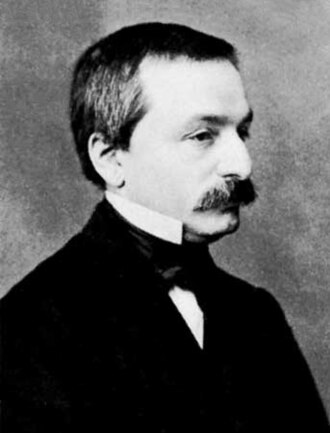
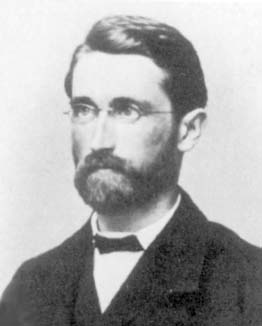
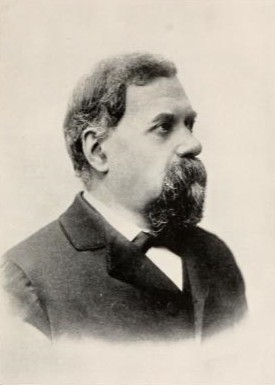
图:作者不详 · Public domain · Wikimedia Commons
- 出生
- 1823 年 12 月 7 日,莱格尼察
- 逝世
- 1891 年 12 月 29 日,柏林
- 国籍
- 普鲁士王国
- 学科
- 数学、博物与综合
- 职业
- 数学家、大学教师、银行家
- 母语 / 工作语言
- 德语
- 母校
- 波恩大学(1843 年)、弗里德里希·威廉大学(1843 年)、弗罗茨瓦夫大学(1844 年)、Liegnitz Ritter-Akademie(1841 年)、弗里德里希·威廉大学(1845 年)
- 工作单位
- 弗里德里希·威廉大学(1862—1891)
研究领域
主要贡献
代表成就
以他 / 她命名
师承
博士生13
学生3
来自 Wikidata 的「博士导师」「师从」「博士生」「学生」记录,可能不全。
所获奖项(1)
- 1884英国皇家学会外籍会员
学会与院士
百科正文
生平
出生于西里西亚利格尼茨(现属波兰的莱格尼察),卒于柏林。他认为算术与数学分析都必须以整数为基础,他曾说:“上帝创造了整数,其余都是人做的工作”(Bell 1986, 477页)。这与数学家格奥尔格·康托尔的观点相互对立。克罗内克是恩斯特·库默尔的学生和终身挚友。
主要研究代数和数论,特别是椭圆函数理论有突出贡献。1823年12月7日生于德国布雷斯劳附近的利格尼茨(现属波兰的莱格尼察),1891年12月29日卒于柏林。他1841年入柏林大学,1845年获博士学位。1861年经EE库默尔推荐,成为柏林科学院正式成员,并以此身份在柏林大学授课。1868年当选为巴黎科学院通讯院士。1880年任著名的“克雷尔杂志”的主编。1883年接替库默尔成为柏林大学教授,时年60岁。1884年成为伦敦皇家学会国外成员。
以克罗内克命名的数学理论包括克罗内克δ、克罗内克积等。
Kronecker–Weber定理说明若 K/Q 是有理数集 Q 的有限阿贝尔扩张,则K是的一个分圆域的子域。
Kronecker引理说明:
若 (xₙ)ₙ₌₁^(∞) 是一个实数数列,使得 ∑ ₙ₌₁^(∞)xₙ=s
存在且有限,则对于 0<b₁≤ b₂≤ b₃≤ … 及 bₙ→ ∞ 则有 (公式略)
以上内容摘自维基百科「利奥波德·克罗内克」,按 CC BY-SA 4.0 使用,去掉了参考文献、外部链接等尾部小节,公式改写成了纯文本。全文、配图和出处见原文。
英文维基百科补充中文条目比较短,下面是英文条目「Leopold Kronecker」的原文
Leopold Kronecker (German: [ˈkʁoːnɛkɐ]; 7 December 1823 – 29 December 1891) was a German mathematician who worked on number theory, abstract algebra and logic, and criticized Georg Cantor's work on set theory. Heinrich Weber quoted Kronecker
as having said, "Die ganzen Zahlen hat der liebe Gott gemacht, alles andere ist Menschenwerk" ("God made the integers, all else is the work of man").
Kronecker was a student and life-long friend of Ernst Kummer.
Biography
Leopold Kronecker was born on 7 December 1823 in Liegnitz, Prussia (now Legnica, Poland) in a wealthy Jewish family. His parents, Isidor and Johanna (née Prausnitzer), took care of their children's education and provided them with private tutoring at home –Leopold's younger brother Hugo Kronecker would also follow a scientific path, later becoming a notable physiologist. Kronecker then went to the Liegnitz Gymnasium where he was interested in a wide range of topics including science, history and philosophy, while also practicing gymnastics and swimming. At the gymnasium he was taught by Ernst Kummer, who noticed and encouraged the boy's interest in mathematics.
In 1841 Kronecker became a student at the University of Berlin where his interest did not immediately focus on mathematics, but rather spread over several subjects including astronomy and philosophy. He spent the summer of 1843 at the University of Bonn studying astronomy and 1843–44 at the University of Breslau following his former teacher Kummer. Back in Berlin, Kronecker studied mathematics with Peter Gustav Lejeune Dirichlet and in 1845 defended his dissertation in algebraic number theory written under Dirichlet's supervision.
After obtaining his degree, Kronecker did not follow his interest in research on an academic career path. He went back to his hometown to manage a large farming estate built up by his mother's uncle, a former banker. In 1848 he married his cousin Fanny Prausnitzer, and the couple had six children. For several years Kronecker focused on business, and although he continued to study mathematics as a hobby and corresponded with Kummer, he published no mathematical results. In 1853 he wrote a memoir on the algebraic solvability of equations extending the work of Évariste Galois on the theory of equations.
Due to his business activity, Kronecker was financially comfortable, and thus he could return to Berlin in 1855 to pursue mathematics as a private scholar.
Scientific activity
Mathematics research
An important part of Kronecker's research focused on number theory and algebra. In an 1853 paper on the theory of equations and Galois theory he formulated the Kronecker–Weber theorem, without however offering a definitive proof (the theorem was proved completely much later by David Hilbert). He also introduced the structure theorem for finitely generated abelian groups. Kronecker studied elliptic functions and conjectured his "liebster Jugendtraum" ("dearest dream of youth"), a generalization that was later put forward by Hilbert in a modified form as his twelfth problem. In an 1850 paper, On the Solution of the General Equation of the Fifth Degree, Kronecker solved the quintic equation by applying group theory (though his solution was not in terms of radicals: that was already proven impossible by the Abel–Ruffini theorem).
In algebraic number theory Kronecker introduced the theory of divisors as an alternative to Dedekind's theory of ideals, which he did not find acceptable for philosophical reasons. Although the general adoption of Dedekind's approach led Kronecker's theory to be ignored for a long time, his divisors were found useful and were revived by several mathematicians in the 20th century.
Kronecker also contributed to the concept of continuity, reconstructing the form of irrational numbers in real numbers. In analysis, Kronecker rejected the formulation of a continuous, nowhere differentiable function by his colleague, Karl Weierstrass.
Also named for Kronecker are the Kronecker limit formula, Kronecker's congruence, Kronecker delta, Kronecker comb, Kronecker symbol, Kronecker product, Kronecker's method for factorizing polynomials, Kronecker substitution, Kronecker's theorem in number theory, Kronecker's lemma, and Eisenstein–Kronecker numbers.
Philosophy of mathematics
Kronecker's finitism made him a forerunner of intuitionism in foundations of mathematics.
Honors
- Kronecker was elected as a member of several academies:
- Prussian Academy of Sciences (1861)
- French Academy of Sciences (1868)
Royal Society (1884).
The 25624 Kronecker asteroid is named after him.
以上节选摘自英文维基百科「Leopold Kronecker」,按 CC BY-SA 4.0 使用,去掉了参考文献、外部链接等尾部小节,公式改写成了纯文本。篇幅所限,较长的小节只摘了开头一部分,有的小节没有收;全文、配图和出处见原文。
同一学科、同时代的科学家